Behrens Yvonne Lisa, Reinkens Thea, Hofmann Winfried, Gumann Amelie, Förster Alisa, Gaschler Laura, Ghete Tabita, Strasser Renate, Espenkötter Jennifer, Haermeyer Bernd, Losch Michaela, Sembill Stephanie, Wotschofsky Zofia, von Hörsten Stephan, Schuh Wolfgang, Di Donato Nataliya, Suttorp Meinolf, Krumbholz Manuela, Ripperger Tim, Schlegelberger Brigitte, Göhring Gudrun, Metzler Markus, Karow Axel
Department of Human Genetics, Hannover Medical School, Hannover, Germany.
Institute of Medical Genetics, Carl von Ossietzky University Oldenburg, Oldenburg, Germany.
Br J Haematol. 2025 Jul;207(1):141-150. doi: 10.1111/bjh.20133. Epub 2025 May 8.
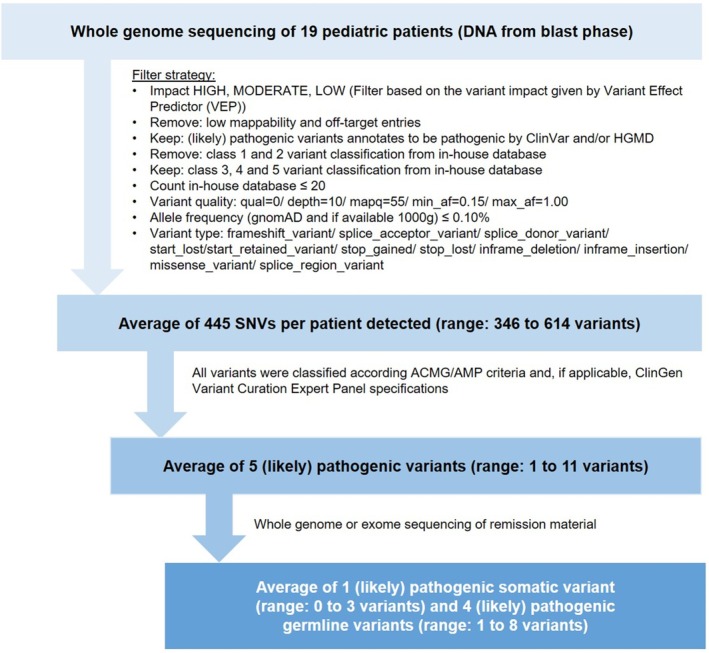
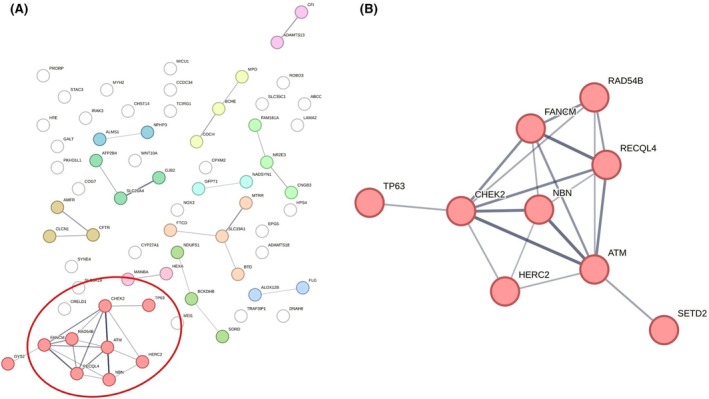
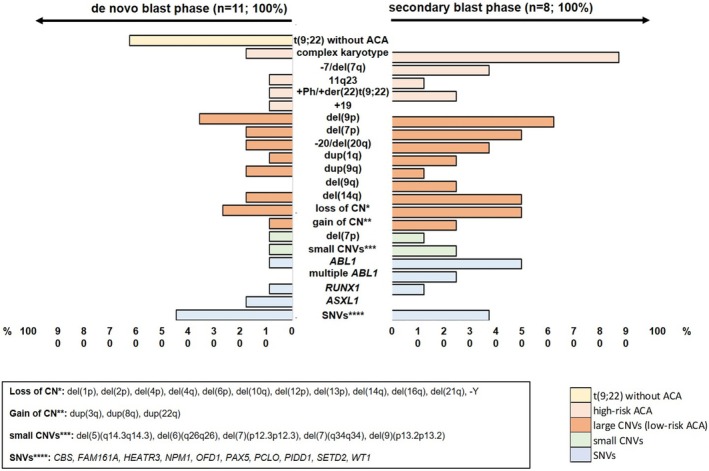
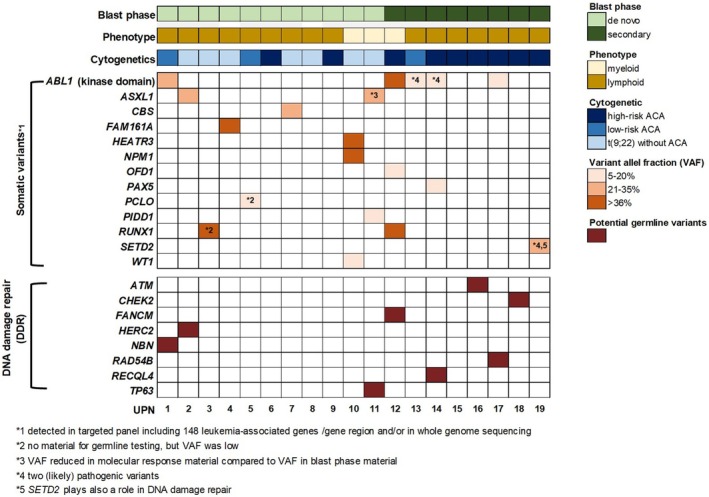
Paediatric blast-phase chronic myeloid leukaemia (CML-BP) is a rare and serious condition. Of 231 paediatric patients enrolled in the German CML-PAED-II registry between January 2007 and September 2023, 25 individuals (11%) were diagnosed with CML-BP. To identify genetic variants associated with early onset and disease transformation, we performed whole genome sequencing (WGS), deep targeted sequencing and cytogenetic analyses in 19 cases with de novo (n = 11) or secondary (n = 8) CML-BP and sufficient available biomaterial. Copy number variants (CNVs) were more frequent than single nucleotide variants (SNVs) and more prevalent in secondary than in de novo CML-BP. Recurrent pathogenic somatic SNVs were observed in ABL1 (n = 5, 24%), RUNX1 (n = 2, 12%) and ASXL1 (n = 2, 12%). Nine patients (47%) carried pathogenic germline (n = 8) or somatic (n = 1) variants in either of the genes ATM, CHEK2, FANCM, HERC2, NBN, RAD54B, RECQL4, SETD2 or TP63 belonging to the DNA damage response (DDR). Within a comparison cohort of 19 patients with chronic phase paediatric CML, only one individual (5%) exhibited a pathogenic DDR germline variant. Our study provides novel pathogenetic insights into paediatric CML-BP. The identification of pathogenic DDR-associated germline variants suggests a genetic predisposition with potential implications for patients and families concerning cancer treatment and surveillance.
儿童急变期慢性髓系白血病(CML-BP)是一种罕见且严重的疾病。在2007年1月至2023年9月期间纳入德国CML-PAED-II登记处的231例儿科患者中,有25例(11%)被诊断为CML-BP。为了识别与疾病早发和转化相关的基因变异,我们对19例初发(n = 11)或继发(n = 8)CML-BP且有足够可用生物材料的病例进行了全基因组测序(WGS)、深度靶向测序和细胞遗传学分析。拷贝数变异(CNV)比单核苷酸变异(SNV)更常见,且在继发CML-BP中比在初发CML-BP中更普遍。在ABL1(n = 5,24%)、RUNX1(n = 2,12%)和ASXL1(n = 2,12%)中观察到复发性致病性体细胞SNV。9例患者(47%)在属于DNA损伤反应(DDR)的ATM、CHEK2、FANCM、HERC2、NBN、RAD54B、RECQL4、SETD2或TP63基因中的任何一个中携带致病性种系(n = 8)或体细胞(n = 1)变异。在19例儿童慢性期CML患者的比较队列中,只有1例个体(5%)表现出致病性DDR种系变异。我们的研究为儿童CML-BP提供了新的发病机制见解。致病性DDR相关种系变异的鉴定表明存在遗传易感性,这对患者及其家庭的癌症治疗和监测可能具有潜在影响。