Georgiou Katerina, Angers Denis, Champiny Ryan E, Cotrufo M Francesca, Craig Matthew E, Doetterl Sebastian, Grandy A Stuart, Lavallee Jocelyn M, Lin Yang, Lugato Emanuele, Poeplau Christopher, Rocci Katherine S, Schweizer Steffen A, Six Johan, Wieder William R
Department of Biological and Ecological Engineering, Oregon State University, Corvallis, Oregon, USA.
Physical and Life Sciences Directorate, Lawrence Livermore National Laboratory, Livermore, California, USA.
Glob Chang Biol. 2025 May;31(5):e70197. doi: 10.1111/gcb.70197.
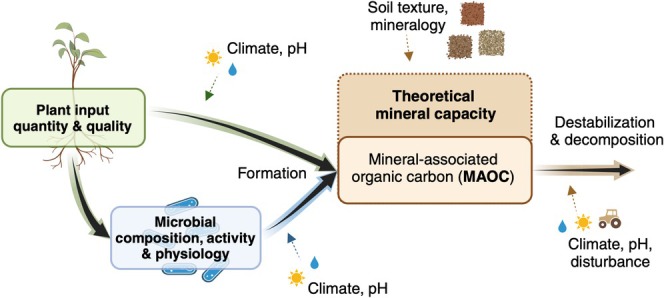
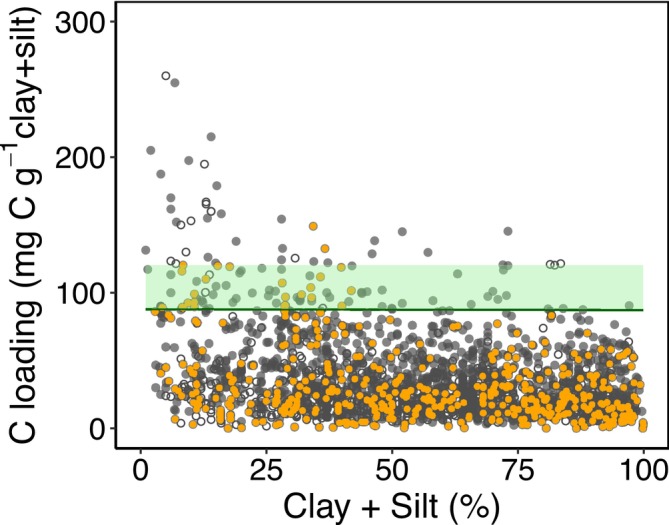
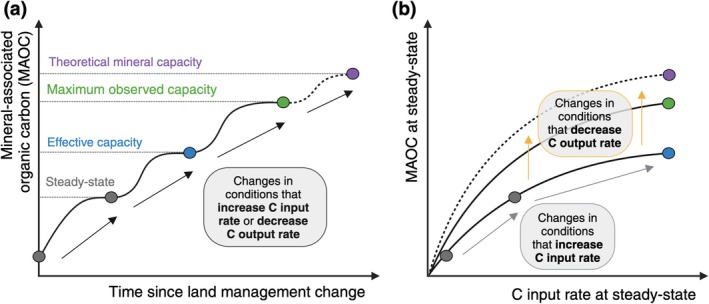
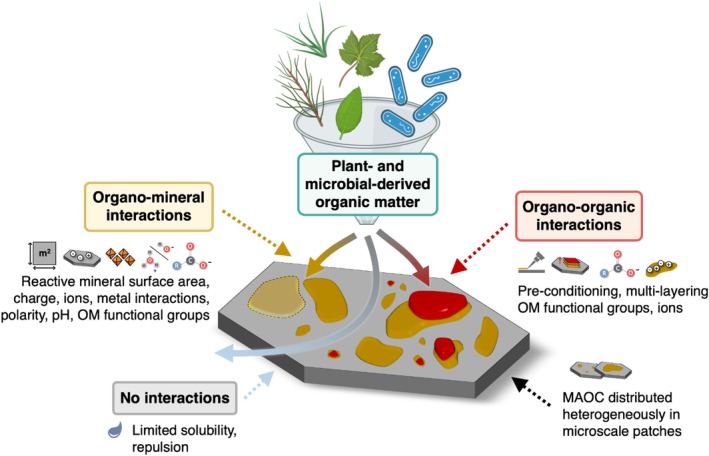
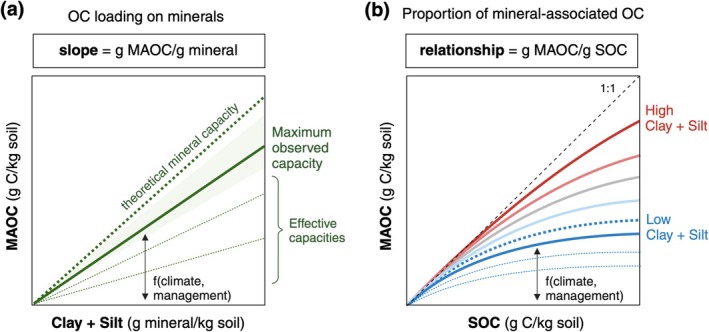
Managing soils to increase organic carbon storage presents a potential opportunity to mitigate and adapt to global change challenges, while providing numerous co-benefits and ecosystem services. However, soils differ widely in their potential for carbon sequestration, and knowledge of biophysical limits to carbon accumulation may aid in informing priority regions. Consequently, there is great interest in assessing whether soils exhibit a maximum capacity for storing organic carbon, particularly within organo-mineral associations given the finite nature of reactive minerals in a soil. While the concept of soil carbon saturation has existed for over 25 years, recent studies have argued for and against its importance. Here, we summarize the conceptual understanding of soil carbon saturation at both micro- and macro-scales, define key terminology, and address common concerns and misconceptions. We review methods used to quantify soil carbon saturation, highlighting the theory and potential caveats of each approach. Critically, we explore the utility of the principles of soil carbon saturation for informing carbon accumulation, vulnerability to loss, and representations in process-based models. We highlight key knowledge gaps and propose next steps for furthering our mechanistic understanding of soil carbon saturation and its implications for soil management.
管理土壤以增加有机碳储存为缓解和适应全球变化挑战提供了一个潜在机会,同时还能带来诸多协同效益和生态系统服务。然而,土壤的碳固存潜力差异很大,了解碳积累的生物物理限制可能有助于确定优先区域。因此,人们非常关注评估土壤是否具有储存有机碳的最大容量,特别是考虑到土壤中活性矿物质的有限性,在有机-矿物结合体中更是如此。虽然土壤碳饱和度的概念已经存在了25年多,但最近的研究对其重要性存在支持和反对的观点。在这里,我们总结了在微观和宏观尺度上对土壤碳饱和度的概念性理解,定义了关键术语,并解决了常见的问题和误解。我们回顾了用于量化土壤碳饱和度的方法,强调了每种方法的理论和潜在注意事项。至关重要的是,我们探讨了土壤碳饱和度原理在指导碳积累、易损性以及基于过程模型中的表示方面的实用性。我们强调了关键的知识空白,并提出了进一步深化我们对土壤碳饱和度及其对土壤管理影响的机理理解的下一步措施。