Alessi Dario, Morgan Luca, Pelorosso Elisa, Graiff Claudia, Pinter Piermaria, Aliprandi Alessandro
Dipartimento di Scienze Chimiche, Università degli Studi di Padova, Via Marzolo 1, 35131, Padova, Italy.
Department of Chemistry, Life Sciences and Environmental Sustainability, Università degli Studi di Parma, Parco Area delle Scienze 17/A, 43124, Parma, Italy.
Nat Commun. 2025 May 9;16(1):4316. doi: 10.1038/s41467-025-58890-4.
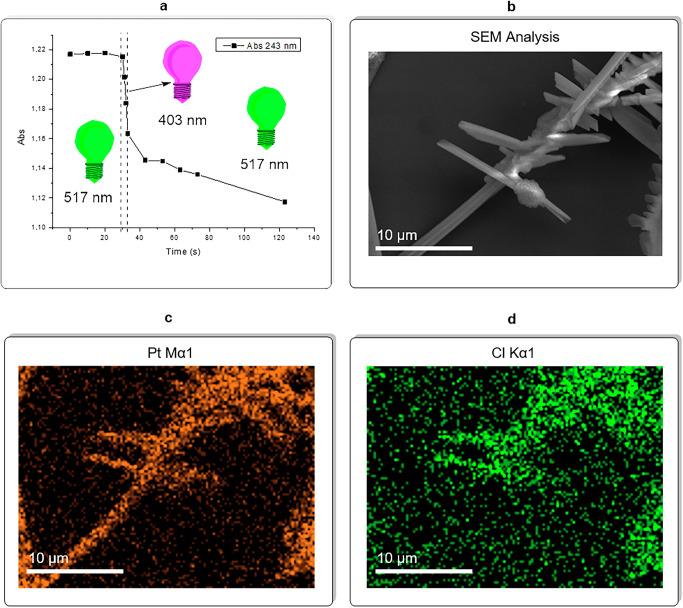
Self-assembly via non-covalent interactions is key to constructing complex architectures with advanced functionalities. A noncovalent synthetic chemistry approach, akin to organic chemistry, allows stepwise construction with enhanced control. Here, we explore this by coupling Pt(II) complex self-assembly with a redox reaction. Oxidation to Pt(IV) creates a non-emissive monomer that, upon reduction to Pt(II), forms luminescent gels with unique kinetic and thermodynamic pathways. UV irradiation induces Pt(IV) reduction, generating supramolecular fibers with Pt∙∙∙Pt interactions, enhancing photophysical properties and enabling visible light absorption up to 550 nm. This allows photoselective growth, where fibers convert surrounding Pt(IV) to Pt(II), promoting growth over nucleation, as observed via real-time fluorescence microscopy.
通过非共价相互作用进行自组装是构建具有先进功能的复杂结构的关键。一种类似于有机化学的非共价合成化学方法能够实现具有更强控制能力的逐步构建。在此,我们通过将Pt(II)配合物自组装与氧化还原反应相结合来探索这一方法。氧化为Pt(IV)会产生一种不发光的单体,该单体在还原为Pt(II)时,会通过独特的动力学和热力学途径形成发光凝胶。紫外线照射会诱导Pt(IV)还原,生成具有Pt∙∙∙Pt相互作用的超分子纤维,增强光物理性质并实现高达550 nm的可见光吸收。这使得光选择性生长成为可能,即纤维将周围的Pt(IV)转化为Pt(II),促进生长而非成核,这一过程通过实时荧光显微镜观察到。