Abdel-Motleb Asmaa, Abd El-Hamid Rania M, Sayed Sara S M
Environmental Research Department, Theodor Bilharz Research Institute, Giza, Egypt.
Central Agricultural Pesticides Labratory, Agricultural Research Centre, Giza, Egypt.
Arch Environ Contam Toxicol. 2025 May;88(4):419-436. doi: 10.1007/s00244-025-01129-6. Epub 2025 May 9.
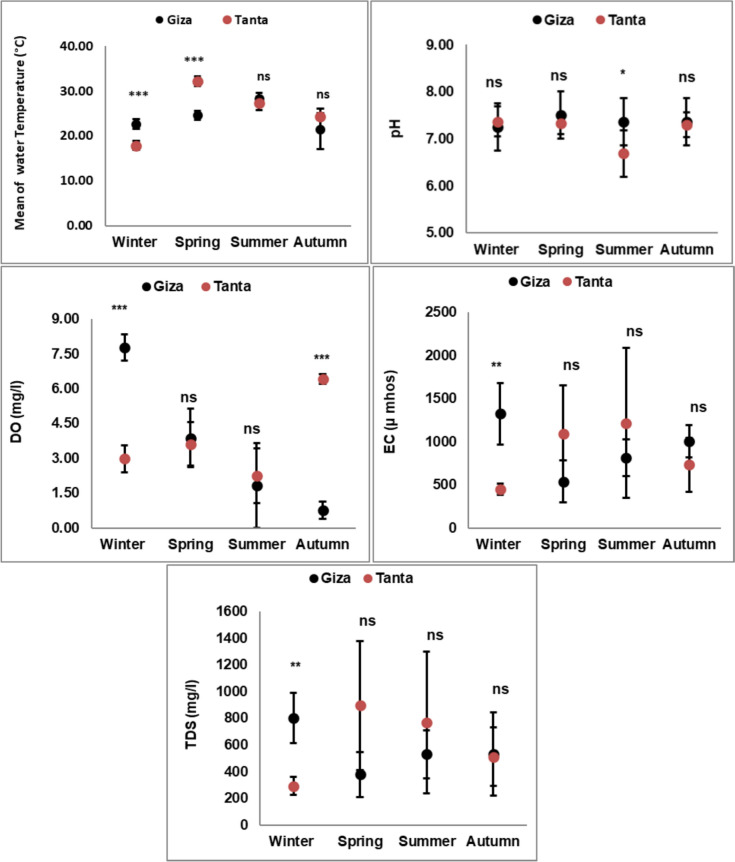
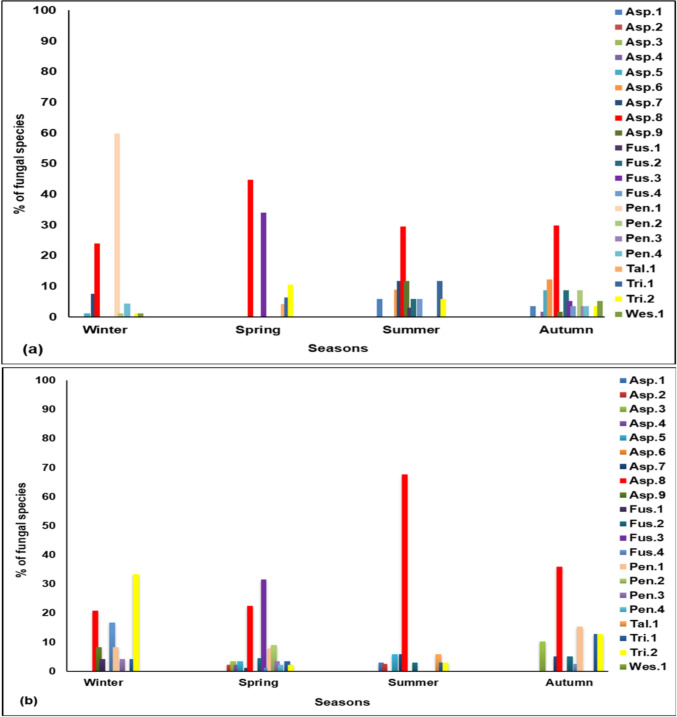
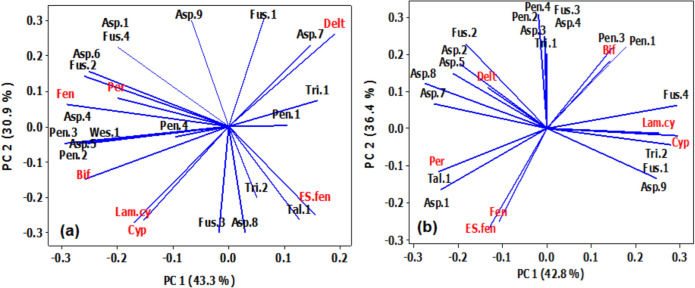
The aquatic environment has been contaminated by pyrethroids and triazole pesticide applications, which pose serious health risks to the aquatic ecosystem and human beings. Therefore, the current study aims to evaluate water quality parameters, fungal diversity, and distribution of snails and aquatic plants of certain Egyptian water courses contaminated with pyrethroids and triazole pesticides. Seasonal samples were taken throughout 2021 from different water courses at Giza Governorate and Tanta (Gharbeya Governorate). Qualitative and quantitative surveys showed significant differences in water physical parameters between the two investigated governorates. Deltamethrin, permethrin, Es-fenvalerate, and lambada-cyhalothrin showed the highest pyrethroids concentrations, while tebuconazole, tetraconazole, and difenoconazole were the highest triazole concentrations. Fungal diversity displayed 21 molecularly identified fungal species related to four fungal genera: Aspergillus, Fusarium, Penicillium, and Trichoderma. Penicillium sp. and Aspergillus niger were the most frequent species. Snail diversity recorded 10 and 9 species in Giza and Tanta, respectively. Physa acuta was the most abundant snail. Ten species of aquatic plants were observed in Giza, while six species were observed in Tanta. Specifically, Eichhornia crassipes and Lemna gibba were the dominant species in the two governorates, with the relative abundance (39 and 22%) in Giza and (27 and 23%) in Tanta, respectively. Water quality parameters and seasonal variations could control fungal diversity, snails, and aquatic plant distribution. Different relations between pesticides and biological communities may reflect the ability/inability of certain snails and fungi species to commensalism with pesticide concentrations. Continuous pesticide monitoring is essential for life below water and aligns with SDG14.
拟除虫菊酯和三唑类农药的使用污染了水生环境,这对水生生态系统和人类构成了严重的健康风险。因此,本研究旨在评估受拟除虫菊酯和三唑类农药污染的埃及某些水道的水质参数、真菌多样性以及蜗牛和水生植物的分布情况。2021年全年从吉萨省和坦塔(加贝亚省)的不同水道采集了季节性样本。定性和定量调查显示,两个被调查省份的水体物理参数存在显著差异。溴氰菊酯、氯菊酯、乙氰菊酯和高效氯氟氰菊酯的拟除虫菊酯浓度最高,而戊唑醇、四氟醚唑和苯醚甲环唑的三唑浓度最高。真菌多样性显示有21种经分子鉴定的真菌物种,分属于四个真菌属:曲霉属、镰刀菌属、青霉属和木霉属。青霉属和黑曲霉是最常见的物种。蜗牛多样性在吉萨记录到10种,在坦塔记录到9种。尖膀胱螺是数量最多的蜗牛。在吉萨观察到10种水生植物,在坦塔观察到6种。具体而言,凤眼莲和浮萍是两个省份的优势物种,在吉萨的相对丰度分别为39%和22%,在坦塔的相对丰度分别为27%和23%。水质参数和季节变化可以控制真菌多样性、蜗牛和水生植物的分布。农药与生物群落之间的不同关系可能反映了某些蜗牛和真菌物种与农药浓度共生的能力/无能力。持续的农药监测对于水下生物至关重要,并且符合可持续发展目标14。