Visier-Alfonso María Eugenia, Sánchez-López Mairena, Bizzozero-Peroni Bruno, Díaz-Goñi Valentina, Cekrezi Shkelzen, Suazo Iván, Martínez-Vizcaíno Vicente
Health and Social Research Center, Universidad de Castilla-La Mancha, Cuenca, Spain.
Facultad de Enfermería de Cuenca, Universidad de Castilla-La Mancha, Cuenca, Spain.
BMC Public Health. 2025 May 9;25(1):1726. doi: 10.1186/s12889-025-22912-z.
The use of standing desks may reduce sedentary behavior and, in turn, improve other health and academic outcomes. However, the evidence is sparse among university settings. The aim of this scoping review was to identify and map evidence for the effects of standing desk interventions on sedentary behavior and physical, mental, and academic outcomes in university students, as well as instructors and students' perceptions of this type of equipment in the classroom.
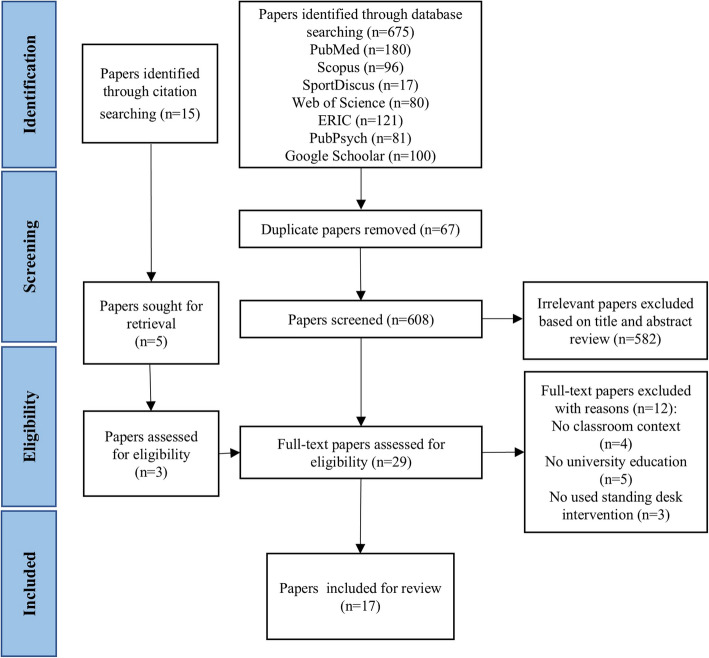
A scoping review was conducted in accordance with the Joanna Briggs Institute and the Preferred Reporting Items for Systematic Reviews and Meta-Analyses extension for Scoping Review guidelines. PubMed, Web of Science, Scopus, PsycINFO, PubPsych and ERIC databases were searched for qualitative and quantitative studies from their inception to 2024. Narrative synthesis and network plots were used to summarize the available evidence.
Seventeen studies involving 2886 university students and 163 instructors were included. Fourteen studies were experimental and three were cross-sectional. In seven studies standing desks improved movement patterns (sitting and standing time in the classroom) and in four studies improved mental health outcomes (anxiety, mood, stress, and positive or negative feelings). Four studies analyzed pain and discomfort, one found significant improvements and three found mixed results. Eleven studies analyzed academic and classroom outcomes and seven found significant improvements in the standing desks group and five did not. Additionally, the use of standing desks was accepted and positively perceived by students in ten studies and by instructors in two.
The implementation of standing desks at university settings could be a behavioral intervention for improving movement patterns and mental health. However, the extant evidence is sparse; further long-term, high-quality trials are needed to draw robust conclusions.
使用站立式办公桌可能会减少久坐行为,进而改善其他健康和学业成果。然而,在大学环境中的相关证据并不充分。本综述的目的是识别和梳理关于站立式办公桌干预对大学生久坐行为、身体、心理和学业成果影响的证据,以及教师和学生对课堂上这类设备的看法。
根据乔安娜·布里格斯研究所和系统评价与Meta分析扩展版的范围综述指南进行范围综述。检索了PubMed、科学网、Scopus、PsycINFO、PubPsych和ERIC数据库,查找从建库至2024年的定性和定量研究。采用叙述性综合分析和网络图来总结现有证据。
纳入了17项涉及2886名大学生和163名教师的研究。14项为实验性研究,3项为横断面研究。7项研究表明站立式办公桌改善了运动模式(课堂上的坐姿和站姿时间),4项研究表明改善了心理健康结果(焦虑、情绪、压力以及积极或消极情绪)。4项研究分析了疼痛和不适情况,1项发现有显著改善,3项结果不一。11项研究分析了学业和课堂成果,7项发现站立式办公桌组有显著改善,5项未发现。此外,在10项研究中,学生接受并积极看待站立式办公桌的使用,在2项研究中教师也持同样态度。
在大学环境中设置站立式办公桌可能是一种改善运动模式和心理健康的行为干预措施。然而,现有证据不足;需要进一步开展长期、高质量的试验才能得出有力结论。