Wei Hang, Hou Jialu, Liu Yumeng, Shaytan Alexey K, Liu Bin, Wu Hao
School of Computer Science and Technology, Xidian University, Xi'an, Shaanxi, 710126, China.
School of Computer Science and Technology, Beijing Institute of Technology, Beijing, 100081, China.
BMC Biol. 2025 May 9;23(1):119. doi: 10.1186/s12915-025-02221-y.
Exploring piRNA-disease associations can help discover candidate diagnostic or prognostic biomarkers and therapeutic targets. Several computational methods have been presented for identifying associations between piRNAs and diseases. However, the existing methods encounter challenges such as over-smoothing in feature learning and overlooking specific local proximity relationships, resulting in limited representation of piRNA-disease pairs and insufficient detection of association patterns.
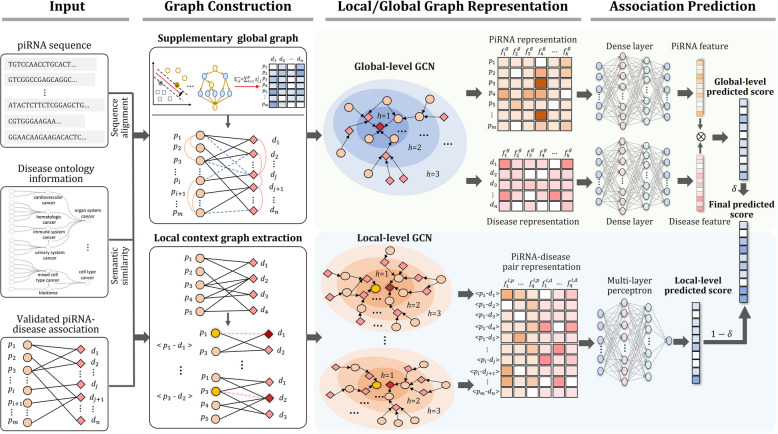
In this study, we propose a novel computational method called iPiDA-LGE for piRNA-disease association identification. iPiDA-LGE comprises two graph convolutional neural network modules based on local and global piRNA-disease graphs, aimed at capturing specific and general features of piRNA-disease pairs. Additionally, it integrates their refined and macroscopic inferences to derive the final prediction result.
The experimental results show that iPiDA-LGE effectively leverages the advantages of both local and global graph learning, thereby achieving more discriminative pair representation and superior predictive performance.
探索piRNA与疾病的关联有助于发现候选诊断或预后生物标志物以及治疗靶点。已经提出了几种计算方法来识别piRNA与疾病之间的关联。然而,现有方法面临诸如特征学习中的过度平滑以及忽略特定局部邻近关系等挑战,导致piRNA-疾病对的表示有限,且关联模式的检测不足。
在本研究中,我们提出了一种名为iPiDA-LGE的用于piRNA-疾病关联识别的新型计算方法。iPiDA-LGE由基于局部和全局piRNA-疾病图的两个图卷积神经网络模块组成,旨在捕获piRNA-疾病对的特定和一般特征。此外,它整合了它们的精细和宏观推断以得出最终预测结果。
实验结果表明,iPiDA-LGE有效地利用了局部和全局图学习的优势,从而实现了更具判别力的配对表示和卓越的预测性能。