Belachew Tegegne Wale, Mekuriaw Begizew Yimenu, Ferede Wassie Yazie, Tegegne Dagnaw Mersha, Mengistu Temesgen Dessie, Tadesse Selamawit Girma, Tariku Yaregal Dessalew, Sisay Fillorenes Ayalew, Mitiku Assefa Kebie
Department of Midwifery, College of Medicine and Health Sciences, Debre Tabor University, Debre Tabor, Amhara 272, Ethiopia.
Department of Midwifery, College of Medicine and Health Sciences, Debre Tabor University, Debre Tabor, Ethiopia.
Ther Adv Vaccines Immunother. 2025 May 8;13:25151355251337622. doi: 10.1177/25151355251337622. eCollection 2025.
Human papillomaviruses are the most common sexually transmitted infections, and persistent infection can lead to cervical cancer. In line with WHO recommendations to prevent cervical cancer, human papillomavirus vaccination is considered mandatory. Despite various challenges influencing decision-making for HPV vaccination, including HPV vaccine hesitancy, efforts are made to promote its uptake.
A community-based cross-sectional study was conducted from March 1 to April 30 among 400 parents of adolescents. A simple random sampling technique was used to select study participants. A structured questionnaire was employed for data collection, and the data were gathered through interviews. Subsequently, the data were entered into EPI data 3.1 statistical software and analyzed using SPSS version 25. The association between variables was analyzed using bivariate and multivariable logistic regression models, and a -value <0.05 at 95% confidence interval was considered statistically significant.
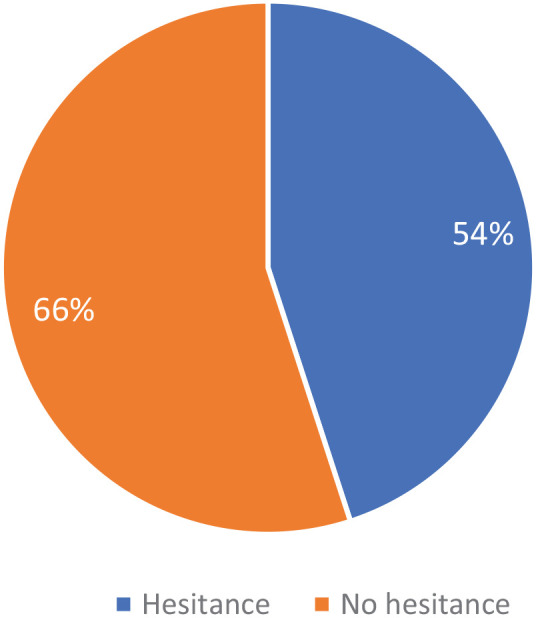
A total of 400 participants were included with a response rate of 99.3%. The prevalence of HPV vaccine hesitancy among parents of daughters was 54%. Multivariable logistic regression showed that educational status (Adjusted Odds Ratio (AOR) = 0.8, 95% CI: (0.69-0.93)), effectiveness of HPV vaccine (AOR = 1.9, 95% CI: (1.14-3.17)), knowledge (AOR = 0.5, 95% CI: (0.13-0.75)), and obtained information (AOR = 3.1, 95% CI: (2.24-4.29)) were significantly associated with human papillomavirus vaccine hesitancy.
This study demonstrates that parents' hesitance to vaccinate their daughters with the human papillomavirus vaccine was high. Parents' hesitance to vaccinate their daughters with the human papillomavirus vaccine was strongly associated with the effectiveness of the HPV vaccine, obtained information about the HPV vaccine, knowledge, and educational status.
人乳头瘤病毒是最常见的性传播感染,持续感染可导致宫颈癌。根据世界卫生组织预防宫颈癌的建议,人乳头瘤病毒疫苗接种被视为强制性的。尽管有各种因素影响人乳头瘤病毒疫苗接种的决策,包括对人乳头瘤病毒疫苗的犹豫态度,但仍在努力推广其接种率。
3月1日至4月30日,对400名青少年的父母进行了一项基于社区的横断面研究。采用简单随机抽样技术选择研究参与者。使用结构化问卷收集数据,并通过访谈收集数据。随后,将数据录入EPI数据3.1统计软件,并使用SPSS 25版进行分析。使用双变量和多变量逻辑回归模型分析变量之间的关联,95%置信区间的P值<0.05被认为具有统计学意义。
共纳入400名参与者,回复率为99.3%。女儿的父母中对人乳头瘤病毒疫苗犹豫的患病率为54%。多变量逻辑回归显示,教育程度(调整优势比(AOR)=0.8,95%置信区间:(0.69-0.93))、人乳头瘤病毒疫苗的有效性(AOR=1.9,95%置信区间:(1.14-3.17))、知识(AOR=0.5,95%置信区间:(0.13-0.75))和获得的信息(AOR=3.1,95%置信区间:(2.24-4.29))与人乳头瘤病毒疫苗犹豫显著相关。
本研究表明,父母对女儿接种人乳头瘤病毒疫苗的犹豫程度较高。父母对女儿接种人乳头瘤病毒疫苗的犹豫与该疫苗的有效性、获得的关于人乳头瘤病毒疫苗的信息、知识和教育程度密切相关。