
肠道微生物群变化导致性早熟的研究总结、可能机制及展望
Research summary, possible mechanisms and perspectives of gut microbiota changes causing precocious puberty.
作者信息
Bao Maorong, Wu Rui, Li Jingwei, Tang Runan, Song Cui
机构信息
Chongqing Key Laboratory of Pediatrics, Ministry of Education Key Laboratory of Child Development and Disorders, National Clinical Research Center for Child Health and Disorders, Children's Hospital of Chongqing Medical University, Chongqing, China.
Ba'nan Hospital Affiliated to Chongqing Medical University, Chongqing, China.
出版信息
Front Nutr. 2025 Apr 25;12:1596654. doi: 10.3389/fnut.2025.1596654. eCollection 2025.
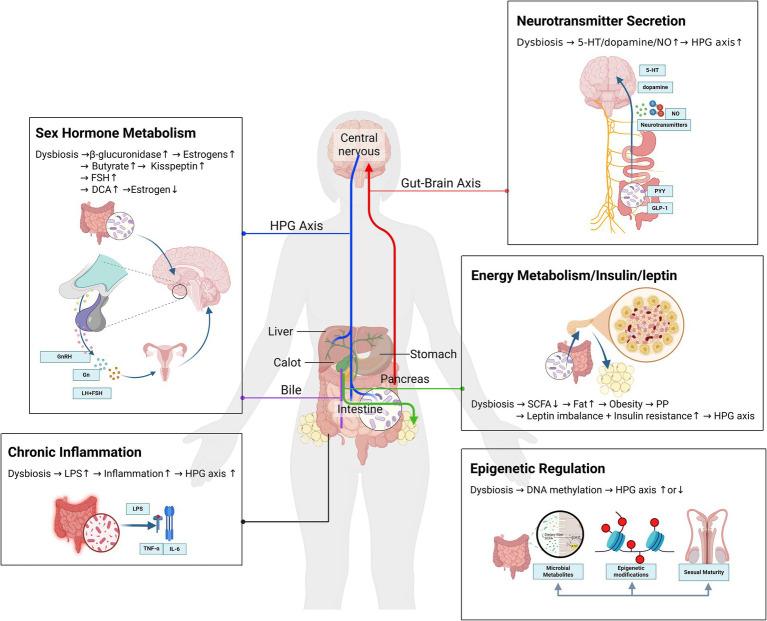
The increasing global incidence of precocious puberty, linked to environmental, metabolic, and genetic factors, necessitates innovative therapies beyond gonadotropin-releasing hormone (GnRH) analogs. Accumulating evidence implicates gut microbiota dysbiosis as a pivotal regulator of pubertal timing via interactions with hormone metabolism (e.g., estrogen reactivation via -glucuronidase), neuroendocrine pathways (nitric oxide signaling), and immune-inflammatory responses. This review delineates taxonomic alterations in central precocious puberty (CPP) and obesity-related subtypes, including enrichment and depletion, alongside functional shifts in microbial metabolite production. Mechanistic insights highlight microbiota-driven modulation of the hypothalamic-pituitary-gonadal (HPG) axis, leptin/insulin dynamics, and epigenetic regulation. Emerging interventions-probiotics, fecal microbiota transplantation (FMT), and dietary modifications-demonstrate efficacy in preclinical models and early clinical studies for delaying puberty onset and restoring hormonal balance. Translational efforts to validate these strategies are critical for addressing the clinical and psychosocial challenges posed by precocious puberty, positioning gut microbiota modulation as a novel therapeutic frontier in pediatric endocrinology.
性早熟在全球的发病率不断上升,这与环境、代谢和遗传因素有关,因此除了促性腺激素释放激素(GnRH)类似物之外,还需要创新疗法。越来越多的证据表明,肠道微生物群失调通过与激素代谢(例如,通过β-葡萄糖醛酸酶重新激活雌激素)、神经内分泌途径(一氧化氮信号传导)和免疫炎症反应相互作用,成为青春期时间的关键调节因子。这篇综述阐述了中枢性性早熟(CPP)和肥胖相关亚型中的分类学改变,包括某些菌的富集和另一些菌的减少,以及微生物代谢产物产生的功能变化。机制方面的见解突出了微生物群对下丘脑-垂体-性腺(HPG)轴、瘦素/胰岛素动态变化和表观遗传调控的驱动作用。新兴的干预措施——益生菌、粪便微生物群移植(FMT)和饮食调整——在临床前模型和早期临床研究中显示出对延迟青春期开始和恢复激素平衡的疗效。验证这些策略的转化研究工作对于应对性早熟带来的临床和心理社会挑战至关重要,将肠道微生物群调节定位为儿科内分泌学的一个新的治疗前沿领域。
 Zotero 插件