Kwak Jae Hyeok, Park Do Young, Han Jong Chul
Sungkyunkwan University School of Medicine, Seoul, Korea.
Department of Ophthalmology, Samsung Medical Center, Sungkyunkwan University School of Medicine, Seoul, Korea.
Eye Vis (Lond). 2025 May 13;12(1):19. doi: 10.1186/s40662-025-00436-2.
This study aimed to investigate the combined effects of obstructive sleep apnea (OSA) risk and short sleep duration on glaucoma prevalence and intraocular pressure (IOP) using data from the 2019 to 2021 Korea National Health and Nutrition Examination Survey (KNHANES).
This cross-sectional study analyzed data from 7,732 KNHANES participants aged ≥ 40 years. OSA risk was assessed using the STOP-BANG questionnaire, with a high risk defined as a score ≥ 3. The diagnosis of glaucoma was based on the criteria of the International Society of Geographical and Epidemiological Ophthalmology. Multivariate logistic regression models were used to evaluate the associations among glaucoma prevalence, OSA risk, and sleep duration, adjusting for demographic and health-related variables. The interaction effects of OSA risk and sleep duration on glaucoma and IOP were also assessed.
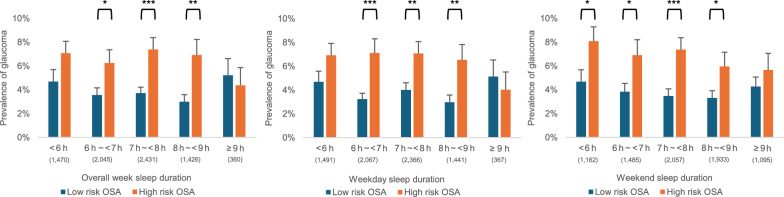
Among the 7,732 participants, 5.28% (n = 408) were diagnosed with glaucoma. Individuals with a high risk of OSA had significantly higher odds of glaucoma compared to those with a low risk (odds ratio: 1.34, 95% confidence interval: 1.02-1.77; P < 0.05), with the STOP-BANG components "snoring", "pressure", and "age" being most associated with increased glaucoma risk. No significant association was observed between abnormal sleep duration (< 7 h or ≥ 9 h) alone and glaucoma prevalence (P > 0.05). Individuals with a high risk of OSA with a sleep duration < 9 h showed a significantly higher glaucoma prevalence than those with ≥ 9 h of sleep (P < 0.05), suggesting that sleep duration modifies the association between OSA risk and glaucoma. Similar trends were observed for IOP, with significant interaction effects between OSA risk and sleep duration.
Our findings suggest that sleep duration modulates the association between OSA risk and both glaucoma prevalence and higher IOP, highlighting the importance of including sleep duration in glaucoma risk assessments for patients with OSA. Further research is required to clarify the mechanisms underlying the association between OSA, sleep duration, and glaucoma.
本研究旨在利用2019年至2021年韩国国家健康与营养检查调查(KNHANES)的数据,调查阻塞性睡眠呼吸暂停(OSA)风险和短睡眠时间对青光眼患病率和眼压(IOP)的综合影响。
这项横断面研究分析了7732名年龄≥40岁的KNHANES参与者的数据。使用STOP-BANG问卷评估OSA风险,高风险定义为得分≥3分。青光眼的诊断基于国际地理和流行病学眼科学会的标准。采用多变量逻辑回归模型评估青光眼患病率、OSA风险和睡眠时间之间的关联,并对人口统计学和健康相关变量进行调整。还评估了OSA风险和睡眠时间对青光眼和眼压的交互作用。
在7732名参与者中,5.28%(n = 408)被诊断为青光眼。与低风险者相比,高OSA风险个体患青光眼的几率显著更高(优势比:1.34,95%置信区间:1.02 - 1.77;P < 0.05),STOP-BANG问卷中的“打鼾”“压力”和“年龄”与青光眼风险增加最为相关。单独的异常睡眠时间(<7小时或≥9小时)与青光眼患病率之间未观察到显著关联(P > 0.05)。睡眠时间<9小时的高OSA风险个体的青光眼患病率显著高于睡眠时间≥9小时的个体(P < 0.05),这表明睡眠时间改变了OSA风险与青光眼之间的关联。眼压也观察到类似趋势,OSA风险和睡眠时间之间存在显著的交互作用。
我们的研究结果表明,睡眠时间调节了OSA风险与青光眼患病率及更高眼压之间的关联,突出了在OSA患者的青光眼风险评估中纳入睡眠时间的重要性。需要进一步研究以阐明OSA、睡眠时间和青光眼之间关联的潜在机制。