Zhang Xiangjun, Liu Lu, Niu Pilian, Ye Tong, Ding Wei, Wei Xiaobo, Xu Junnan, Fang Haitian, Liu Huiyan
School of Life Science, Ningxia University, Yinchuan, 750021, Ningxia, China.
School of Food Science and Engineering, Ningxia Key Laboratory for Food Microbial- Applications Technology and Safety Control, Ningxia University, Yinchuan, 750021, Ningxia, China.
Microb Cell Fact. 2025 May 13;24(1):103. doi: 10.1186/s12934-025-02731-y.
The modification of single or multiple genes via metabolic engineering can lead to the dysregulation of central metabolism and affect bacterial growth and metabolite accumulation. Meanwhile, transcription factor engineering can trigger metabolic network reprogramming at the global or systemic level, redirecting metabolic flux toward the synthetic pathways of target metabolites. In this study, we modulated pyrimidine and carbon-nitrogen metabolism in Bacillus subtilis through transcription factor engineering to promote the synthesis of cytidine, a drug intermediate.
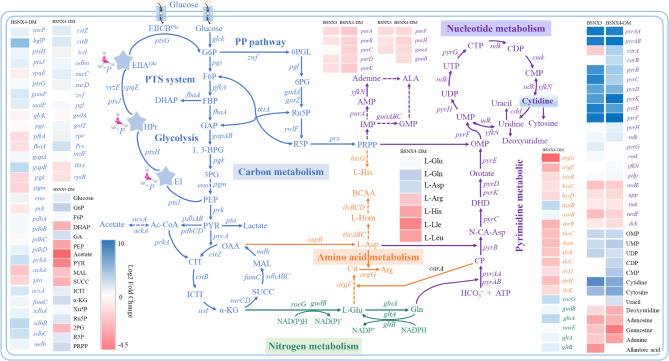
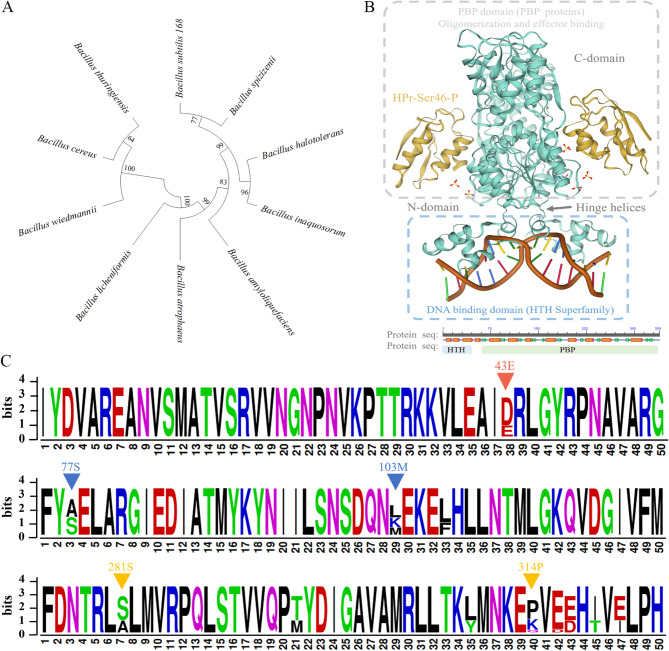
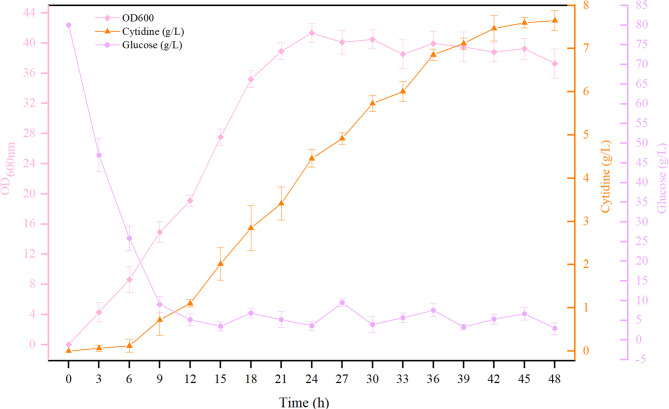
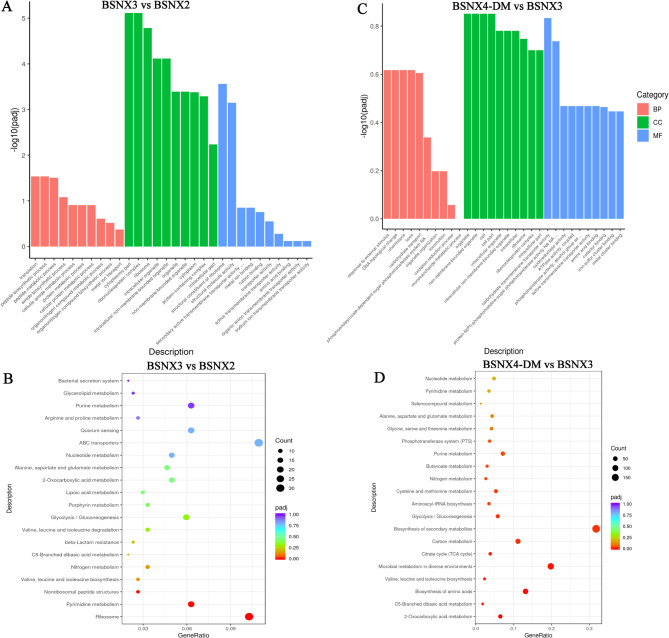
First, cytidine synthesis was enhanced by knocking out the transcriptional regulator PyrR, which increased the cytidine titer during shake flask fermentation to 0.67 g/L. Second, mutations in the transcriptional regulator catabolite control protein A (CcpA) significantly promoted cytidine synthesis, increasing the shake flask titer to 2.03 g/L. Finally, after culture in a 5 L fermenter, the cytidine titer reached 7.65 g/L, which was 3.77-fold that of shake flask fermentation. Moreover, a cytidine yield and productivity of 0.06 g/g glucose and 0.16 g/L/h, respectively, were achieved. Subsequently, the regulatory mechanisms through which PyrR and CcpA modification affect cytidine biosynthesis were explored through multi-omics analysis. Transcriptome and metabolome analysis revealed that coordinated alterations in carbon, nitrogen, nucleotide, and amino acid metabolism were essential to promote cytidine synthesis. However, the increased cytidine production in recombinant strains was attributed to the enhancement of pyrimidine metabolism, the Phosphotransferase (PTS) system, the tricarboxylic acid (TCA) cycle, the pentose phosphate (PP) pathway, and nitrogen metabolism.
These results indicate that PyrR knockdown can enhance pyrimidine metabolic pathway and promote cytidine synthesis. CcpA mutation can reprogram the central carbon-nitrogen metabolic network, change the metabolic flow to de novo synthesis pathway of pyrimidine nucleoside, increase the supply of cytidine synthesis precursors and promote the accumulation of cytidine. Overall, regulation of engineered carbon and nitrogen metabolic networks is essential for improving the efficiency of microbial cell factories.
通过代谢工程对单个或多个基因进行修饰可能导致中心代谢失调,影响细菌生长和代谢产物积累。同时,转录因子工程可以在全局或系统水平触发代谢网络重编程,将代谢流导向目标代谢产物的合成途径。在本研究中,我们通过转录因子工程调节枯草芽孢杆菌中的嘧啶和碳氮代谢,以促进药物中间体胞苷的合成。
首先,通过敲除转录调节因子PyrR增强了胞苷合成,这使摇瓶发酵期间的胞苷滴度提高到0.67 g/L。其次,转录调节因子分解代谢物控制蛋白A(CcpA)的突变显著促进了胞苷合成,将摇瓶滴度提高到2.03 g/L。最后,在5 L发酵罐中培养后,胞苷滴度达到7.65 g/L,是摇瓶发酵的3.77倍。此外,胞苷产量和生产率分别达到0.06 g/g葡萄糖和0.16 g/L/h。随后,通过多组学分析探索了PyrR和CcpA修饰影响胞苷生物合成的调控机制。转录组和代谢组分析表明,碳、氮、核苷酸和氨基酸代谢的协同改变对于促进胞苷合成至关重要。然而,重组菌株中胞苷产量的增加归因于嘧啶代谢、磷酸转移酶(PTS)系统、三羧酸(TCA)循环、戊糖磷酸(PP)途径和氮代谢的增强。
这些结果表明,敲低PyrR可以增强嘧啶代谢途径并促进胞苷合成。CcpA突变可以重新编程中心碳氮代谢网络,改变代谢流向嘧啶核苷的从头合成途径,增加胞苷合成前体的供应并促进胞苷积累。总体而言,工程化碳氮代谢网络的调控对于提高微生物细胞工厂的效率至关重要。