Department of Immunology, Weizmann Institute of Science, Rehovot, Israel.
Cancer Research Center, Sheba Medical Center, Ramat-Gan, Israel.
Front Immunol. 2022 Jul 11;13:849701. doi: 10.3389/fimmu.2022.849701. eCollection 2022.
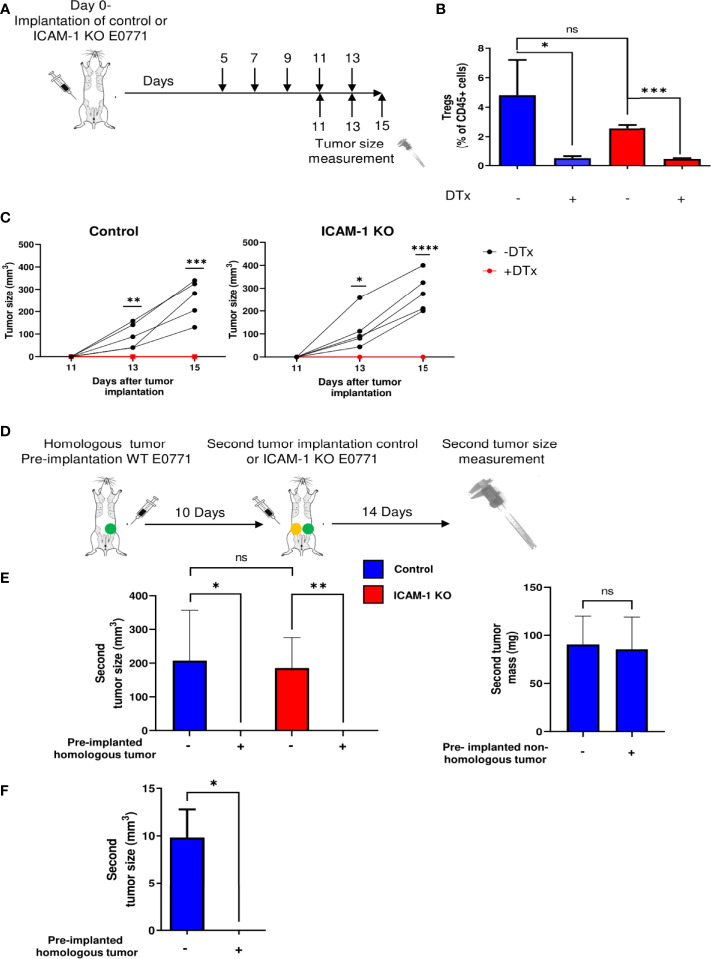
Breast tumors and their derived circulating cancer cells express the leukocyte β integrin ligand Intercellular adhesion molecule 1 (ICAM-1). We found that elevated ICAM-1 expression in breast cancer cells results in a favorable outcome and prolonged survival of breast cancer patients. We therefore assessed the direct contribution of ICAM-1 expressed by breast cancer cells to breast tumorigenesis and lung metastasis in syngeneic immunocompetent mice hosts using spontaneous and experimental models of the lung metastasis of the C57BL/6-derived E0771 cell line, a luminal B breast cancer subtype. Notably, the presence of ICAM-1 on E0771 did not alter tumor growth or the leukocyte composition in the tumor microenvironment. Interestingly, the elimination of Tregs led to the rapid killing of primary tumor cells independently of tumor ICAM-1 expression. The elimination of a primary E0771 tumor expressing the ovalbumin (OVA) model neoantigen by the OVA-specific OVA-tcr-I mice (OT-I) transgenic cytotoxic T lymphocytes (CTLs) also took place normally in the absence of ICAM-1 expression by E0771 breast cancer target cells. The whole lung imaging of these cells by light sheet microscopy (LSM) revealed that both Wild type (WT)- and ICAM-1-deficient E0771 cells were equally disseminated from resected tumors and accumulated inside the lung vasculature at similar magnitudes. ICAM-1-deficient breast cancer cells developed, however, much larger metastatic lesions than their control counterparts. Strikingly, the vast majority of these cells gave rise to intravascular tumor colonies both in spontaneous and experimental metastasis models. In the latter model, ICAM-1 expressing E0771- but not their ICAM-1-deficient counterparts were highly susceptible to elimination by neutrophils adoptively transferred from E0771 tumor-bearing donor mice. , neutrophils derived from tumor-bearing mice also killed cultured E0771 cells ICAM-1-dependent interactions. Collectively, our results are a first indication that ICAM-1 expressed by metastatic breast cancer cells that expand inside the lung vasculature is involved in innate rather than in adaptive cancer cell killing. This is also a first indication that the breast tumor expression of ICAM-1 is not required for CTL-mediated killing but can function as a suppressor of intravascular breast cancer metastasis to lungs.
乳腺肿瘤及其衍生的循环癌细胞表达白细胞 β 整合素配体细胞间黏附分子 1(ICAM-1)。我们发现,乳腺癌细胞中 ICAM-1 表达水平的升高导致乳腺癌患者的预后良好和生存期延长。因此,我们使用自发和实验性肺转移模型评估了乳腺癌细胞中 ICAM-1 的直接贡献,这些模型使用源自 C57BL/6 的 E0771 细胞系,一种腔 B 型乳腺癌亚型,在同种免疫活性宿主的乳腺肿瘤发生和肺转移中。值得注意的是,E0771 上的 ICAM-1 的存在并未改变肿瘤生长或肿瘤微环境中的白细胞组成。有趣的是,消除 Tregs 会导致原发性肿瘤细胞迅速死亡,而与肿瘤 ICAM-1 的表达无关。OVA 特异性 OVA-tcr-I 小鼠(OT-I)转基因细胞毒性 T 淋巴细胞(CTL)对表达卵清蛋白(OVA)模型新抗原的原发性 E0771 肿瘤的消除,在缺乏 E0771 乳腺癌靶细胞的 ICAM-1 表达的情况下也能正常进行。通过光片显微镜(LSM)对这些细胞进行全肺成像显示,WT 和 ICAM-1 缺陷型 E0771 细胞均从切除的肿瘤中均匀扩散,并以相似的幅度在肺血管内积聚。然而,ICAM-1 缺陷型乳腺癌细胞形成的转移灶比对照细胞大得多。引人注目的是,在自发和实验性转移模型中,绝大多数这些细胞都在血管内形成肿瘤集落。在后一种模型中,E0771 中表达 ICAM-1 的细胞——但不是其 ICAM-1 缺陷型细胞——极易被从 E0771 荷瘤供体小鼠中过继转移的中性粒细胞消除。此外,来自荷瘤小鼠的中性粒细胞也依赖于 ICAM-1 相互作用杀死培养的 E0771 细胞。总之,我们的结果首次表明,在肺血管内扩张的转移性乳腺癌细胞表达的 ICAM-1 参与了先天而不是适应性的癌细胞杀伤。这也是第一个表明乳腺肿瘤中 ICAM-1 的表达不是 CTL 介导的杀伤所必需的,但可以作为抑制血管内乳腺癌转移到肺部的抑制物。