Okada Shogo, Murakami Koichi, Kusumoto Tamon, Hirano Yoshiyuki, Amako Katsuya, Sasaki Takashi
High Energy Accelerator Research Organization (KEK), 1-1, Oho, Tsukuba, Ibaraki, 305-0801, Japan.
National Institutes for Quantum Science and Technology (QST), 4-9-1 Anagawa, Inage-ku, Chiba, 263-8555, Japan.
Sci Rep. 2025 May 13;15(1):16534. doi: 10.1038/s41598-025-00875-w.
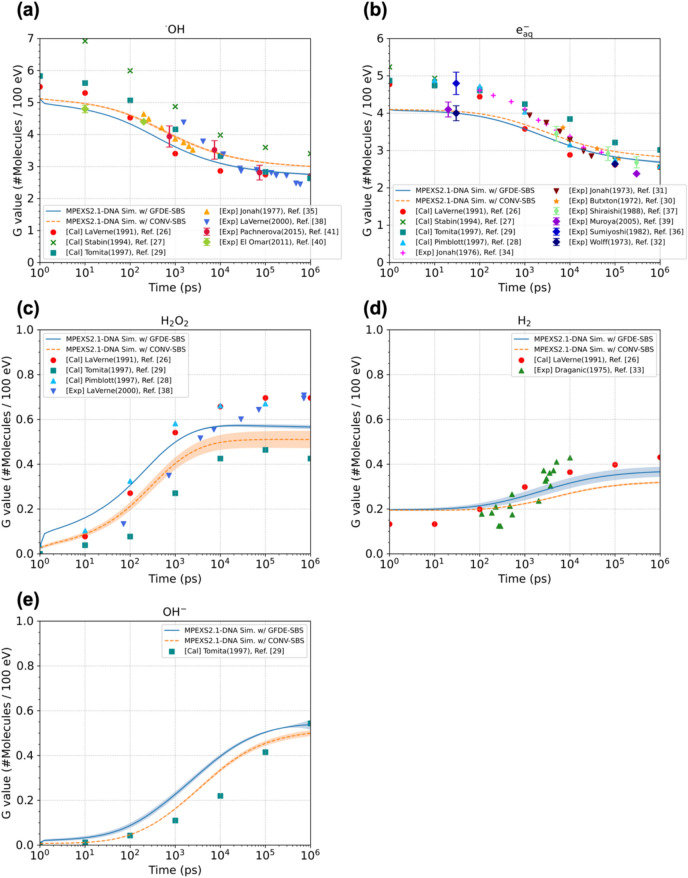
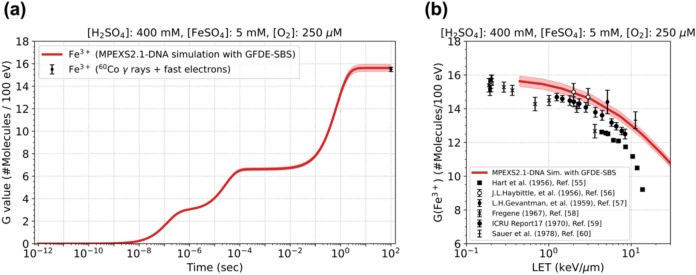
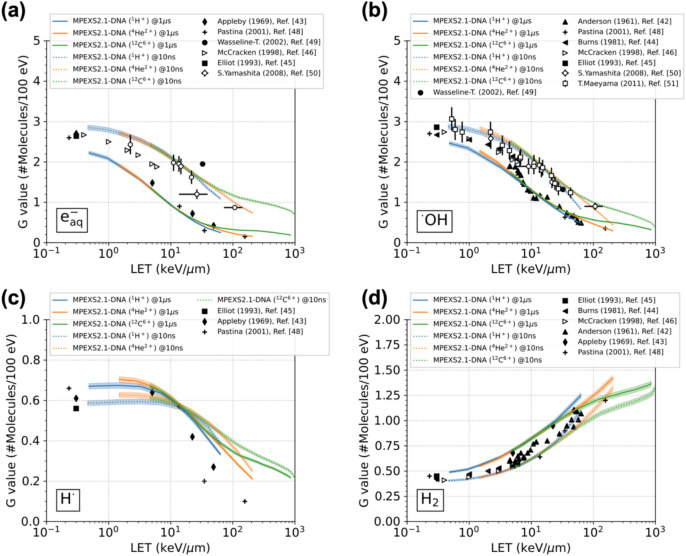
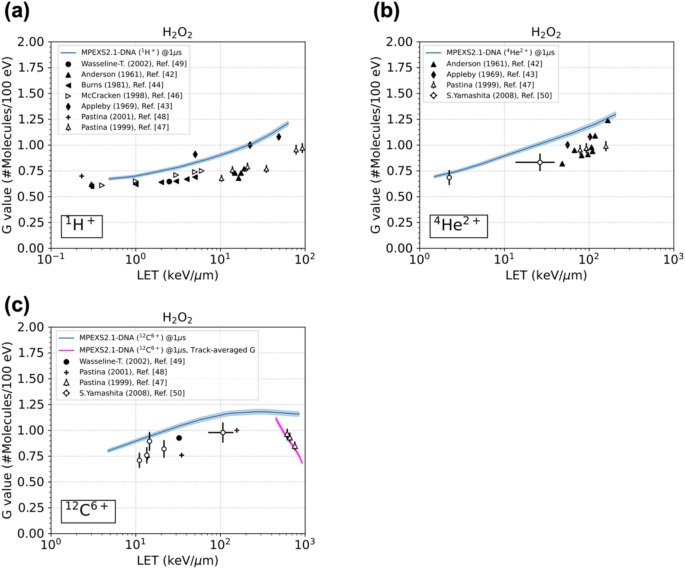
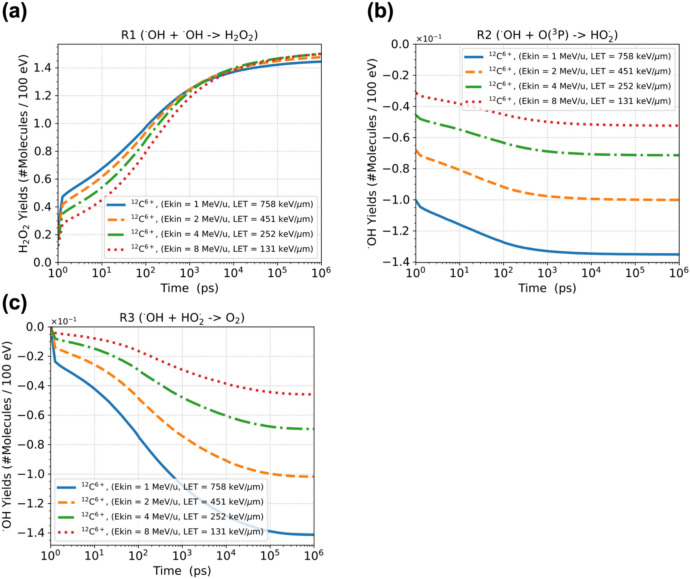
To improve radiotherapy, especially that with ion beams such as proton and carbon ion beams, the mechanisms of interactions induced by ionizing radiation must be understood. MPEXS2.1-DNA is a Monte Carlo simulation code developed for water radiolysis studies and DNA damage simulations that uses GPU devices for fast computation. However, the original chemistry model in MPEXS2.1-DNA did not include detailed chemical reactions for reactive oxygen species (ROS), e.g., O, O, O, HO, HO. In the present study, drawing the former work on the step-by-step (SBS) model for the RITRACKS code, we implemented an alternative SBS model into MPEXS2.1-DNA to increase the capabilities and computational speed of water radiolysis simulations under ion irradiation. This model is based on the theory of Green's function of the diffusion equation (GFDE-SBS). Also, we implemented multiple ionization processes which enhance ROS generation under high-LET irradiation. We compared the simulation results obtained by GFDE-SBS with experimental data from previous studies. The validation results demonstrated that the GFDE-SBS model accurately reproduced the measured radiation chemical yields of major species, such as hydroxyl radicals and hydrogen peroxide. Furthermore, the computational speed of GFDE-SBS was increased approximately ten times faster than the original model due to the changes in time stepping. Additionally, simulations using a Fricke dosimeter confirmed that this model is reliable for long-term simulations over seconds. These improvements enable simulations of radiation interactions and can help in the study of DNA damage mechanisms.
为了改进放射治疗,尤其是质子和碳离子束等离子束放疗,必须了解电离辐射诱导的相互作用机制。MPEXS2.1-DNA是一个为水辐射分解研究和DNA损伤模拟而开发的蒙特卡罗模拟代码,它使用GPU设备进行快速计算。然而,MPEXS2.1-DNA中的原始化学模型没有包括活性氧(ROS)的详细化学反应,例如O、O、O、HO、HO。在本研究中,借鉴之前为RITRACKS代码开发的逐步(SBS)模型的工作,我们在MPEXS2.1-DNA中实现了一个替代的SBS模型,以提高离子辐照下水辐射分解模拟的能力和计算速度。该模型基于扩散方程格林函数理论(GFDE-SBS)。此外,我们还实现了多个电离过程,这些过程可增强高传能线密度(LET)辐照下ROS的生成。我们将GFDE-SBS获得的模拟结果与先前研究的实验数据进行了比较。验证结果表明,GFDE-SBS模型准确地再现了主要物种(如羟基自由基和过氧化氢)的测量辐射化学产额。此外,由于时间步长的变化,GFDE-SBS的计算速度比原始模型快了约十倍。此外,使用弗里克剂量计的模拟证实,该模型对于长达数秒的长期模拟是可靠的。这些改进使得能够模拟辐射相互作用,并有助于研究DNA损伤机制。