Amjadi Motahareh Ala, Özdemir Yusuf Can, Ramezani Maryam, Jakab Kristóf, Megyes Melinda, Bibak Arezoo, Salehi Zeinab, Hayatmehar Zahra, Taheri Mohammad Hossein, Moradi Hossein, Zargari Peyman, Hasanpour Ata, Jahani Vali, Sharifi Abdol Motalleb, Egyed Balázs, Mende Balázs Gusztáv, Tavallaie Mahmood, Szécsényi-Nagy Anna
Doctoral School of Biology, ELTE-Eötvös Loránd University, Budapest, Hungary.
Institute of Archaeogenomics, HUN-REN Research Centre for the Humanities, Budapest, Hungary.
Sci Rep. 2025 May 13;15(1):16530. doi: 10.1038/s41598-025-99743-w.
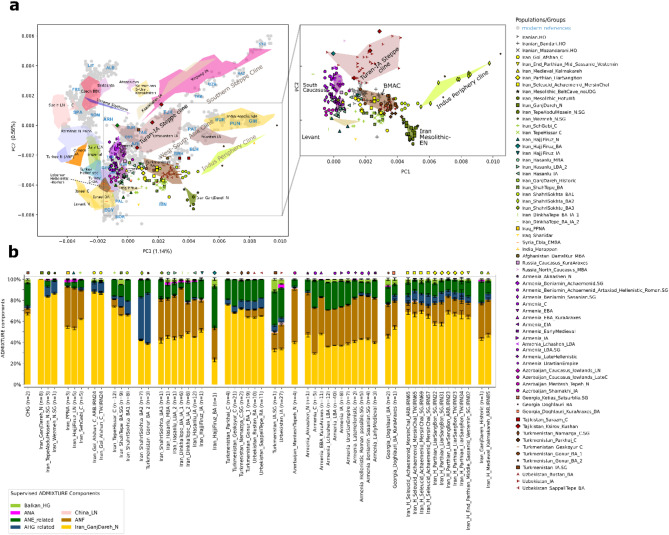
In this study, we present new ancient DNA data from prehistoric and historic populations of the Iranian Plateau. By analysing 50 samples from nine archaeological sites across Iran, we report 23 newly sequenced mitogenomes and 13 nuclear genomes, spanning 4700 BCE to 1300 CE. We integrate an extensive reference sample set of previously published ancient DNA datasets from Western and South-Central Asia, enhancing our understanding of genetic continuity and diversity within ancient Iranian populations. A new Early Chalcolithic sample, predating all other Chalcolithic genomes from Iran, demonstrates mostly Early Neolithic Iranian genetic ancestry. This finding reflects long-term cultural and biological continuity in and around the Zagros area, alongside evidence of some western genetic influence. Our sample selection prioritizes northern Iran, with a particular focus on the Achaemenid, Parthian, and Sassanid periods (355 BCE-460 CE). The genetic profiles of historical samples from this region position them as intermediates on an east-west genetic cline across the Persian Plateau. They also exhibit strong connections to local and South-Central Asian Bronze Age populations, underscoring enduring genetic connections across these regions. Diachronic analyses of uniparental lineages on the Iranian Plateau further highlight population stability from prehistoric to modern times.
在本研究中,我们展示了来自伊朗高原史前和历史时期人群的全新古代DNA数据。通过分析来自伊朗各地九个考古遗址的50个样本,我们报告了23个新测序的线粒体基因组和13个核基因组,时间跨度从公元前4700年至公元1300年。我们整合了来自西亚和中亚中西部先前发表的古代DNA数据集的广泛参考样本集,增进了我们对古代伊朗人群遗传连续性和多样性的理解。一个新的早铜石并用时代样本早于伊朗所有其他铜石并用时代基因组,显示出主要是新石器时代早期伊朗人的遗传血统。这一发现反映了扎格罗斯地区及其周边地区长期的文化和生物连续性,同时也有一些西方遗传影响的证据。我们的样本选择优先考虑伊朗北部,特别关注阿契美尼德、帕提亚和萨珊时期(公元前355年至公元460年)。该地区历史样本的遗传特征表明,它们处于横跨波斯高原的东西向遗传梯度上的中间位置。它们还与当地及中亚和南亚青铜时代人群表现出紧密联系,突显了这些地区之间持久的遗传联系。对伊朗高原单亲谱系的历时分析进一步凸显了从史前到现代的人口稳定性。