Zhang Chuankun, Yang Penghui, Yi Qijian
Department of Cardiovascular Medicine, Ministry of Education Key Laboratory of Child Development and Disorders, Chongqing Municipal Health Commission Key Laboratory of Children's Vital Organ Development and Diseases, National Clinical Research Center for Child Health and Disorders, National Clinical Key Cardiovascular Specialty, Children's Hospital of Chongqing Medical University, Chongqing, 400014, China.
BMC Womens Health. 2025 May 13;25(1):220. doi: 10.1186/s12905-025-03773-5.
There are no studies on the burden of ischemic heart disease (IHD) among women of childbearing age (WCBA) in China. This study aims to describe the IHD burden among WCBA in China from 1990 to 2021, predict the trends over the next 15 years, and identify the contributing factors associated with IHD-related deaths.
The data was extracted from the Global Burden of Disease Database 2021. The Direct age-standardized method was used to estimate the age-standardized (AS) prevalence rate (ASPR), mortality rate (ASMR), incidence rate (ASIR), and disability-adjusted life years rate (ASDR) of IHD among WCBA. Joinpoint regression analysis was used to analyze the Annual Percent Change and Average Annual Percent Change from 1990 to 2021. The Autoregressive Integrated Moving Average model was used to predict the trend over the next 15 years.
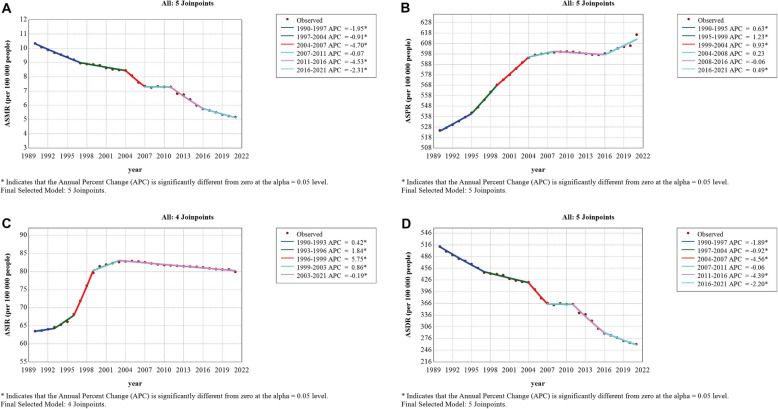
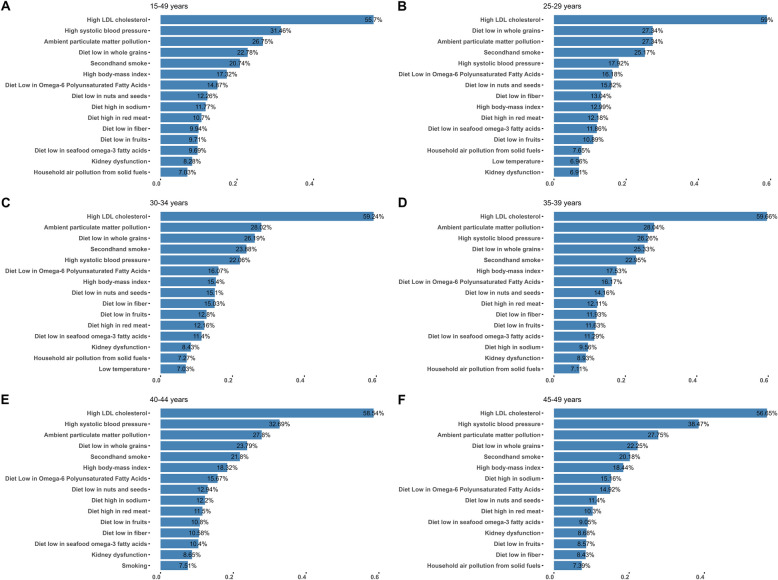
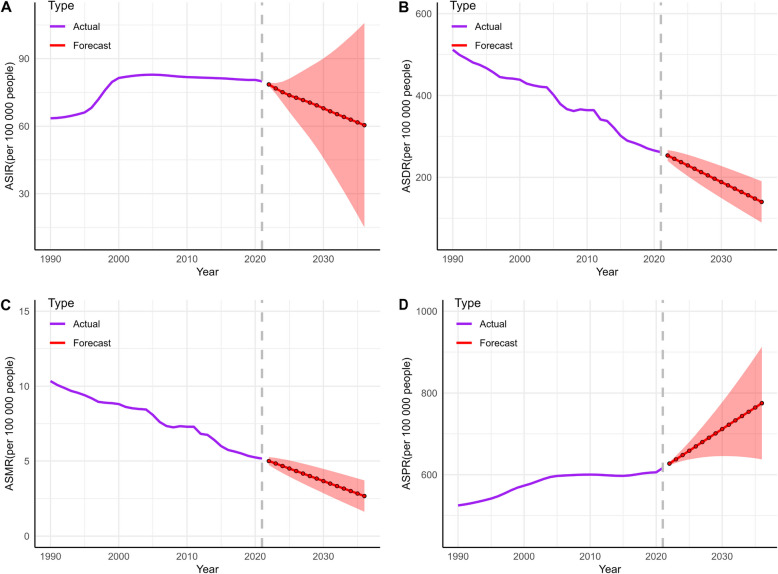
From 1990 to 2021, the ASPR and ASIR increased by 17.44% and 25.83%, culminating in 616.50 (95% UI, 498.42-762.38) and 79.93 (95% UI, 49.43-113.88) cases per 100,000 individuals. Conversely, the ASMR and ASDR declined to 5.17 (95% UI, 4.14-6.33) and 261.24 (95% UI, 212.03-318.03) cases per 100,000 individuals. Over the next 15 years, the ASPR is projected to increase by 25.74%, culminating in 775.20 (95% UI, 637.98-912.42) cases per 100,000 individuals. The main contributor to increased IHD-related deaths among WCBA in China was high low-density lipoprotein.
Despite the significant decline in the ASMR and ASDR of IHD among WCBA in China over the last 30 years, the ASPR and ASIR continue to increase. Additionally, the ASPR is projected to rise over the next 15 years. These findings emphasize that effective measures and timely interventions are needed to reduce the disease burden.
中国尚无关于育龄期女性缺血性心脏病(IHD)负担的研究。本研究旨在描述1990年至2021年中国育龄期女性的缺血性心脏病负担,预测未来15年的趋势,并确定与缺血性心脏病相关死亡的影响因素。
数据取自《2021年全球疾病负担数据库》。采用直接年龄标准化方法估算中国育龄期女性缺血性心脏病的年龄标准化患病率(ASPR)、死亡率(ASMR)、发病率(ASIR)和伤残调整生命年率(ASDR)。采用Joinpoint回归分析来分析1990年至2021年的年度百分比变化和平均年度百分比变化。使用自回归积分滑动平均模型预测未来15年的趋势。
1990年至2021年,年龄标准化患病率和发病率分别上升了17.44%和25.83%,最终达到每10万人616.50例(95%可信区间,498.42 - 762.38)和79.93例(95%可信区间,49.43 - 113.88)。相反,年龄标准化死亡率和伤残调整生命年率下降至每10万人5.17例(95%可信区间,4.14 - 6.33)和261.24例(95%可信区间,212.03 - 318.03)。在未来15年中,年龄标准化患病率预计将上升25.74%,最终达到每10万人775.20例(95%可信区间,637.98 - 912.42)。中国育龄期女性缺血性心脏病相关死亡增加的主要因素是低密度脂蛋白水平低。
尽管在过去30年里中国育龄期女性缺血性心脏病的年龄标准化死亡率和伤残调整生命年率显著下降,但年龄标准化患病率和发病率仍在持续上升。此外,预计在未来15年中年龄标准化患病率还会上升。这些发现强调需要采取有效措施并及时进行干预,以减轻疾病负担。