Zhang Caiyun, Chen Yanlin, Hou Fang, Li Yanzhi, Wang Wanxin, Guo Lan, Zhang Caixia, Li Li, Lu Ciyong
Department of Medical Statistics and Epidemiology, School of Public Health, Sun Yat-sen University, Guangzhou 510275, China.
Guangdong Provincial Key Laboratory of Food, Nutrition and Health, Sun Yat-sen University, Guangzhou 510275, China.
Nutrients. 2025 May 7;17(9):1602. doi: 10.3390/nu17091602.
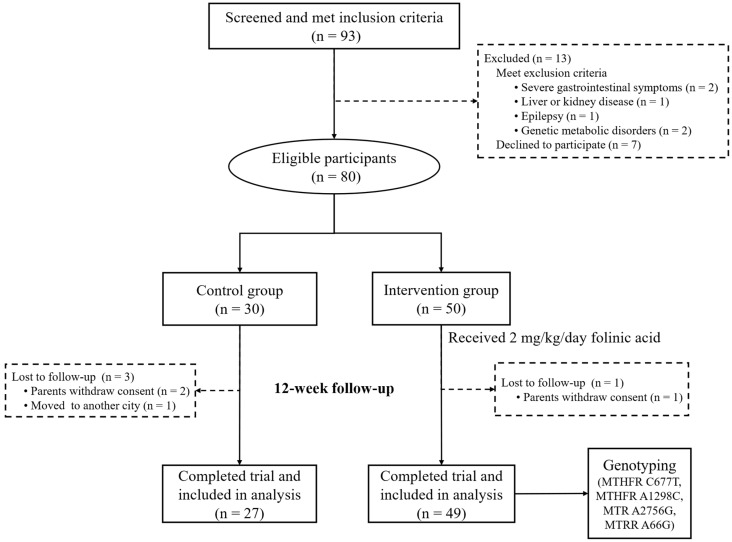
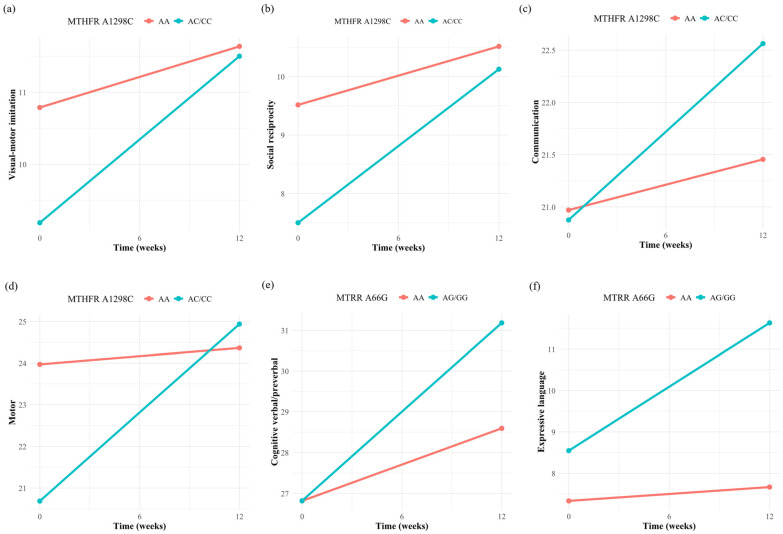
Research on the safety and efficacy of high-dose folinic acid in Chinese children with autism spectrum disorder (ASD) is limited, and the impact of folate metabolism gene polymorphisms on its efficacy remains unclear. This trial aimed to evaluate the safety and efficacy of high-dose folinic acid intervention in Chinese children with ASD and explore the association between folate metabolism gene polymorphisms and efficacy. A 12-week randomized clinical trial was conducted, including 80 eligible children with ASD, randomly assigned to an intervention group ( = 50) or a control group ( = 30). The intervention group was administered folinic acid (2 mg/kg/day, max 50 mg/day) in two divided doses. Efficacy was measured using the Psycho-Educational Profile, Third Edition (PEP-3) at baseline and 12 weeks by two trained professionals blind to the group assignments. Methylenetetrahydrofolate reductase ( C677T, A1298C), methionine synthase ( A2756G), and methionine synthase reductase ( A66G) were genotyped by the gold standard methods in the intervention group. 49 participants in the intervention group and 27 in the control group completed this trial. Both groups showed improvements from baseline to 12 weeks across most outcome measures. The intervention group demonstrated significantly greater improvements in social reciprocity compared to the control group. Children with A1298C or A66G mutations demonstrated greater improvements in various developmental domains than wild type. Folinic acid may be more effective in certain genotype combinations, such as C677T and A1298C. No significant adverse effects were observed during the intervention. High-dose folinic acid may be a promising intervention for children with ASD, and its efficacy is associated with folate metabolism gene polymorphisms. High-dose folinic acid intervention may promote better neurodevelopmental outcomes by alleviating folate metabolism abnormalities caused by single or combined mutations in folate metabolism genes.
关于大剂量亚叶酸在中国自闭症谱系障碍(ASD)儿童中的安全性和有效性的研究有限,且叶酸代谢基因多态性对其疗效的影响仍不明确。本试验旨在评估大剂量亚叶酸干预对中国ASD儿童的安全性和有效性,并探讨叶酸代谢基因多态性与疗效之间的关联。进行了一项为期12周的随机临床试验,纳入80名符合条件的ASD儿童,随机分为干预组(n = 50)和对照组(n = 30)。干预组给予亚叶酸(2 mg/kg/天,最大50 mg/天),分两次服用。由两名对分组情况不知情的经过培训的专业人员在基线和12周时使用第三版心理教育档案(PEP - 3)测量疗效。干预组采用金标准方法对亚甲基四氢叶酸还原酶(C677T、A1298C)、蛋氨酸合酶(A2756G)和蛋氨酸合酶还原酶(A66G)进行基因分型。干预组49名参与者和对照组27名参与者完成了本试验。两组在大多数结局指标上从基线到12周均有改善。与对照组相比,干预组在社交互动方面的改善更为显著。携带A1298C或A66G突变的儿童在各个发育领域的改善比野生型更大。亚叶酸在某些基因型组合中可能更有效,如C677T和A1298C。干预期间未观察到明显不良反应。大剂量亚叶酸可能是ASD儿童一种有前景的干预措施,其疗效与叶酸代谢基因多态性有关。大剂量亚叶酸干预可能通过减轻叶酸代谢基因单突变或联合突变引起的叶酸代谢异常,促进更好的神经发育结局。