Santos Weiner, Rojas Carmen, Isidoro Rui, Lorente Alejandro, Dias Ana, Mariscal Gonzalo, Benlloch María, Lorente Rafael
International Doctoral School, University of Extremadura, 06006 Badajoz, Spain.
Local Health Unit Litoral Alentejano (ULSLA), 7540-230 Santiago do Cacém, Portugal.
J Clin Med. 2025 Apr 28;14(9):3034. doi: 10.3390/jcm14093034.
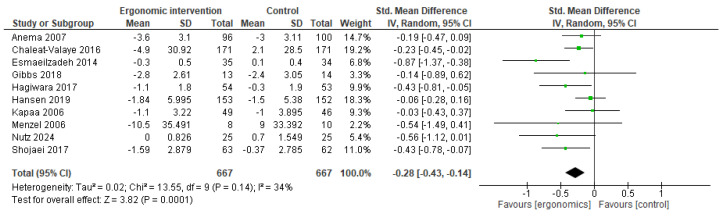
: Among the leading causes of work-related disability, musculoskeletal diseases (MSDs) profoundly affect productivity and quality of life. Workplace changes, equipment adjustments, and training courses, among other ergonomic interventions, seek to lower the frequency and degree of MSDs. This systematic review and meta-analysis evaluated whether ergonomic interventions help prevent and control MSDs in various workplace environments. : A systematic search was conducted in PubMed, Scopus, Embase, Web of Science, and Cochrane Library to identify relevant studies. Inclusion criteria included randomized controlled trials (RCTs) that evaluated ergonomic interventions against conventional conditions. Effect sizes were computed using mean differences and pooled using a random-effects model in case of heterogeneity. A uniform Excel sheet was used for data extraction. Revman software (Cochrane Collaboration, Copenhagen, Denmark) was used for statistical analysis. : This meta-analysis included 24 RCTs with 4086 workers with different occupations. A meta-analysis of 10 included studies demonstrated lower pain intensity with a mean difference in VAS score between ergonomic interventions and the control group of -0.28 (95%CI: -0.43, -0.14, = 0.0001). Also, there was a significant reduction in reported MSD-related pain in the lower back with ergonomic interventions with an OR 0.53 (95%CI: 0.40-0.70, < 0.00001). Moreover, there were statistically significant results for ergonomic interventions in the upper back, ankles, wrists, and neck. In contrast, there were no significant improvements in the thighs, arms, knees, shoulders, and elbows. : Our findings support implementing ergonomic strategies as a practical approach to reducing work-related MSDs. However, further research is needed to improve intervention design and long-term effectiveness.
在与工作相关的残疾主要原因中,肌肉骨骼疾病(MSDs)对生产力和生活质量有深远影响。工作场所的变化、设备调整以及培训课程等其他工效学干预措施,旨在降低MSDs的发生频率和程度。本系统评价和荟萃分析评估了工效学干预措施是否有助于预防和控制各种工作场所环境中的MSDs。
在PubMed、Scopus、Embase、Web of Science和Cochrane图书馆进行了系统检索,以识别相关研究。纳入标准包括评估工效学干预措施与传统条件对比的随机对照试验(RCTs)。效应量使用均值差异计算,若存在异质性则采用随机效应模型进行合并。使用统一的Excel工作表进行数据提取。使用Revman软件(丹麦哥本哈根Cochrane协作网)进行统计分析。
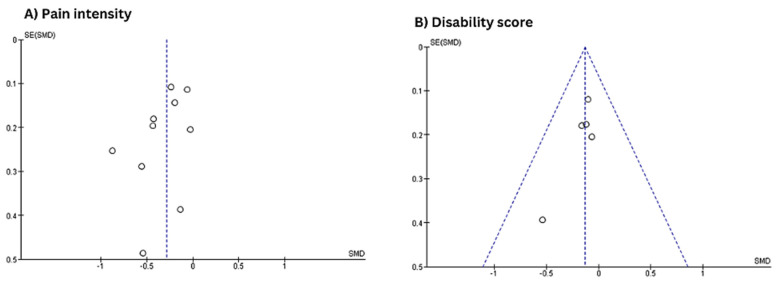
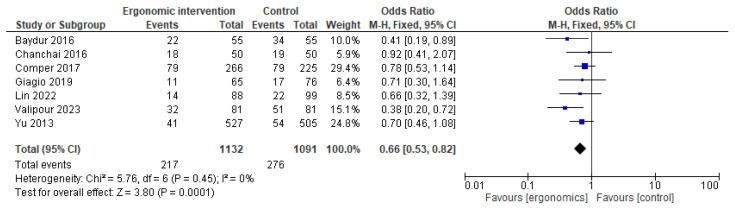
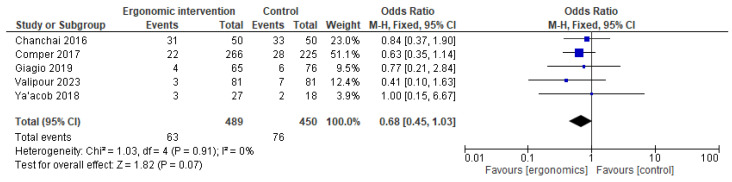
本荟萃分析纳入了24项RCTs,涉及4086名不同职业的工人。对10项纳入研究的荟萃分析表明,疼痛强度较低,工效学干预措施与对照组之间的VAS评分均值差异为-0.28(95%CI:-0.43,-0.14,P = 0.0001)。此外,通过工效学干预措施,下背部报告的与MSD相关的疼痛显著减少,OR为0.53(95%CI:0.40 - 0.70,P < 0.00001)。此外,在上背部、脚踝、手腕和颈部,工效学干预措施也取得了统计学上的显著结果。相比之下,在大腿、手臂、膝盖、肩膀和肘部则没有显著改善。
我们的研究结果支持将工效学策略作为减少与工作相关的MSDs的一种实用方法。然而,需要进一步研究以改进干预设计和长期效果。