Department of Healthcare Management, School of Management, Putian University, Putian, China.
School of Public Health, Guangdong Pharmaceutical University, Guangzhou, China.
J Occup Health. 2022 Jan;64(1):e12330. doi: 10.1002/1348-9585.12330.
This study is to evaluate the efficacy of participatory ergonomic (PE) intervention on musculoskeletal disorders (MSDs) and work ability among young dental professionals in China.
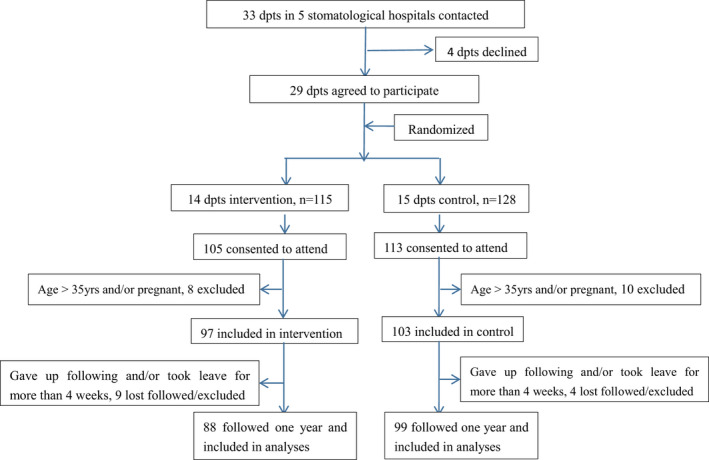
A cluster randomized controlled trail was conducted during 2015-2016. Twenty-nine departments from five hospitals in the South of China were randomized into intervention (14 departments) and control (15 departments), with individuals of 125 and 138 dental professionals, respectively. Main participatory ergonomic interventions involved work posture, repetitive motions, tool usage, work break relaxation and work time re-arrangement with total 235 ergonomic changes in the trail. Individual ergonomic risk exposure was assessed by investigator's observation using quick exposure check (QEC). Work ability index (WAI) and MSDs were collected by questionnaires at baseline, and every 3 months during the 1-year follow-up.
Follow-up rate was 91% and 96% for the intervention and control group, respectively. Significant reductions in ergonomic risk exposure and MSD prevalence on six anatomic sites were found in the PE group during the different follow-up stages. WAI scores improved by 1.1 (95% CI 0.43, 1.89) after the 9-month intervention. Compared to the control, the PE participants significantly reduced MSDs on neck (OR = 2.93, 95% CI: 1.25, 4.03) and wrists/hands (OR = 2.33, 95% CI: 1.08, 4.21), marginally increased WAI scores by 0.53 (95% CI: -0.02, 1.56) due to the interventions.
PE intervention is effective in reducing ergonomic risk exposure and MSDs on neck and wrists/hands among young dental professionals. PE ought to be offered in the early dental career for preventing MSDs.
本研究旨在评估参与性人体工程学(PE)干预对中国年轻牙科专业人员肌肉骨骼疾病(MSD)和工作能力的疗效。
采用 2015-2016 年期间进行的整群随机对照试验。将中国南方五家医院的 29 个科室随机分为干预组(14 个科室)和对照组(15 个科室),每组分别有 125 名和 138 名牙科专业人员。主要参与性人体工程学干预措施包括工作姿势、重复动作、工具使用、工作间歇放松和工作时间重新安排,共进行了 235 次人体工程学改变。个体人体工程学风险暴露情况由研究者使用快速暴露检查(QEC)进行观察评估。工作能力指数(WAI)和 MSDs 在基线时以及 1 年随访期间每 3 个月通过问卷调查收集。
干预组和对照组的随访率分别为 91%和 96%。在不同随访阶段,PE 组的人体工程学风险暴露和六个解剖部位 MSD 的患病率均显著降低。经过 9 个月的干预,WAI 评分提高了 1.1(95%CI 0.43,1.89)。与对照组相比,PE 参与者颈部(OR=2.93,95%CI:1.25,4.03)和手腕/手部(OR=2.33,95%CI:1.08,4.21)的 MSD 显著减少,由于干预,WAI 评分平均增加 0.53(95%CI:-0.02,1.56)。
PE 干预可有效降低年轻牙科专业人员颈部和手腕/手部的人体工程学风险暴露和 MSD。PE 应该在牙科职业生涯早期提供,以预防 MSD。