Kumari Deepika, Kumar Manoj, Upadhyay Ashish Datt, Malhotra Neena, Mahey Reeta, Dadhwal Vatsala, Sehgal Tushar, Mishra Richa, Dada Rima
Department of Anatomy, Laboratory for Molecular Reproduction and Genetics, AIIMS, New Delhi, India.
Department of Clinical Research Unit (CRU), AIIMS, New Delhi, India.
Int J Yoga. 2025 Jan-Apr;18(1):45-57. doi: 10.4103/ijoy.ijoy_212_24. Epub 2025 Apr 22.
Hormonal imbalance, mitochondrial dysfunctions, and oxidative stress (OS) have been implicated in the pathogenesis of polycystic ovarian syndrome (PCOS) and its associated clinical features. A sedentary lifestyle, exposure to air pollutants, prenatal exposure to endocrine-disrupting chemicals, processed and nutritionally depleted food, rich in trans fats, salts, and sugars, and high BMI specifically in visceral adiposity induce OS. OS damages the mitochondrial DNA, lipids, and proteins that impair mitochondrial function. Sequentially, dysfunctional mitochondria produce more reactive oxygen species that aggravate the OS. Mitochondria is pivotal for ovarian cell functioning for instance steroidogenesis, ovarian follicle development, and energy metabolism. Dysfunctional mitochondria can alter the ovarian follicle functioning leading to ovulatory dysfunction and infertility in PCOS.
This study is designed to investigate the effect of 12-week yoga practice on endocrine parameters, OS, and mitochondrial health, comparing outcomes in yoga and non-yoga groups.
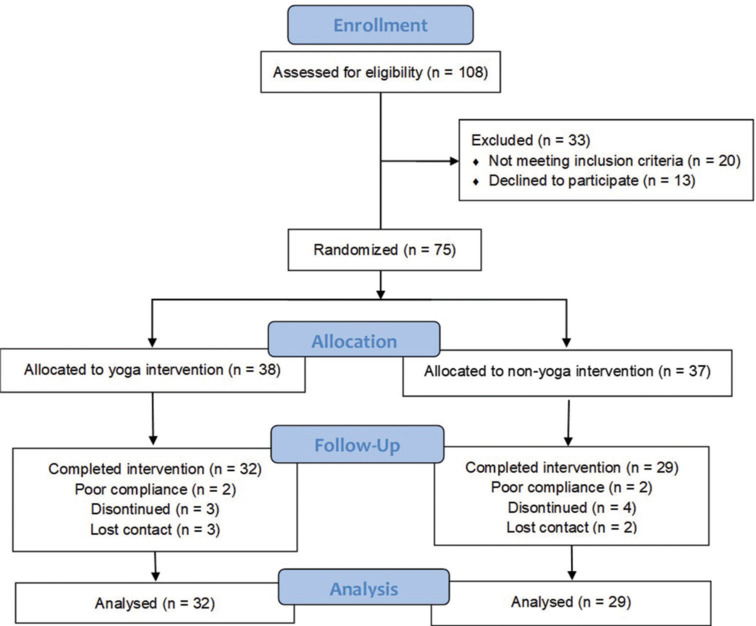
A total of 75 participants, 32 PCOS females who completed yoga intervention in the yoga group and 29 in the nonyoga group. Hormonal levels were assessed through an immunoassay, while mitochondrial health markers, such as mtDNA copy number (mtDNA CN), reactive oxygen species, and lipid peroxidation were measured through quantitative polymerase chain reaction (qPCR), chemiluminescence, and ELISA respectively. Gene expression related to mitochondrial integrity, respiratory chain, and inflammation was analyzed via reverse transcription qPCR. Additionally, depression severity was also assessed using beck depression inventory II.
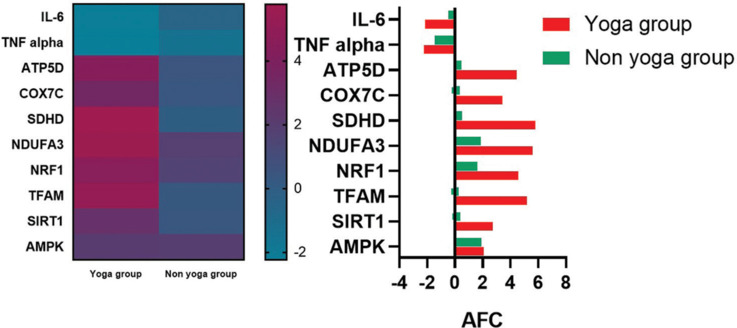
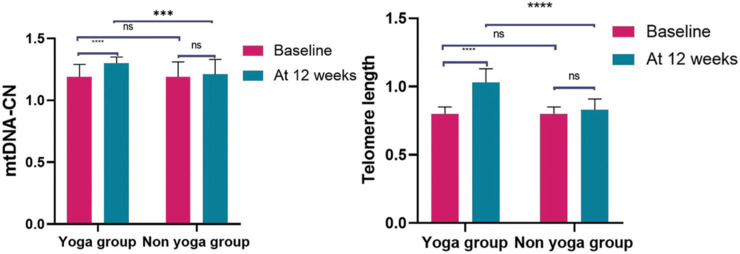
The Yoga group showed a significant increase in mtDNA-CN and upregulation of transcripts responsible for maintaining mitochondrial integrity and the mitochondrial respiratory chain. In addition, the post-yoga group shows a reduction in, lipid peroxidation, inflammatory, OS markers, and an improvement in telomere length.
Yoga positively affects hormonal balance, mitochondrial health, OS, and inflammation in women with PCOS. It also alleviates depression symptoms, highlighting yoga as an effective adjunct therapy for managing PCOS. Regular yoga practice could prevent, delay, and help in managing PCOS symptoms.
激素失衡、线粒体功能障碍和氧化应激(OS)与多囊卵巢综合征(PCOS)的发病机制及其相关临床特征有关。久坐不动的生活方式、暴露于空气污染物、产前暴露于内分泌干扰化学物质、富含反式脂肪、盐和糖的加工及营养匮乏食物,以及尤其是内脏肥胖导致的高体重指数(BMI)会引发氧化应激。氧化应激会损害线粒体DNA、脂质和蛋白质,进而损害线粒体功能。随后,功能失调的线粒体产生更多活性氧,加剧氧化应激。线粒体对卵巢细胞功能至关重要,例如类固醇生成、卵巢卵泡发育和能量代谢。功能失调的线粒体可改变卵巢卵泡功能,导致PCOS患者排卵功能障碍和不孕。
本研究旨在调查为期12周的瑜伽练习对内分泌参数、氧化应激和线粒体健康的影响,比较瑜伽组和非瑜伽组的结果。
共有75名参与者,32名PCOS女性在瑜伽组完成了瑜伽干预,29名在非瑜伽组。通过免疫测定评估激素水平,而线粒体健康标志物,如线粒体DNA拷贝数(mtDNA CN)、活性氧和脂质过氧化分别通过定量聚合酶链反应(qPCR)、化学发光和酶联免疫吸附测定(ELISA)进行测量。通过逆转录qPCR分析与线粒体完整性、呼吸链和炎症相关的基因表达。此外,还使用贝克抑郁量表II评估抑郁严重程度。
瑜伽组的mtDNA-CN显著增加,负责维持线粒体完整性和线粒体呼吸链转录本上调。此外,瑜伽后组的脂质过氧化、炎症、氧化应激标志物减少,端粒长度改善。
瑜伽对PCOS女性的激素平衡、线粒体健康、氧化应激和炎症有积极影响。它还能缓解抑郁症状,突出了瑜伽作为管理PCOS的有效辅助疗法。定期练习瑜伽可以预防、延缓和帮助管理PCOS症状。