Kong Fanyun, Bao Ensi, Zhong Yujie, Wang Yuxin, Liu Ruyu, Zhang Huanyang, Yang Lu, Jiang Rong, Liu Xuanke, Li Chen, Liu Xiangye, Pan Xiucheng, Zheng Kuiyang, You Hongjuan, Tang Renxian
Department of Pathogenic Biology and Immunology, Jiangsu Key Laboratory of Immunity and Metabolism, Xuzhou Medical University, Xuzhou, Jiangsu, China.
Department of Hepatology Division 2, Beijing Ditan Hospital, Capital Medical University, Beijing, China.
Hepatol Commun. 2025 May 6;9(5). doi: 10.1097/HC9.0000000000000680. eCollection 2025 May 1.
The HBV core protein (HBC) is crucial for the progression of HCC. WD repeat-containing (WDR) 46 (WDR46) is implicated in the development of different tumors. Nevertheless, whether WDR46 is controlled by HBC to drive hepatocarcinogenesis remains unclear.
Different HCC cohorts, immunohistochemical staining, and bioinformatics analysis were utilized to estimate the clinical correlation between WDR46 and HBV-associated HCC. Western blotting, co-immunoprecipitation, chromatin immunoprecipitation, and oncology functional assays were performed to evaluate the effect of HBC on WDR46 in upregulating nucleolar spindle-associated protein 1 (NUSAP1), the influence of WDR46 on HBC-mediated HCC cell biological functions, and the mechanisms of WDR46 upregulation mediated by HBC to increase NUSAP1.
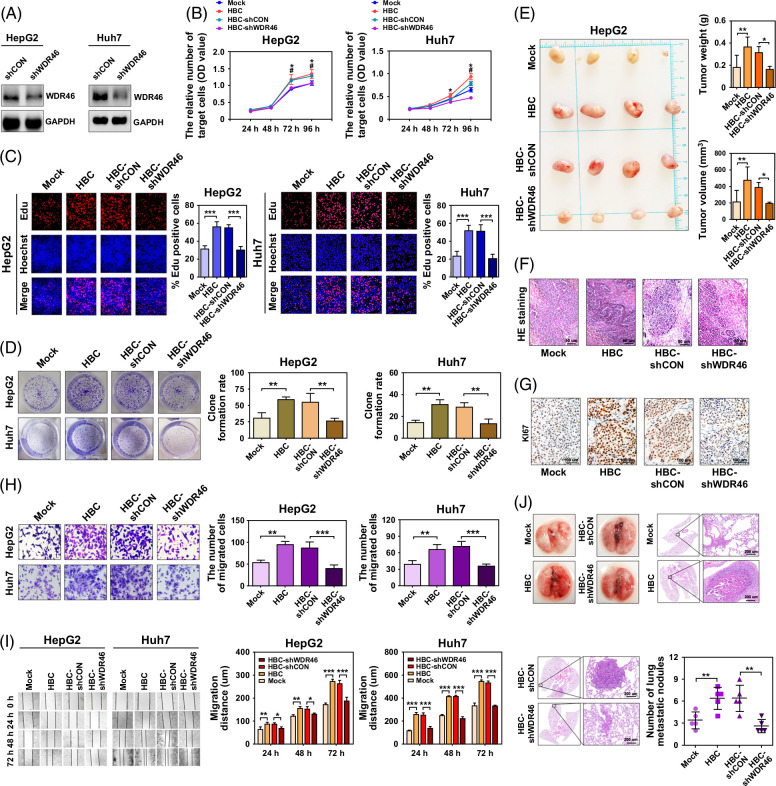
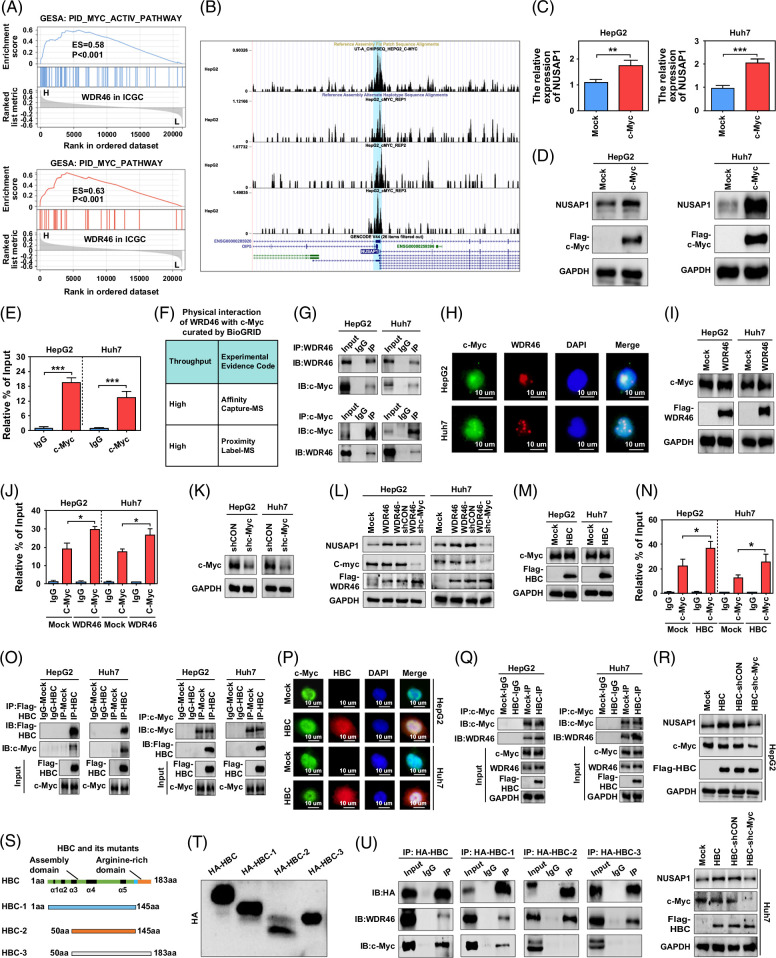
WDR46 expression was elevated in HBV-related HCC in a HBC-dependent manner. Overexpression of WDR46 is closely linked to severe prognosis of tumors. Functionally, WDR46 contributes to HBC-induced cell growth and migration in vitro and in vivo. Furthermore, HBC enhanced WDR46 protein stabilization by hampering the interaction between WDR46 and TRIM25, thereby decreasing WDR46 ubiquitination. NUSAP1, a DNA replication-related molecule, is a vital downstream target of WDR46. Relying on WDR46, HBC promoted NUSAP1 upregulation to modulate the biological functions of HBC in HCC cells. Importantly, HBC enhanced the interaction between WDR46 and the transcription factor c-Myc to facilitate c-Myc recruitment to the NUSAP1 promoter, leading to the increase of NUSAP1 transcription.
Our comprehensive data provides new insights into the mechanisms responsible for HBC-induced hepatocarcinogenesis. WDR46 and its downstream molecule, NUSAP1, may act as novel therapeutic targets for HBV-related tumors.
乙肝核心蛋白(HBC)对肝癌进展至关重要。含WD重复序列(WDR)46(WDR46)与不同肿瘤的发生发展有关。然而,WDR46是否受HBC调控以驱动肝癌发生仍不清楚。
利用不同的肝癌队列、免疫组化染色和生物信息学分析来评估WDR46与乙肝相关肝癌之间的临床相关性。进行蛋白质免疫印迹、免疫共沉淀、染色质免疫沉淀和肿瘤功能测定,以评估HBC对WDR46上调核仁纺锤体相关蛋白1(NUSAP1)的影响、WDR46对HBC介导的肝癌细胞生物学功能的影响以及HBC介导WDR46上调以增加NUSAP1的机制。
WDR46表达在乙肝相关肝癌中以HBC依赖的方式升高。WDR46的过表达与肿瘤的严重预后密切相关。在功能上,WDR46在体外和体内促进HBC诱导的细胞生长和迁移。此外,HBC通过阻碍WDR46与TRIM25之间的相互作用来增强WDR46蛋白稳定性,从而减少WDR46泛素化。NUSAP1是一种与DNA复制相关的分子,是WDR46的重要下游靶点。HBC依赖WDR46促进NUSAP1上调,以调节HBC在肝癌细胞中的生物学功能。重要的是,HBC增强了WDR46与转录因子c-Myc之间的相互作用,促进c-Myc募集到NUSAP1启动子,导致NUSAP1转录增加。
我们的综合数据为HBC诱导肝癌发生的机制提供了新的见解。WDR46及其下游分子NUSAP1可能作为乙肝相关肿瘤的新型治疗靶点。