Greene Mallik, Pew Timo, Ozbay A Burak, Rincón López Juliana Vanessa, Brooks Durado, Karlitz Jordan, Duarte Martha
Exact Sciences Corporation, Madison, WI, USA.
Unisanitas, Bogota, Colombia.
Cancer Control. 2025 Jan-Dec;32:10732748251343334. doi: 10.1177/10732748251343334. Epub 2025 May 14.
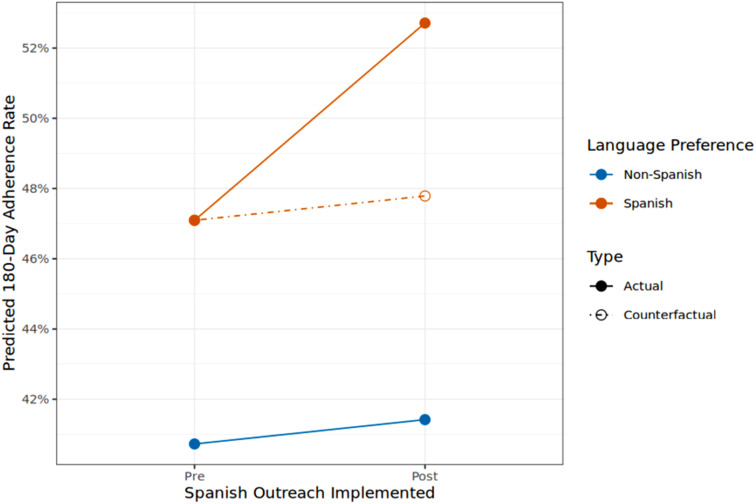
IntroductionThe objective of the current study was to examine the impact of Spanish-language patient outreach and navigation services on adherence to initial colorectal cancer (CRC) screening with multitarget stool DNA (mt-sDNA) testing in a predominantly Spanish-speaking patient population receiving care at Federally Qualified Health Centers (FQHCs).MethodThis study included patients aged 45 years or older who identified as Hispanic from FQHCs in a California Health System who were new to mt-sDNA testing and shipped a Cologuard® collection kit between 10-1-2022, and 1-1-2024. Patient outreach was provided only in English prior to 1-22-2023 (pre-intervention period). From 1-23-2023, onward, patient outreach was offered in either English or Spanish based on the patients' preferred language selection (post-intervention period). Patients were classified into two subgroups: Spanish language preference (SLP) or non-Spanish language preference (NSLP). It was hypothesized that adherence would be greater in SLP patients when patient outreach was provided in Spanish compared to the NSLP.ResultsThe final sample comprised 20 341 Hispanic patients who met the study criteria, comprising 15 702 patients with SLP and 4639 with NSLP, stratified across pre- and post-intervention periods. Overall, adherence to initial mt-sDNA testing within 180 days following the index date was 51.4% for SLP patients and 41.3% for NSLP patients, with a significant post-intervention improvement observed after the intervention for SLP patients (47.1% to 52.7%, < .001), compared to a non-significant improvement (40.7% to 41.4%, = .713) among NSLP patients.DiscussionFollowing the introduction of Spanish-language patient outreach, adherence to mt-sDNA testing improved significantly among SLP patients. The preference of Hispanic individuals for stool-based tests, combined with the non-invasive nature of mt-sDNA testing, supports its suitability as a CRC screening option for this population.
引言
本研究的目的是探讨西班牙语患者外展和导航服务对在联邦合格医疗中心(FQHCs)接受治疗的以西班牙语为主的患者群体中采用多靶点粪便DNA(mt-sDNA)检测进行初次结直肠癌(CRC)筛查的依从性的影响。
方法
本研究纳入了加利福尼亚医疗系统中FQHCs的45岁及以上自认为是西班牙裔的患者,这些患者是mt-sDNA检测的新手,在2022年10月1日至2024年1月1日期间运送了Cologuard®采集试剂盒。在2023年1月22日之前(干预前期),仅以英语提供患者外展服务。从2023年1月23日起,根据患者的首选语言选择,以英语或西班牙语提供患者外展服务(干预后期)。患者被分为两个亚组:西班牙语偏好(SLP)或非西班牙语偏好(NSLP)。假设当以西班牙语提供患者外展服务时,SLP患者的依从性将高于NSLP患者。
结果
最终样本包括20341名符合研究标准的西班牙裔患者,其中包括15702名SLP患者和4639名NSLP患者,按干预前期和干预后期分层。总体而言,在索引日期后的180天内,SLP患者初次mt-sDNA检测的依从性为51.4%,NSLP患者为41.3%,干预后SLP患者有显著改善(从47.1%提高到52.7%,P<0.001),而NSLP患者改善不显著(从40.7%提高到41.4%,P = 0.713)。
讨论
引入西班牙语患者外展服务后,SLP患者对mt-sDNA检测的依从性显著提高。西班牙裔个体对基于粪便检测的偏好,加上mt-sDNA检测的非侵入性,支持其作为该人群CRC筛查选项的适用性。