Peng Liangfei, Yang Xuemei, Qiu Xiaohua, Wang Li, Chen Ling, Wei Jiachen, Jing Chuwei, Wu Xiancheng, Li Wen, Wang Danni, Qian Qian, Sun Wenkui
Department of Respiratory and Critical Care Medicine, The First Affiliated Hospital With Nanjing Medical University, Nanjing, Jiangsu, China.
Department of Respiratory and Critical Care Medicine, The Second Affiliated Hospital of Wannan Medical College, Wuhu, Anhui, China.
Microbiol Spectr. 2025 Jun 3;13(6):e0335524. doi: 10.1128/spectrum.03355-24. Epub 2025 May 14.
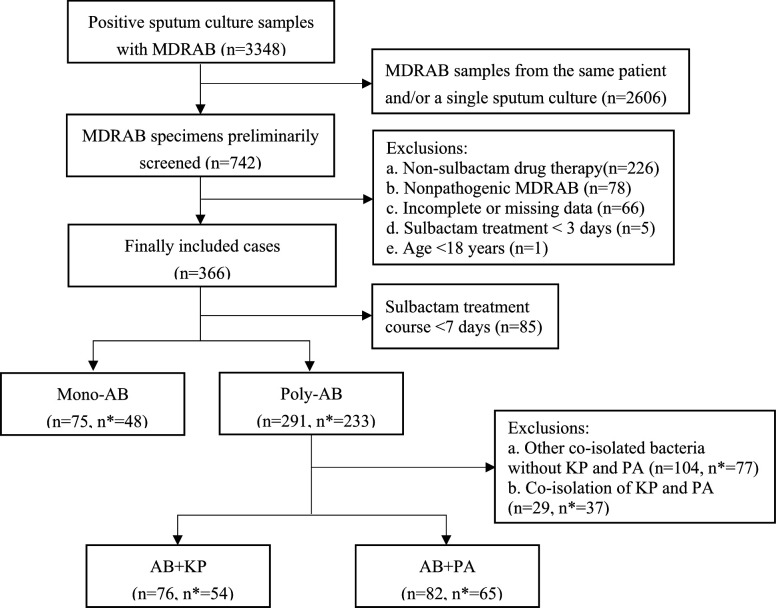
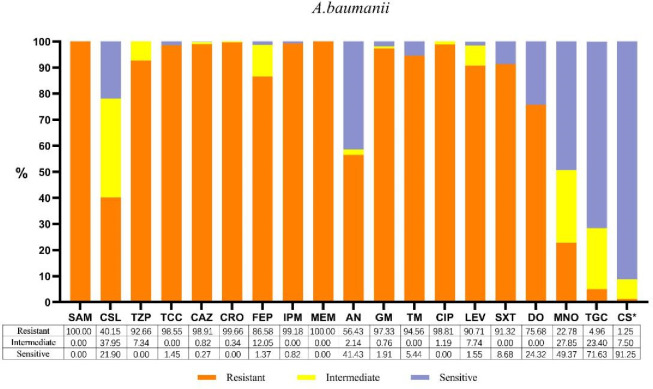
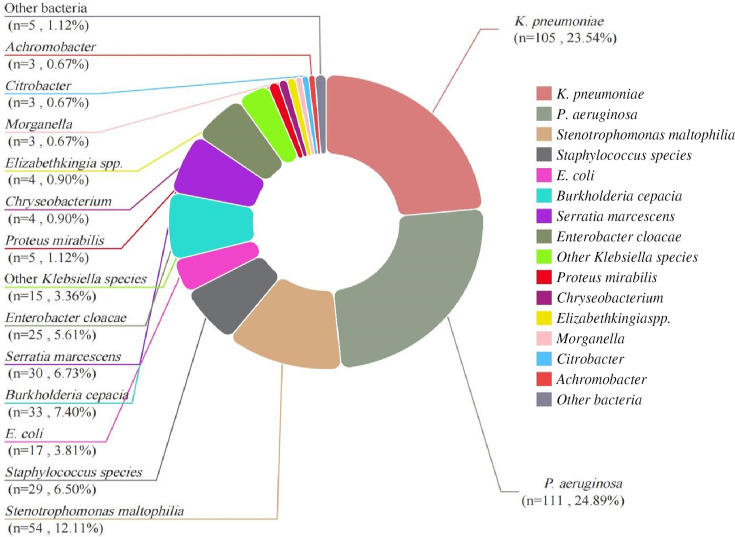
The efficacy in treatment of monomicrobial versus polymicrobial (mono-AB vs poly-AB) pulmonary infections remains unclear. This study mainly investigated the efficacy of sulbactam combination regimens against mono-AB and poly-AB pulmonary infections. A multicenter retrospective study of adult patients who received sulbactam or cefoperazone/sulbactam for multidrug-resistant (MDRAB) between August 2021 and July 2023 was conducted. The outcomes of 7-day microbiological efficacy and 14-day clinical efficacy were measured. A total of 366 patients were enrolled, including 75 mono-AB patients. Among the 291 poly-AB cases, 82 patients were co-infected with and 76 patients with . All isolates exhibited multidrug resistance. The antibiotics demonstrating the highest sensitivity against these isolates were polymyxins and tigecycline, with sensitivity rates of 91.25% and 71.63%, respectively. In the multivariable analysis, patients receiving sulbactam-based treatment for poly-AB pulmonary infections exhibited significantly higher microbial clearance of compared with those with mono-AB infections. Microbial efficacy analysis of co-infection with or showed similar results to overall poly-AB infections. Sulbactam doses ≥ 8 g/day showed the best microbiological and clinical efficacy. Sulbactam combined with tigecycline and/or polymyxins demonstrated significantly better microbiological efficacy compared with sulbactam alone. Sulbactam combined with polymyxins resulted in better microbiological and clinical efficacy than when combined with tigecycline. In conclusion, patients with poly-AB lung infections exhibit a higher microbial clearance rate of following treatment compared with those with mono-AB infections. A daily dose ≥8 g sulbactam may be optimal for treating MDRAB pneumonia. The combination of sulbactam and polymyxins demonstrates significant advantages over other sulbactam-containing regimens in terms of microbiological and clinical efficacy.IMPORTANCEThis is the first multicenter retrospective study to investigate the efficacy of sulbactam combination regimens in the treatment of monomicrobial and polymicrobial AB-related pulmonary infections. Our study found that patients receiving sulbactam-based treatment for poly-AB pulmonary infections exhibited significantly higher microbial clearance of compared with those with mono-AB infections. Microbial efficacy analysis of co-infection with or showed similar results to overall poly-AB infections. These findings are significantly important for further analyzing the potential mechanisms underlying the differences in efficacy between antimicrobial treatments for monomicrobial and polymicrobial infections, as well as for optimizing clinical antimicrobial combination strategies.
单微生物与多微生物(单重AB感染与多重AB感染)肺部感染的治疗效果仍不明确。本研究主要探讨了舒巴坦联合用药方案治疗单重AB感染和多重AB感染肺部感染的疗效。对2021年8月至2023年7月期间接受舒巴坦或头孢哌酮/舒巴坦治疗多重耐药鲍曼不动杆菌(MDRAB)的成年患者进行了一项多中心回顾性研究。测量了7天微生物学疗效和14天临床疗效。共纳入366例患者,其中单重AB感染患者75例。在291例多重AB感染病例中,82例患者合并感染[具体菌种1],76例患者合并感染[具体菌种2]。所有[具体菌种1]和[具体菌种2]分离株均表现出多重耐药性。对这些分离株显示出最高敏感性的抗生素是多黏菌素和替加环素,敏感性率分别为91.25%和71.63%。在多变量分析中,接受基于舒巴坦治疗的多重AB感染肺部感染患者的[具体菌种]微生物清除率显著高于单重AB感染患者。[具体菌种1]或[具体菌种2]合并感染的微生物疗效分析结果与总体多重AB感染相似。舒巴坦剂量≥8 g/天显示出最佳的微生物学和临床疗效。与单独使用舒巴坦相比,舒巴坦联合替加环素和/或多黏菌素显示出显著更好的微生物学疗效。舒巴坦联合多黏菌素比联合替加环素产生更好的微生物学和临床疗效。总之,与单重AB感染患者相比,多重AB肺部感染患者治疗后[具体菌种]的微生物清除率更高。每日剂量≥8 g舒巴坦可能是治疗MDRAB肺炎的最佳选择。在微生物学和临床疗效方面,舒巴坦与多黏菌素的联合用药方案比其他含舒巴坦的方案具有显著优势。
这是第一项调查舒巴坦联合用药方案治疗单微生物和多微生物AB相关肺部感染疗效的多中心回顾性研究。我们的研究发现,接受基于舒巴坦治疗的多重AB感染肺部感染患者的[具体菌种]微生物清除率显著高于单重AB感染患者。[具体菌种1]或[具体菌种2]合并感染的微生物疗效分析结果与总体多重AB感染相似。这些发现对于进一步分析单微生物和多微生物感染抗菌治疗疗效差异的潜在机制以及优化临床抗菌联合策略具有重要意义。