Higashikuni Yasutomi, Platt Colin, Hastings Margaret H, Chen William C W, Guerra Justin R B, Tokuyama Takeshi, Torizal Fuad Gandhi, Liu Wenhao, Obana Takumi, Bayer Abraham L, Whipple Hannah, Kuznetsov Alexandra, Yeri Ashish, Turissini Cole, Kitchen Robert R, Shibayama Kota, Matsumura Takayoshi, Takeda Norihiko, Uosaki Hideki, Asnani Aarti H, Lu Timothy K, Rosenzweig Anthony
Division of Cardiovascular and Genetic Research, Center for Molecular Medicine, Jichi Medical University, Shimotsuke, Japan; Department of Cardiovascular Medicine, The University of Tokyo, Tokyo, Japan; Synthetic Biology Group, MIT Synthetic Biology Center, Massachusetts Institute of Technology, Cambridge, Massachusetts, USA; Research Laboratory of Electronics, Massachusetts Institute of Technology, Cambridge, Massachusetts, USA; Department of Biological Engineering, Massachusetts Institute of Technology, Cambridge, Massachusetts, USA.
Cardiovascular Research Center, Division of Cardiology, Corrigan Minehan Heart Center, Department of Medicine, Massachusetts General Hospital, Harvard Medical School, Boston, Massachusetts, USA.
JACC CardioOncol. 2025 Jun;7(4):396-410. doi: 10.1016/j.jaccao.2025.03.007. Epub 2025 May 13.
Cardiomyocyte loss occurs in acute and chronic cardiac injury, including cardiotoxicity due to chemotherapeutics like doxorubicin, and contributes to heart failure development. There is a pressing need for cardiac-specific therapeutics that target cardiomyocyte loss, preventing chemotherapy complications without compromising chemotherapeutic efficacy.
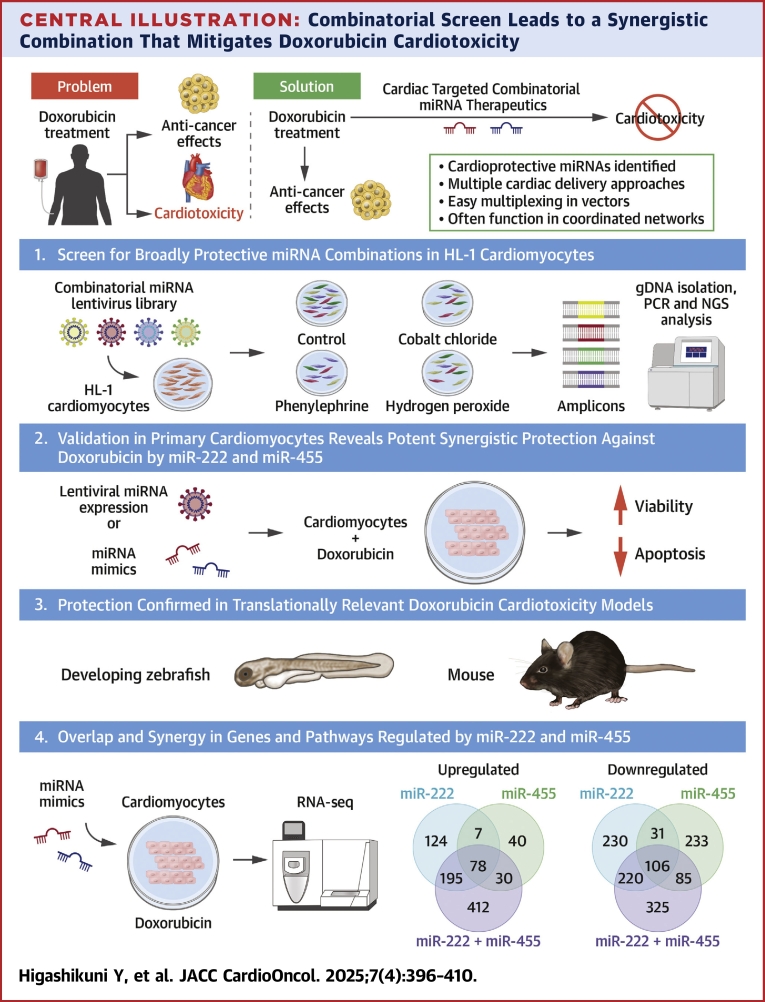
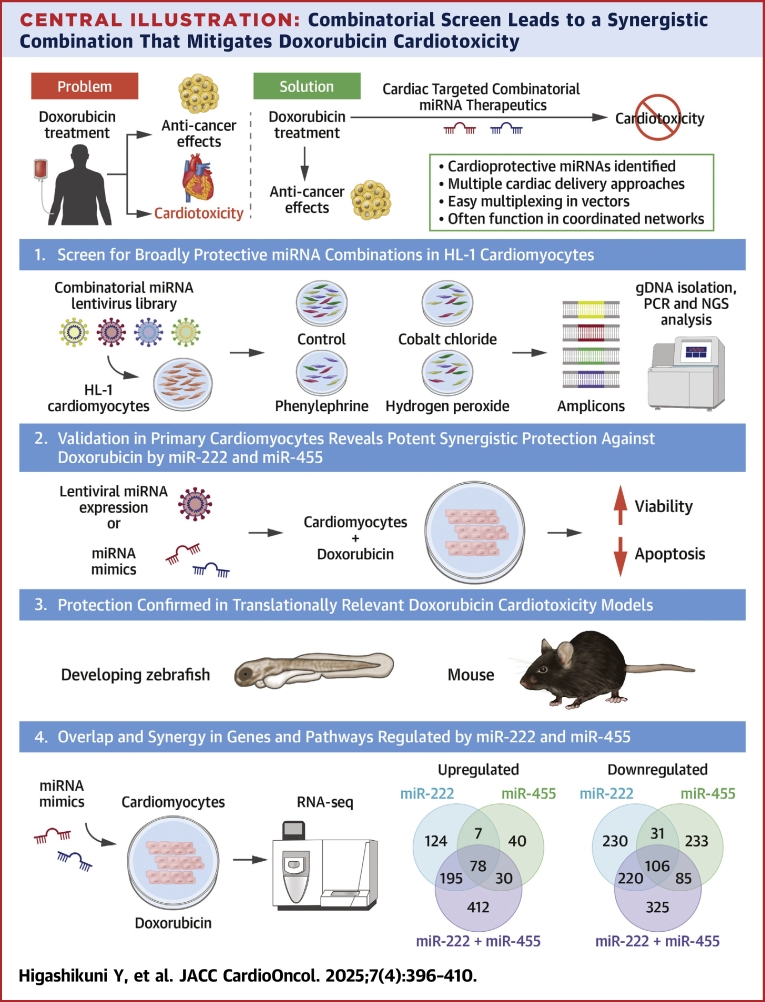
The authors employed massively parallel combinatorial genetic screening to find microRNA (miRNA) combinations that promote cardiomyocyte survival.
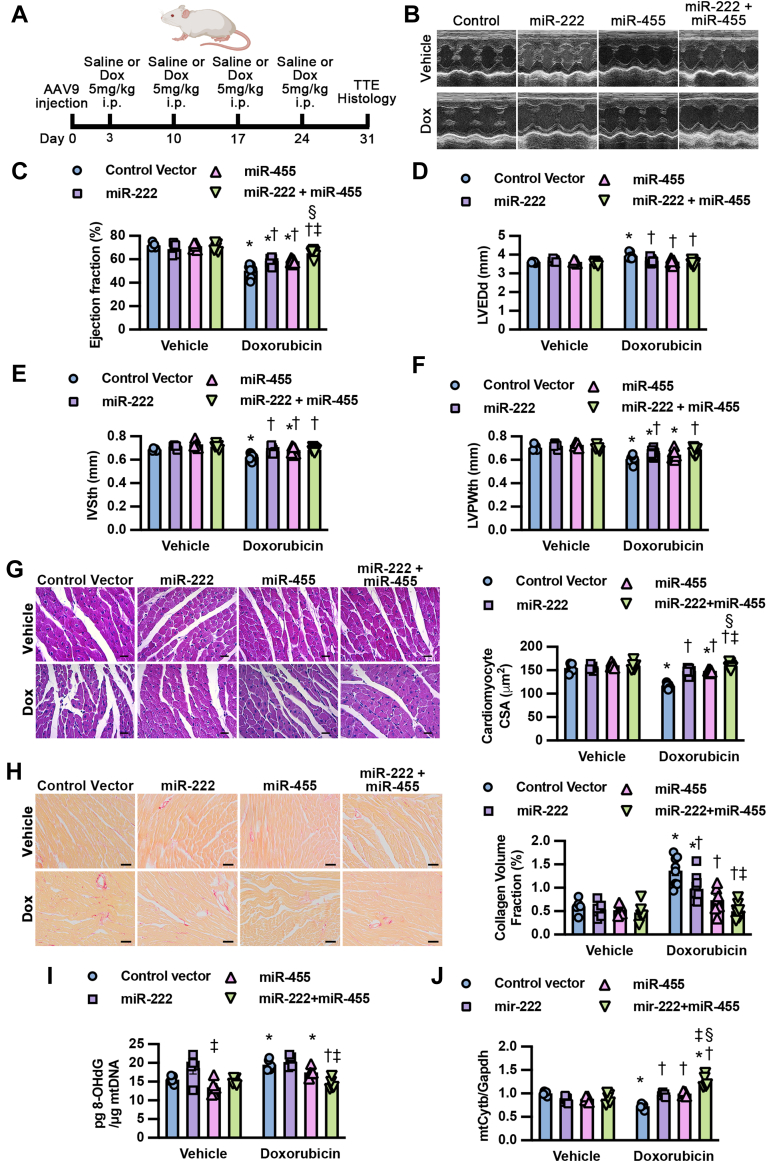
CombiGEM (combinatorial genetics en masse) screening in a cardiomyocyte cell line was followed by validation in the original cell type and screening in primary cardiomyocytes. The top combination was tested in mouse and developing zebrafish models of doxorubicin cardiotoxicity. RNA sequencing provided insight into possible mechanisms.
Multiple miRNA combinations protected cardiomyocytes from doxorubicin in vitro. The most effective (miR-222+miR-455) appeared to act synergistically, and mitigated doxorubicin cardiotoxicity phenotypes in murine and zebrafish in vivo models. RNA sequencing revealed overlapping and synergistic regulation of relevant genes and biological processes in cardiomyocytes, including mitochondrial homeostasis, oxidative stress, muscle contraction, and others.
We identified miR-222 and miR-455 as a combination with potential therapeutic applications for cardioprotection. This study furthers our knowledge of the cardiac effects of miRNAs and their combinations and demonstrates the potential of CombiGEM for cardioprotective combinatorial therapeutic discovery.
心肌细胞丢失发生在急性和慢性心脏损伤中,包括由多柔比星等化疗药物引起的心脏毒性,并导致心力衰竭的发展。迫切需要针对心肌细胞丢失的心脏特异性治疗方法,以预防化疗并发症而不影响化疗效果。
作者采用大规模平行组合基因筛选来寻找促进心肌细胞存活的微小RNA(miRNA)组合。
在心肌细胞系中进行CombiGEM(大规模组合遗传学)筛选,随后在原始细胞类型中进行验证,并在原代心肌细胞中进行筛选。在多柔比星心脏毒性的小鼠和发育中的斑马鱼模型中测试最佳组合。RNA测序为可能的机制提供了深入了解。
多种miRNA组合在体外保护心肌细胞免受多柔比星的损伤。最有效的组合(miR-222+miR-455)似乎具有协同作用,并减轻了小鼠和斑马鱼体内模型中的多柔比星心脏毒性表型。RNA测序揭示了心肌细胞中相关基因和生物学过程的重叠和协同调节,包括线粒体稳态、氧化应激、肌肉收缩等。
我们确定miR-222和miR-455为具有心脏保护潜在治疗应用的组合。本研究进一步加深了我们对miRNA及其组合的心脏效应的认识,并证明了CombiGEM在心脏保护组合治疗发现方面的潜力。