Wei Nan, Mathy René Michael, Chang De-Hua, Loos Martin, Merle Uta, Gauss Annika, Boxberger Monica, Mayer Philipp, Klauss Miriam, Kauczor Hans-Ulrich, Öcal Osman, Wielpütz Mark O
Translational Lung Research Center (TLRC), German Lung Research Center (DZL), University of Heidelberg, Im Neuenheimer Feld 130.3, Heidelberg, 69120, Germany.
Department of Diagnostic and Interventional Radiology, University Hospital of Heidelberg, Im Neuenheimer Feld 420, Heidelberg, 69120, Germany.
CVIR Endovasc. 2025 May 14;8(1):41. doi: 10.1186/s42155-025-00558-7.
Acute superior mesenteric vein thrombosis (ASMVT) is a rare but life-threatening condition associated with high morbidity and mortality. While anticoagulation remains the standard treatment, endovascular therapies such as thrombolysis, thrombectomy, and angioplasty are increasingly utilized in selected cases. However, evidence on their outcomes remains limited. This study retrospectively reports the clinical outcomes of ASMVT patients treated with endovascular combination therapies.
Between August 2019 and May 2024, 12 patients (males = 9; mean age, 52.33 ± 12.51 years) were diagnosed with ASMVT. The study collected comprehensive data on demographic details, presenting symptoms, etiology, treatment modalities, response to treatment, and follow-up outcomes. Computed Tomography (CT) was available from diagnosis, and an average of 6.3 CT scans with a median follow-up of 3 months (IQR: 2-20 months).
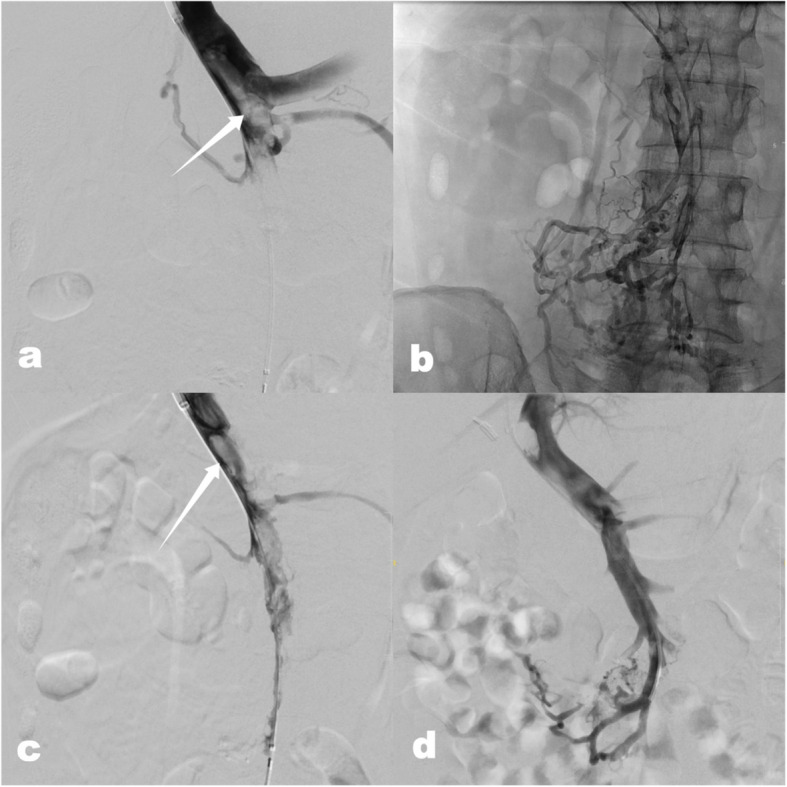
The average time from symptom onset to angiographic treatment initiation was 8.0 ± 4.71 days, preceded by anticoagulation with heparin from the time of diagnosis. Patients were treated with combination therapy involving endovascular thrombolysis, rheolytic thrombectomy, and balloon angioplasty via transjugular (n = 9, 75%) or percutaneous (n = 3, 25%) approaches. Thrombolysis was performed with an average recombinant tissue plasminogen activator (rt-PA) infusion duration of 2.75 ± 1.14 days and a total dose of 61.25 ± 18.48 mg rt-PA. Superior mesenteric vein (SMV) flow was initially restored almost completely in 58.3% and partially in 41.7% of patients. Complications observed were hepatic artery bleeding (n = 2, 16.7%), hepatic arteriovenous fistula (n = 1, 8.3%), hepatic parenchymal bleeding (n = 1, 8.3%), melena (n = 1, 8.3%), and nostril bleeding (n = 1, 8.3%). Two patients experienced worsening symptoms of post-intervention, leading to bowel resection revealing intestinal necrosis. SMV patency was almost complete in 25%, and partially in 25% of patients at follow-up.
Endovascular combination therapy with long-term thrombolysis and thrombectomy in patients with ASMVT demonstrated promising technical outcomes. In view of complications, individual indication for intervention needs to be confirmed in a multidisciplinary team.
急性肠系膜上静脉血栓形成(ASMVT)是一种罕见但危及生命的疾病,具有高发病率和死亡率。虽然抗凝仍然是标准治疗方法,但溶栓、血栓切除术和血管成形术等血管内治疗在特定病例中越来越多地被采用。然而,关于其疗效的证据仍然有限。本研究回顾性报告了接受血管内联合治疗的ASMVT患者的临床结果。
在2019年8月至2024年5月期间,12例患者(男性9例;平均年龄52.33±12.51岁)被诊断为ASMVT。该研究收集了关于人口统计学细节、呈现症状、病因、治疗方式、治疗反应和随访结果的综合数据。从诊断时起可获得计算机断层扫描(CT),平均进行6.3次CT扫描,中位随访时间为3个月(四分位间距:2 - 20个月)。
从症状发作到血管造影治疗开始的平均时间为8.0±4.71天,从诊断时起先用肝素进行抗凝。患者接受了联合治疗,包括通过经颈静脉(n = 9,75%)或经皮(n = 3,25%)途径进行血管内溶栓、旋切血栓切除术和球囊血管成形术。溶栓时重组组织型纤溶酶原激活剂(rt - PA)的平均输注持续时间为2.75±1.14天,rt - PA总剂量为61.25±18.48mg。58.3%的患者肠系膜上静脉(SMV)血流最初几乎完全恢复,41.7%的患者部分恢复。观察到的并发症有肝动脉出血(n = 2,16.7%)、肝动静脉瘘(n = 1,8.3%)、肝实质出血(n = 1,8.3%)、黑便(n = 1,8.3%)和鼻出血(n = 1,8.3%)。2例患者干预后症状恶化,导致肠切除显示肠坏死。随访时,25%的患者SMV通畅几乎完全,25%的患者部分通畅。
ASMVT患者采用长期溶栓和血栓切除术的血管内联合治疗显示出有前景的技术结果。鉴于并发症,需要在多学科团队中确认个体干预指征。