Liu Jianying, Jiang Mengxiao, Chen Xiaoping, Ge Yonglan, Zheng Zongxin, Yang Xia, Zhou Wenhao, Zhang Huiting, Zheng Meichun, Luo Baojia
Department of Colorectal Surgery, State Key Laboratory of Oncology in South China, Guangdong Provincial Clinical Research Center for Cancer, Sun Yat-sen University Cancer Center, Guangzhou, 510060, P.R. China.
Department of Urinary Surgery, State Key Laboratory of Oncology in South China, Guangdong Provincial Clinical Research Center for Cancer, Sun Yat-sen University Cancer Center, Guangzhou, 510060, P.R. China.
World J Surg Oncol. 2025 May 14;23(1):185. doi: 10.1186/s12957-025-03843-w.
Delayed closure of a temporary ileostomy in patients with rectal cancer may cause psychological, physiological, and socioeconomic burdens to patients.
This study aimed to develop and validate a machine learning-based model to predict the delayed ileostomy closure after surgery in patients with rectal cancer.
A retrospective study.
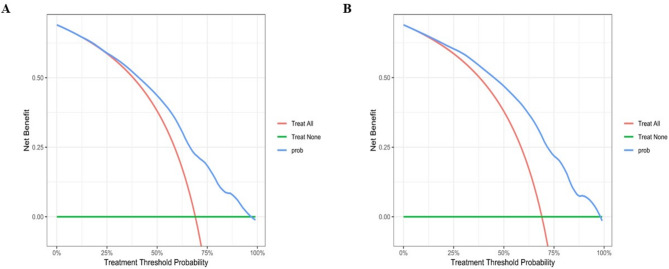
LASSO regression was used for feature screening, and XGBoost was used for machine learning model construction. Model performance was assessed by receiver operating characteristic (ROC) curve analysis, calibration curve analysis, clinical decision curve analysis, sensitivity, specificity, accuracy, and F1 score. The SHAP method was used to interpretate the results of the machine learning model.
A total of 442 rectal cancer patients who received a loop ileostomy were included in this study, and 305 experienced delayed closure (69%). The XGBoost model area under the ROC curve (AUC) of the training set was 0.744 (95% confidence interval [CI]: 0.686-0.806) and of the test set was 0.809 (95% CI: 0.728-0.889). The importance of each variable, in descending order was body mass index (BMI), postoperative chemotherapy, distance from tumor to anal margin, depth of tumor infiltration, neoadjuvant chemoradiotherapy, and anastomotic stenosis. The importance of SHAP variables in the model from high to low was: 'BMI' 'postoperative chemotherapy' 'distance of the tumor from the anal verge' 'depth of tumor infiltration' 'neoadjuvant radiotherapy' 'anastomotic stenosis'.
The XGBoost machine learning model we constructed showed good performance in predicting delayed closure of loop ileostomy in rectal cancer patients. In addition, the SHAP method can help better understand the results of machine learning models.
直肠癌患者临时回肠造口延迟关闭可能给患者带来心理、生理和社会经济负担。
本研究旨在开发并验证一种基于机器学习的模型,以预测直肠癌患者术后回肠造口延迟关闭情况。
一项回顾性研究。
采用LASSO回归进行特征筛选,使用XGBoost构建机器学习模型。通过受试者操作特征(ROC)曲线分析、校准曲线分析、临床决策曲线分析、敏感性、特异性、准确性和F1评分评估模型性能。采用SHAP方法解释机器学习模型的结果。
本研究共纳入442例行袢式回肠造口术的直肠癌患者,其中305例出现延迟关闭(69%)。训练集的XGBoost模型ROC曲线下面积(AUC)为0.744(95%置信区间[CI]:0.686-0.806),测试集为0.809(95%CI:0.728-0.889)。各变量重要性从高到低依次为体重指数(BMI)、术后化疗、肿瘤距肛缘距离、肿瘤浸润深度、新辅助放化疗和吻合口狭窄。模型中SHAP变量重要性从高到低为:“BMI”“术后化疗”“肿瘤距肛缘距离”“肿瘤浸润深度”“新辅助放疗”“吻合口狭窄”。
我们构建的XGBoost机器学习模型在预测直肠癌患者袢式回肠造口延迟关闭方面表现良好。此外,SHAP方法有助于更好地理解机器学习模型的结果。