Zhang Linzixuan, Xiao Ruiqing, Gao Wenhao, Garcia Johnny, Pan Xinyan, Daristotle John L, Forster Timothy, Han Jooli, Chaddah Mehr, Varshney Dhruv, Menon Nandita, McHugh Kevin J, Pedretti Benjamin J, Yeo Jing Ying, Yang Xin, MacDonald Sydney, Langer Robert, Jaklenec Ana
Department of Chemical Engineering, Massachusetts Institute of Technology, Cambridge, MA, 02139, USA.
David H. Koch Institute for Integrative Cancer Research, Massachusetts Institute of Technology, Cambridge, MA, 02139, USA.
Adv Mater. 2025 Aug;37(32):e2501168. doi: 10.1002/adma.202501168. Epub 2025 May 15.
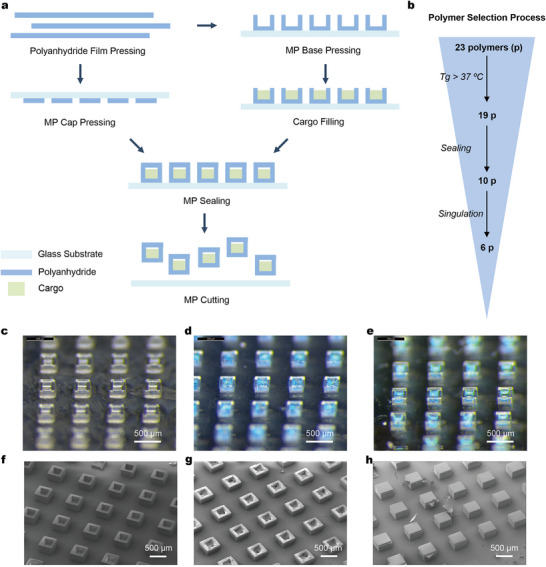
Vaccination remains a critical tool in preventing infectious diseases, yet its effectiveness is undermined by under-immunization, particularly for vaccines requiring multiple doses that patients fail to complete. To address this challenge, the development of single-injection platforms delivering self-boosting vaccines has gained significant attention. Despite some advances, translating these platforms into clinical applications has been limited. In this study, a novel polyanhydride-based polymeric delivery platform is introduced, designed for single-injection self-boosting vaccines, replacing multiple doses. Over 20 polyanhydride polymers are synthesized and screened, ultimately down selecting to 6 for in vitro studies, and 2 for in vivo studies. Using diphtheria toxoid (DT) as a model antigen, programmed pulsatile release with a narrow window is demonstrated, ideal for self-boosting immunization. The platform effectively protects the pH-sensitive antigen before release, achieving recovery rate of 39.7% to 89.7%. The system's tunability is further enhanced by machine learning algorithms, which accurately predict release profiles, confirmed through experimental validation. In vivo studies in a mouse model reveals that the platform induces DT-specific antibody responses comparable to those generated by traditional multi-dose regimens. Collectively, these findings highlight the potential of this platform to deliver various vaccines, offering a potentially promising solution to the global challenge of under-immunization.
疫苗接种仍然是预防传染病的关键工具,但其有效性却因免疫接种不足而受到损害,尤其是对于那些需要多剂接种而患者未能完成全程接种的疫苗。为应对这一挑战,能够提供自我增强疫苗的单注射平台的开发受到了广泛关注。尽管取得了一些进展,但将这些平台转化为临床应用仍很有限。在本研究中,引入了一种新型的基于聚酸酐的聚合物递送平台,该平台专为单注射自我增强疫苗设计,可替代多剂接种。合成并筛选了20多种聚酸酐聚合物,最终筛选出6种用于体外研究,2种用于体内研究。以白喉类毒素(DT)作为模型抗原,证明了具有窄窗口的程序性脉冲释放,这对于自我增强免疫是理想的。该平台在释放前有效保护了对pH敏感的抗原,回收率达到39.7%至89.7%。机器学习算法进一步增强了该系统的可调性,该算法能够准确预测释放曲线,并通过实验验证得到了证实。在小鼠模型中的体内研究表明,该平台诱导的DT特异性抗体反应与传统多剂接种方案产生的反应相当。总的来说,这些发现突出了该平台递送各种疫苗的潜力,为全球免疫接种不足的挑战提供了一个潜在的有前景的解决方案。