Mo Jingjun, Sikandar Asfandyar, Zhao Haowen, Bashiri Ghader, Huo Liujie, Empting Martin, Müller Rolf, Fu Chengzhang
Helmholtz Institute for Pharmaceutical Research Saarland (HIPS), Helmholtz Centre for Infection Research (HZI), Saarbrücken, Germany.
Helmholtz International Lab for Anti-Infectives, Helmholtz Center for Infection Research, Braunschweig, Germany.
Nat Commun. 2025 May 15;16(1):4531. doi: 10.1038/s41467-025-59785-0.
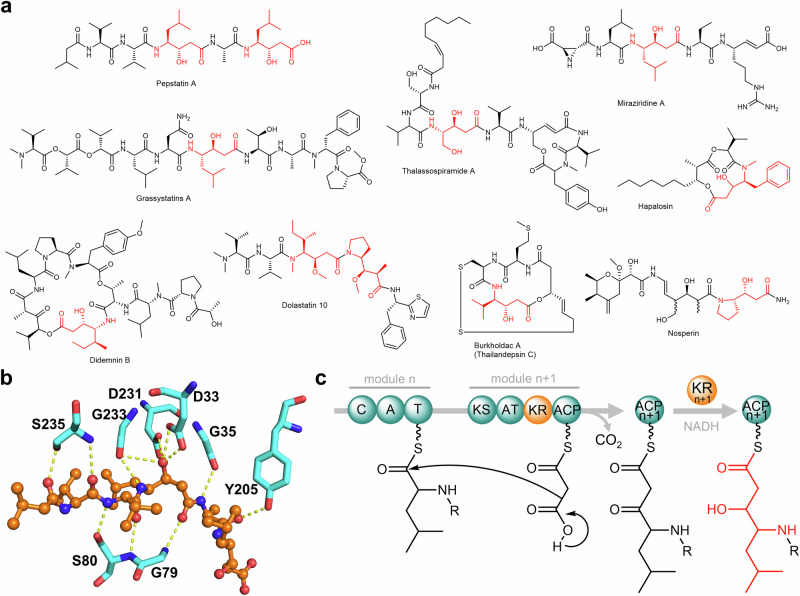
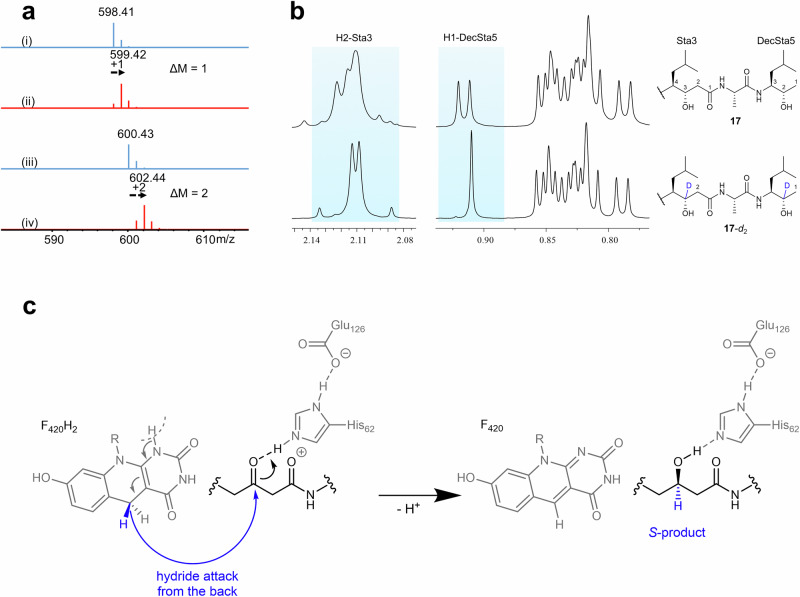
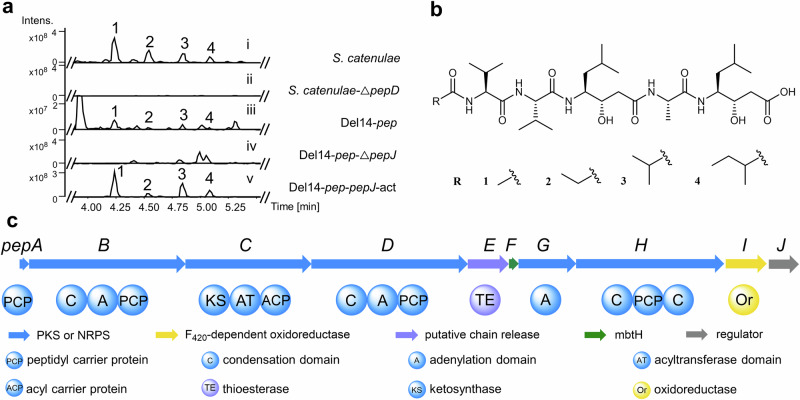
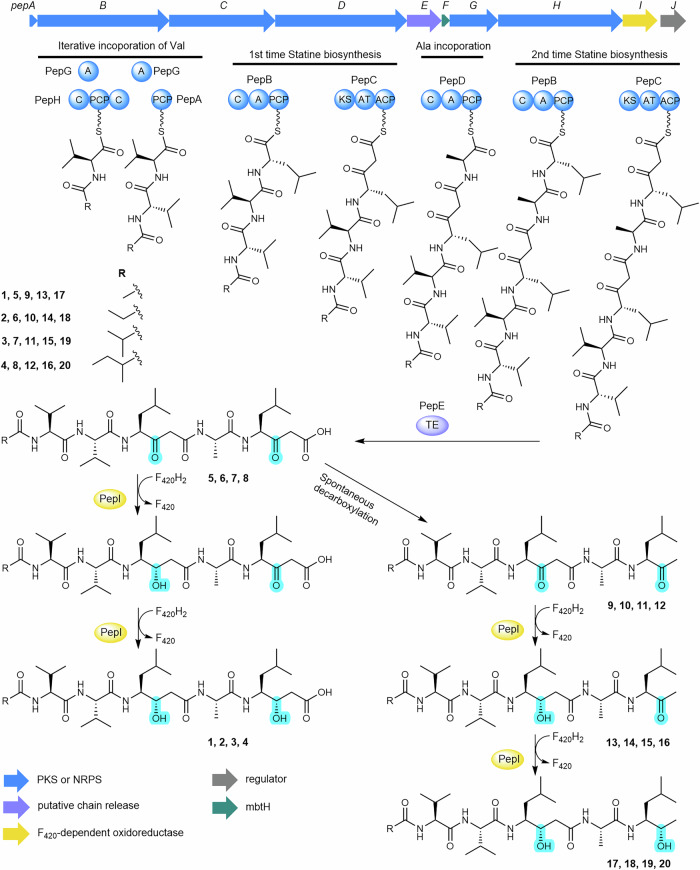
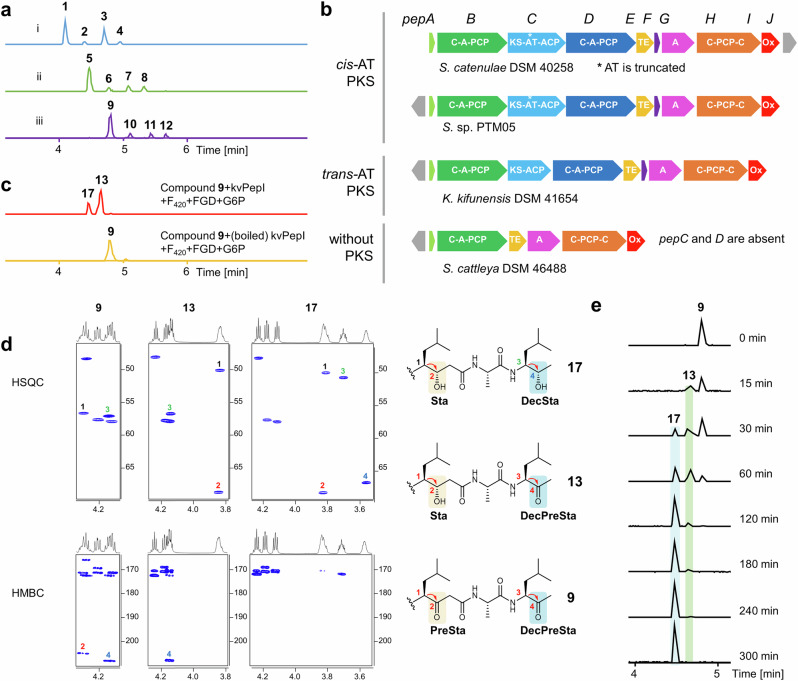
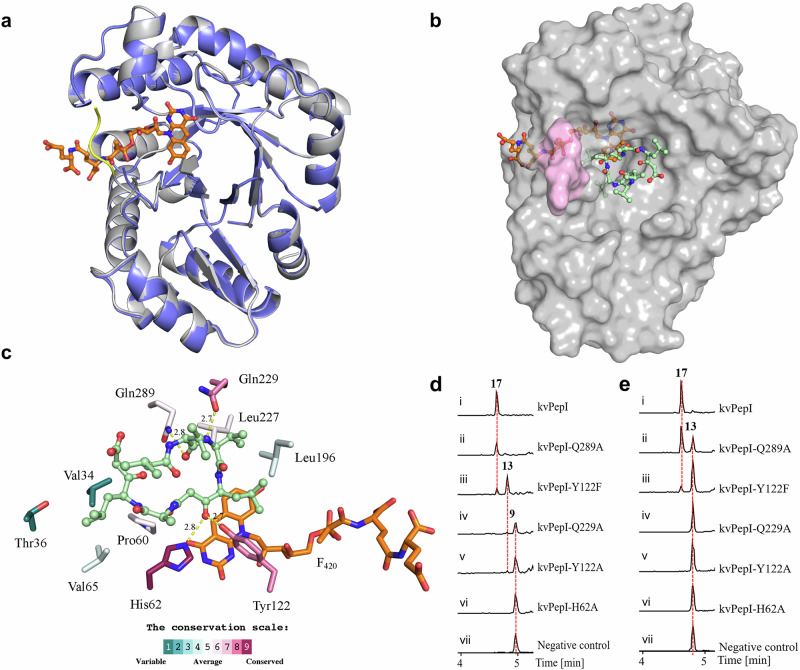
Pepstatins are potent inhibitors of aspartic proteases, featuring two statine residues crucial for target binding. However, the biosynthesis of pepstatins, especially their statine substructure, remains elusive. Here, we discover and characterize an unconventional gene cluster responsible for pepstatin biosynthesis, comprising discrete nonribosomal peptide synthetase and polyketide synthase genes, highlighting its trans-acting and iterative nature. Central to this pathway is PepI, an FH-dependent oxidoreductase. The biochemical characterization of PepI reveals its role in the tandem reduction of β-keto pepstatin intermediates. PepI first catalyzes the formation of the central statine, then produces the C-terminal statine moiety. The post-assembly-line formation of statine by PepI contrasts with the previously hypothesized biosynthesis involving polyketide synthase ketoreductase domains. Structural studies, site-directed mutagenesis, and deuterium-labeled enzyme assays probe the mechanism of FH-dependent oxidoreductases and identify critical residues. Our findings uncover a unique statine biosynthetic pathway employing the only known iterative FH-dependent oxidoreductase to date.
胃蛋白酶抑制剂是天冬氨酸蛋白酶的强效抑制剂,具有两个对靶点结合至关重要的静息素残基。然而,胃蛋白酶抑制剂的生物合成,尤其是其静息素亚结构,仍然不清楚。在这里,我们发现并表征了一个负责胃蛋白酶抑制剂生物合成的非常规基因簇,它由离散的非核糖体肽合成酶和聚酮合酶基因组成,突出了其反式作用和迭代性质。该途径的核心是PepI,一种依赖黄素腺嘌呤二核苷酸(FH)的氧化还原酶。PepI的生化特性揭示了它在β-酮胃蛋白酶抑制剂中间体的串联还原中的作用。PepI首先催化中心静息素的形成,然后产生C端静息素部分。PepI在装配线后形成静息素与先前假设的涉及聚酮合酶酮还原酶结构域的生物合成形成对比。结构研究、定点诱变和氘标记酶分析探究了依赖FH的氧化还原酶的机制,并确定了关键残基。我们的发现揭示了一条独特的静息素生物合成途径,该途径采用了迄今为止唯一已知的迭代依赖FH的氧化还原酶。