Dobrow Mark J, Bruce Eric, Simpson Keisha, Pettifer Glenn
Institute of Health Policy, Management and Evaluation, Dalla Lana School of Public Health, University of Toronto, 155 College Street, Suite 425, Toronto, ON, M5T 3M6, Canada.
Accessing Centre for Expertise, 155 College Street, Suite 425, Toronto, ON, M5T 3M6, Canada.
BMC Oral Health. 2025 May 15;25(1):734. doi: 10.1186/s12903-025-06092-1.
This study conducted a geospatial analysis of the distribution of the dental hygienist workforce relative to the distribution of the population in Ontario, Canada, aiming to address workforce imbalances and inform regional and international workforce planning.
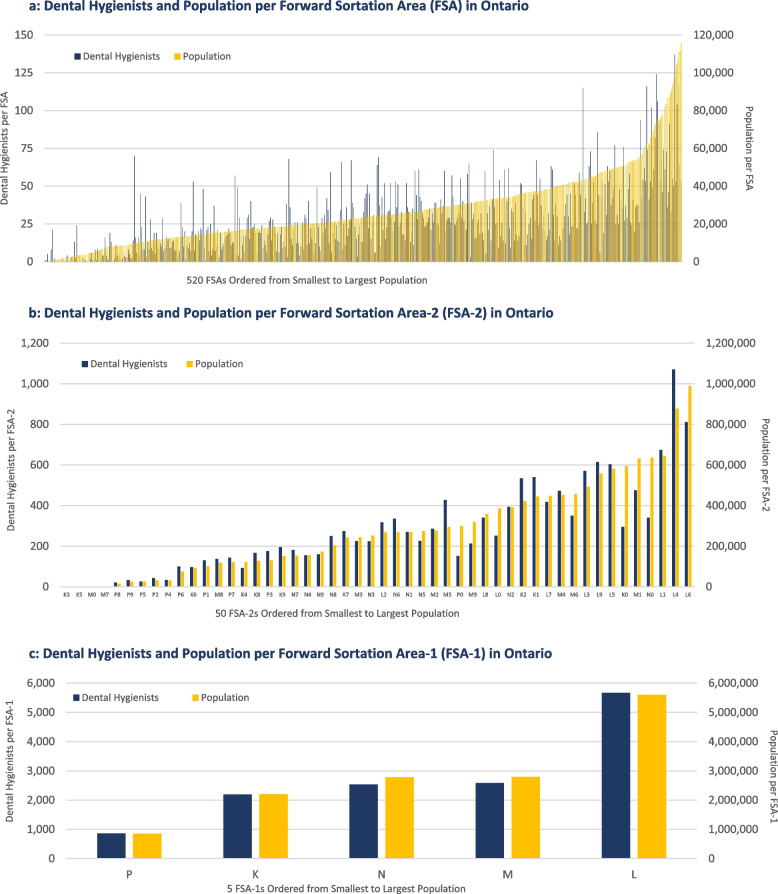
Geospatial analysis techniques were employed to examine the dental hygienist workforce distribution using anonymized datasets from the College of Dental Hygienists of Ontario (the professional regulatory body) and the Canadian census. The data were linked using the forward sortation area (FSA) component of Canadian postal codes, covering 520 FSAs across Ontario. Analyses were conducted at three levels, based on different aggregations of postal code data.
The study found significant variations in the distribution of dental hygienists across Ontario. The analysis revealed pockets of high dental hygienist density, mostly in urban areas, and areas with low dental hygienist rates, especially in rural and remote locations. The overall provincial rate was 97 dental hygienists per 100,000 population, with variation across the 520 FSAs, from zero to 20,000 dental hygienists per 100,000 population (or zero to 739 dental hygienists per 100,000 population if five outlier FSAs were removed).
The study underscores the complexity of dental hygienist workforce distribution in Ontario, revealing significant geographical disparities that suggest areas of both oversupply and undersupply. These insights provide actionable guidance for workforce policies and regulatory strategies, such as targeted incentives and public health initiatives, to address the mismatch between workforce supply and population needs. The findings highlight the importance of regular geospatial analyses to track changes in workforce distribution over time. The rigorous methodological approach and comprehensive evaluation of potential limitations offer valuable guidance for similar analyses in other jurisdictions. By providing a detailed framework and insights that extend beyond Ontario, this study contributes to the global understanding of dental hygienist workforce dynamics and supports the development of informed policies on a broader scale.
本研究对加拿大安大略省口腔卫生工作者劳动力分布与人口分布进行了地理空间分析,旨在解决劳动力失衡问题,并为区域和国际劳动力规划提供参考。
运用地理空间分析技术,利用安大略省口腔卫生工作者学院(专业监管机构)的匿名数据集和加拿大人口普查数据,对口腔卫生工作者劳动力分布进行研究。数据通过加拿大邮政编码的前向排序区域(FSA)部分进行关联,涵盖安大略省的520个FSA。基于邮政编码数据的不同汇总方式,在三个层面进行了分析。
研究发现安大略省口腔卫生工作者的分布存在显著差异。分析显示,口腔卫生工作者密度高的区域主要集中在城市地区,而口腔卫生工作者比例低的区域则集中在农村和偏远地区。全省总体比例为每10万人口中有97名口腔卫生工作者,520个FSA之间存在差异,每10万人口中口腔卫生工作者数量从0到20000不等(若剔除5个异常FSA,则每10万人口中口腔卫生工作者数量从0到739不等)。
该研究强调了安大略省口腔卫生工作者劳动力分布的复杂性,揭示了显著的地理差异,表明存在供应过剩和供应不足的地区。这些见解为劳动力政策和监管策略提供了可操作的指导,如针对性激励措施和公共卫生举措,以解决劳动力供应与人口需求之间的不匹配问题。研究结果凸显了定期进行地理空间分析以跟踪劳动力分布随时间变化的重要性。严谨的方法和对潜在局限性的全面评估为其他司法管辖区的类似分析提供了有价值的指导。通过提供一个详细的框架和超越安大略省范围的见解,本研究有助于全球对口腔卫生工作者劳动力动态的理解,并支持在更广泛范围内制定明智的政策。