Mugyenyi Godfrey R, Tumuhimbise Wilson, Ntayi Joseph M, Byamugisha Josaphat K, Musimenta Angella, Kayondo Musa, Ngonzi Joseph, Tornes Yarine, Atukunda Esther C
Obstetrics and Gynecology, Mbarara University of Science and Technology, Mbarara, UGA.
Computing and Informatics, Mbarara University of Science and Technology, Mbarara, UGA.
Cureus. 2025 Apr 15;17(4):e82295. doi: 10.7759/cureus.82295. eCollection 2025 Apr.
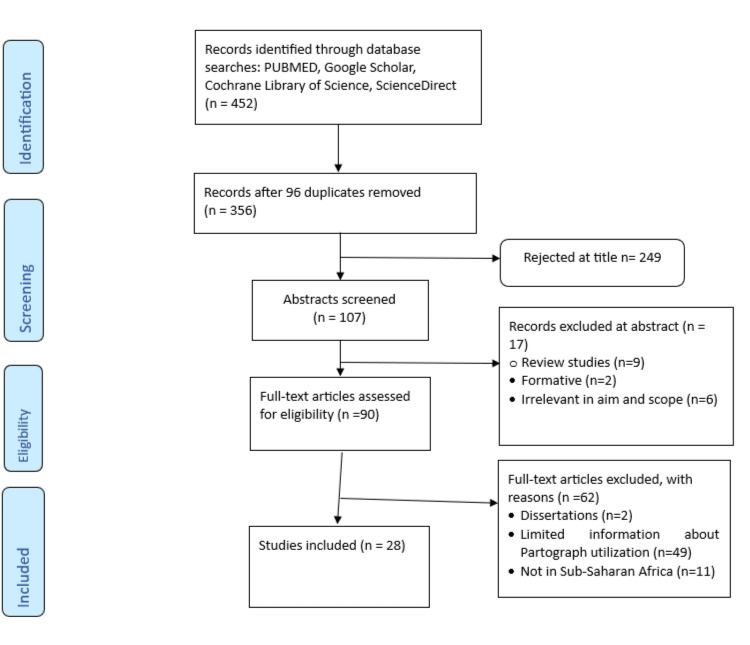
Despite decades of healthcare provider training and investment, rates of utilization and capacity to appropriately plot the partograph and use it to make critical decisions remain sub-optimal in Sub-Saharan Africa. The objective of this review was to synthesize evidence of existing challenges and opportunities of partograph utilization in labor monitoring in Sub-Saharan Africa from existing literature. PUBMED, Cochrane Library of Trials, Google Scholar, and ScienceDirect databases published between January 1, 2013, and July 31, 2023, for studies reporting opportunities and challenges of utilizing the partograph in labor monitoring in Sub-Saharan Africa, were searched. Preferred Reporting Items for Systematic Reviews and Meta-Analyses guided the identification of eligible studies. We utilized a Consolidated Framework for Implementation Research to interpret findings. The review protocol was registered under PROSPERO-CRD42023452882. Twenty-eight high-quality studies identified from a total of 452 in eight countries in Sub-Saharan Africa were analyzed in this review. Opportunities identified included 1) the partograph's uncontested potential to reduce maternal and neonatal mortality facilitated by good support supervision, formal and on-the-job training, active mentorships, and ongoing supervision, and the availability of enabling policies, standards, and protocols on partograph use; 2) the availability of partographs in health facilities. Gaps and challenges identified included 1) lack of inadequate training and tool complexity, 2) availability of different labor monitoring tools other than the partograph, 3) lack of motivation and feedback, 4) unavailability of the partograph in some health facilities, 5) shortage of staff in busy facilities, 6) lack of support supervision, 7) lack of protocols, 8) inappropriate motivation leading to 9) lack of commitment, negative attitude, negligence, careless partograph completion, or non-use. The challenges, opportunities, and lessons learned from this review on partograph utilization in labor monitoring will help develop suitable implementation strategies to guide the introduction and scale-up of the labor care guide in Sub-Saharan Africa if we are to avoid similar challenges.
尽管在医疗服务提供者培训和投资方面投入了数十年时间,但在撒哈拉以南非洲地区,正确绘制产程图并利用其做出关键决策的利用率和能力仍未达到最佳水平。本综述的目的是从现有文献中综合撒哈拉以南非洲地区在产程图用于产程监测方面存在的挑战和机遇的证据。检索了2013年1月1日至2023年7月31日期间在PUBMED、Cochrane试验库、谷歌学术和科学Direct数据库中发表的关于撒哈拉以南非洲地区产程图用于产程监测的机遇和挑战的研究。系统评价和Meta分析的首选报告项目指导了符合条件的研究的识别。我们利用实施研究的综合框架来解释研究结果。该综述方案已在PROSPERO-CRD42023452882下注册。本综述分析了从撒哈拉以南非洲8个国家的452项研究中确定的28项高质量研究。确定的机遇包括:1)在良好的支持监督、正规和在职培训、积极的指导和持续监督以及有关于产程图使用的扶持政策、标准和规程的情况下,产程图在降低孕产妇和新生儿死亡率方面具有无可争议的潜力;2)医疗机构中有产程图。确定的差距和挑战包括:1)培训不足和工具复杂;2)除产程图外还有其他不同的产程监测工具;3)缺乏动力和反馈;4)一些医疗机构没有产程图;5)繁忙机构人员短缺;6)缺乏支持监督;7)缺乏规程;8)动机不当导致9)缺乏承诺、消极态度、疏忽、产程图填写粗心或不使用。如果要避免类似挑战,本次关于产程图用于产程监测的综述中吸取的挑战、机遇和经验教训将有助于制定合适的实施策略,以指导在撒哈拉以南非洲地区引入和推广产程护理指南。