Blasberg Jost Ulrich, Kanske Philipp, Engert Veronika
Institute of Psychosocial Medicine, Psychotherapy and Psychooncology, Jena University Hospital, Friedrich-Schiller University, Jena, Germany.
Clinical Psychology and Behavioral Neuroscience, Faculty of Psychology, Technische Universität Dresden, Dresden, Germany.
Commun Psychol. 2025 May 16;3(1):78. doi: 10.1038/s44271-025-00260-3.
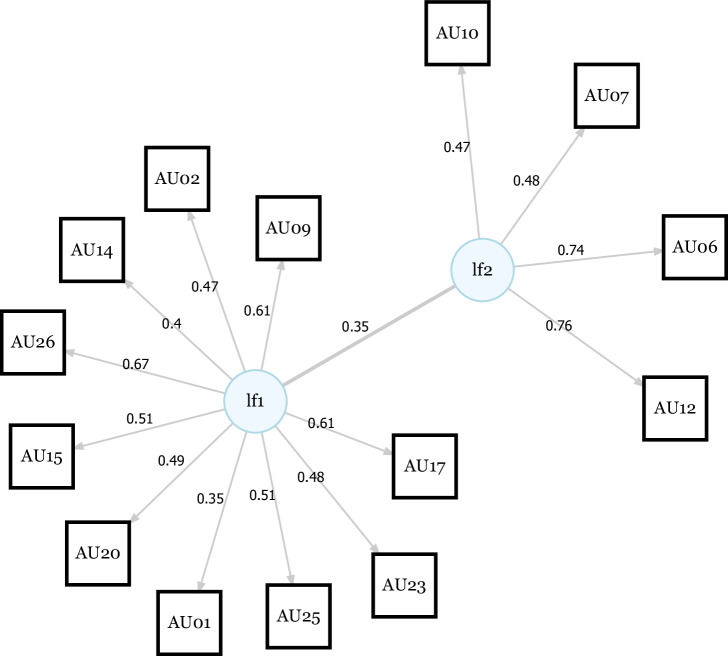
Empathic stress, the spontaneous reproduction of psychosocial stress by mere observation, has been shown to occur between strangers, romantic partners and in mother-child dyads. However, the mechanisms by which stress is transmitted have yet to be understood. We investigated whether facial mimicry modulates the transmission of psychosocial stress. Adolescents (13-16 years old) observed their mothers or fathers (N = 77) undergo a standardized laboratory stressor. Parents' and adolescents' faces were videotaped during the stress task and dyads simultaneously provided multiple samples of subjective stress, heart rate, heart rate variability (HRV), and salivary cortisol. The degree to which adolescents mimicked their parents' facial expressions was calculated in a multi-step procedure based on windowed-cross-lagged-regressions. To integrate the correlational structure of mimicry across different facial action units (AU), an exploratory factor analysis was employed. The solution revealed a two-factor model, constructed of a positive latent factor subsuming mimicked action units associated with the act of smiling and a negative latent factor, subsuming mimicked action units used for various negative emotions. None of the stress markers were significantly associated with the extracted latent factors indexing mimicry between parents and adolescents, providing no statistically significant evidence for an association between facial mimicry and stress-transmission in the parent-adolescent dyad. Bayes Factors generally indicated moderate evidence for a lack of association with the positive and anecdotal evidence for a lack of association with negative latent mimicry factors. In conclusion, our approach to video-based mimicry calculation showed promising results in that mimicry of positive and negative emotions could be detected, albeit no evidence for a link to actual empathic stress transmission in the laboratory was found.
共情应激,即仅通过观察就自发重现心理社会应激,已被证明会在陌生人、浪漫伴侣以及母婴二元组中出现。然而,应激传播的机制尚未明了。我们研究了面部模仿是否会调节心理社会应激的传播。青少年(13 - 16岁)观察他们的母亲或父亲(N = 77)接受标准化的实验室应激源。在应激任务期间,对父母和青少年的面部进行录像,并且二元组同时提供多个主观应激、心率、心率变异性(HRV)和唾液皮质醇样本。基于窗口交叉滞后回归的多步骤程序计算青少年模仿父母面部表情的程度。为了整合不同面部动作单元(AU)的模仿相关结构,采用了探索性因素分析。结果揭示了一个双因素模型,由一个积极潜在因素构成,该因素包含与微笑行为相关的模仿动作单元,以及一个消极潜在因素,包含用于各种负面情绪的模仿动作单元。没有一个应激指标与提取的索引父母与青少年之间模仿的潜在因素显著相关,没有提供关于父母 - 青少年二元组中面部模仿与应激传播之间关联的统计学显著证据。贝叶斯因子总体上表明缺乏与积极因素关联的中等证据以及缺乏与消极潜在模仿因素关联的轶事证据。总之,我们基于视频的模仿计算方法显示出有前景的结果,即可以检测到积极和消极情绪的模仿,尽管在实验室中未发现与实际共情应激传播存在联系的证据。