• 文献检索
  • 文档翻译
  • 深度研究
  • 学术资讯
  • Suppr Zotero 插件Zotero 插件
  • 邀请有礼
  • 套餐&价格
  • 历史记录
应用&插件
Suppr Zotero 插件Zotero 插件浏览器插件Mac 客户端Windows 客户端微信小程序
定价
高级版会员购买积分包购买API积分包
服务
文献检索文档翻译深度研究API 文档MCP 服务
关于我们
关于 Suppr公司介绍联系我们用户协议隐私条款
关注我们

Suppr 超能文献

核心技术专利:CN118964589B侵权必究
粤ICP备2023148730 号-1Suppr @ 2026

文献检索

告别复杂PubMed语法,用中文像聊天一样搜索,搜遍4000万医学文献。AI智能推荐,让科研检索更轻松。

立即免费搜索

文件翻译

保留排版,准确专业,支持PDF/Word/PPT等文件格式,支持 12+语言互译。

免费翻译文档

深度研究

AI帮你快速写综述,25分钟生成高质量综述,智能提取关键信息,辅助科研写作。

立即免费体验

城市微观尺度建成环境对心血管疾病的时空影响。

Spatiotemporal effects of urban micro-scale built environment on cardiovascular diseases.

作者信息

Liang Jinlong, Deng Shuguang, Yang Heping, Zhu Shuyan, Zheng Rui

机构信息

School of Geographical and Planning, Nanning Normal University, No.508 Xinning Road, Wuming District, Nanning, 530100, Guangxi, China.

Neurovascular Intervention Center, Guangxi Ethnic Hospital, Nanning, 530022, Guangxi, China.

出版信息

Sci Rep. 2025 May 17;15(1):17193. doi: 10.1038/s41598-025-02603-w.

DOI:10.1038/s41598-025-02603-w
PMID:40382476
原文链接:https://pmc.ncbi.nlm.nih.gov/articles/PMC12085694/
Abstract

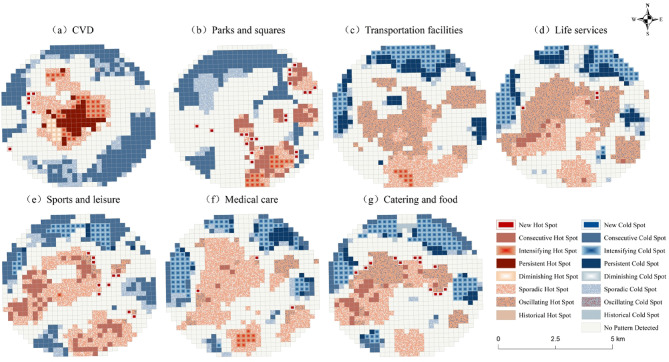
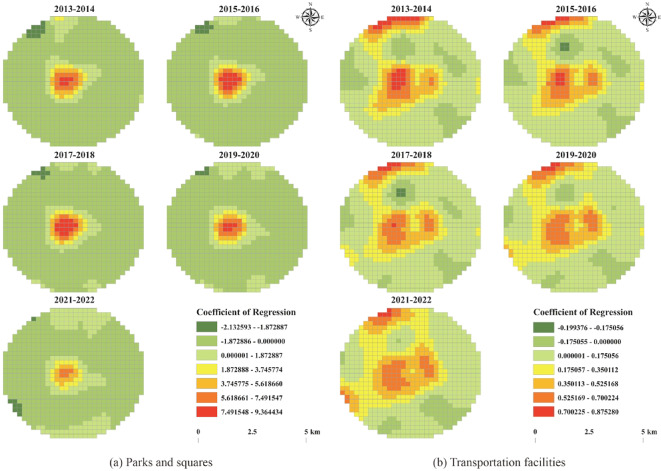
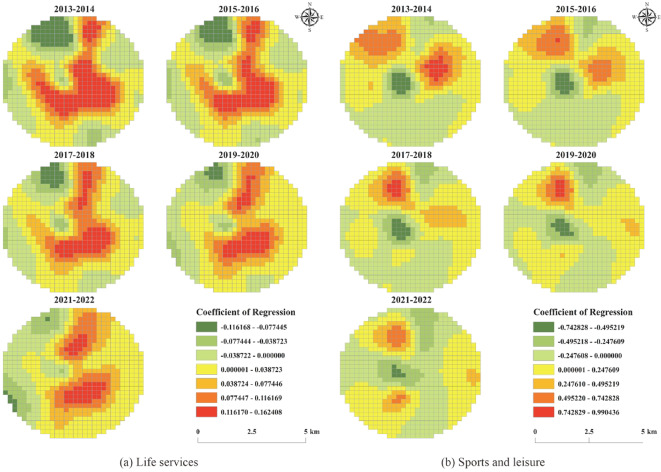
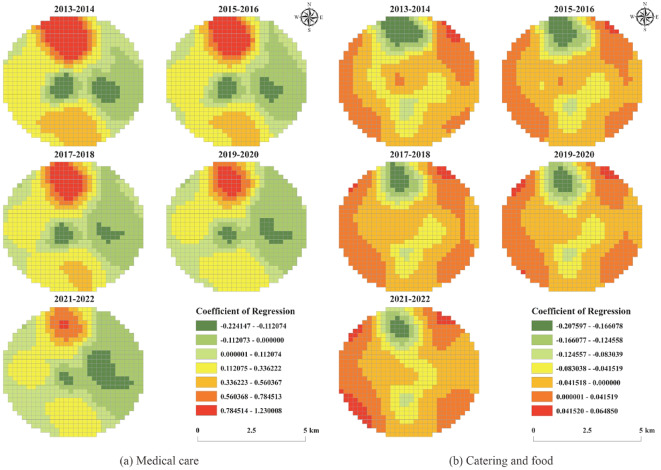
Cardiovascular disease (CVD) has become a significant threat to the health of urban populations, and the urban built environment, as a key determinant of cardiovascular health, affects residents through various dimensions including physical activity, urban pollution, mental health, and dietary habits. However, existing research predominantly focuses on macro-level geographic scales, with limited exploration of the potential impact of intra-urban microenvironments on CVD. This study focuses on the central area of Nanning, China, as the case study area, employing methods such as global spatial autocorrelation analysis, emerging spatiotemporal hotspot analysis, and spatiotemporal geographically weighted regression (GTWR) analysis to comprehensively examine the spatiotemporal associations between CVD and built environment elements. The results reveal that CVD and built environment elements exhibit significant spatial clustering and correlations, with all variables demonstrating spatial clustering patterns. Six built environment factors-parks and squares, transportation facilities, life services, sports and leisure, medical care, and Catering and food-are spatially associated with disease incidence. The influence of built environment factors on CVD varies and exhibits pronounced spatiotemporal heterogeneity, with the greatest coefficient fluctuation observed for parks and squares, and the smallest for catering services. Parks and squares generally contribute positively to cardiovascular health by lowering disease risk across most areas, although in the central zone, dense population and heavy traffic lead to a positive association with disease incidence. Fortunately, this adverse impact has been gradually mitigated through ongoing improvements in urban green space planning; transportation facilities increases disease risk due to associated noise and air pollution, with particularly strong effects observed in the central region. However, the implementation of green transportation initiatives has effectively mitigated this negative impact; life services show a positive association with CVD, but their diverse types and spatially balanced distribution render their impact relatively minor; sports and leisure are associated with reduced disease risk in the central part of the study area, but in the northeast and northwest, they exhibit a positive association due to population dispersion. As residents' usage habits become more consistent, the associated impacts are gradually stabilizing; medical care help reduce disease risk in the central and eastern regions, but show a positive correlation in the northern area due to patient overflow and referral patterns. With the more equitable distribution of healthcare resources, this relationship is gradually stabilizing; catering and food are positively associated with CVD, but the effect is relatively small and spatially balanced, likely due to their widespread and uniform distribution. These findings offer valuable case-based evidence for urban planning and public health policymaking, thereby contributing to the construction and advancement of healthy cities.
https://cdn.ncbi.nlm.nih.gov/pmc/blobs/a0c1/12085694/8e6e2aaac310/41598_2025_2603_Fig5_HTML.jpg
https://cdn.ncbi.nlm.nih.gov/pmc/blobs/a0c1/12085694/23e53af7170e/41598_2025_2603_Fig1_HTML.jpg
https://cdn.ncbi.nlm.nih.gov/pmc/blobs/a0c1/12085694/a9f97bd704b8/41598_2025_2603_Fig2_HTML.jpg
https://cdn.ncbi.nlm.nih.gov/pmc/blobs/a0c1/12085694/d6d7e7098580/41598_2025_2603_Fig3_HTML.jpg
https://cdn.ncbi.nlm.nih.gov/pmc/blobs/a0c1/12085694/f7f4f80d994f/41598_2025_2603_Fig4_HTML.jpg
https://cdn.ncbi.nlm.nih.gov/pmc/blobs/a0c1/12085694/8e6e2aaac310/41598_2025_2603_Fig5_HTML.jpg
https://cdn.ncbi.nlm.nih.gov/pmc/blobs/a0c1/12085694/23e53af7170e/41598_2025_2603_Fig1_HTML.jpg
https://cdn.ncbi.nlm.nih.gov/pmc/blobs/a0c1/12085694/a9f97bd704b8/41598_2025_2603_Fig2_HTML.jpg
https://cdn.ncbi.nlm.nih.gov/pmc/blobs/a0c1/12085694/d6d7e7098580/41598_2025_2603_Fig3_HTML.jpg
https://cdn.ncbi.nlm.nih.gov/pmc/blobs/a0c1/12085694/f7f4f80d994f/41598_2025_2603_Fig4_HTML.jpg
https://cdn.ncbi.nlm.nih.gov/pmc/blobs/a0c1/12085694/8e6e2aaac310/41598_2025_2603_Fig5_HTML.jpg
摘要

心血管疾病(CVD)已成为城市人口健康的重大威胁,而城市建成环境作为心血管健康的关键决定因素,通过身体活动、城市污染、心理健康和饮食习惯等多个维度影响居民。然而,现有研究主要集中在宏观地理尺度上,对城市内部微环境对心血管疾病的潜在影响探索有限。本研究聚焦于中国南宁市的中心区域作为案例研究区域,采用全局空间自相关分析、新兴时空热点分析和时空地理加权回归(GTWR)分析等方法,全面考察心血管疾病与建成环境要素之间的时空关联。结果表明,心血管疾病与建成环境要素呈现出显著的空间聚类和相关性,所有变量均表现出空间聚类模式。六个建成环境因素——公园和广场、交通设施、生活服务、体育休闲、医疗保健以及餐饮食品——与疾病发病率存在空间关联。建成环境因素对心血管疾病的影响各不相同,呈现出明显的时空异质性,其中公园和广场的系数波动最大,餐饮服务的系数波动最小。公园和广场总体上通过降低大多数地区的疾病风险对心血管健康产生积极影响,尽管在中心区域,人口密集和交通繁忙导致其与疾病发病率呈正相关。幸运的是,通过不断改进城市绿地规划,这种不利影响已逐渐得到缓解;交通设施由于相关的噪音和空气污染会增加疾病风险,在中心区域尤为明显。然而,绿色交通倡议的实施有效地减轻了这种负面影响;生活服务与心血管疾病呈正相关,但其类型多样且空间分布均衡,因此影响相对较小;体育休闲在研究区域中部与疾病风险降低相关,但在东北部和西北部,由于人口分散,它们呈现出正相关。随着居民使用习惯愈发一致,相关影响正逐渐趋于稳定;医疗保健在中部和东部地区有助于降低疾病风险,但在北部地区由于患者溢出和转诊模式呈现正相关。随着医疗资源分配更加公平,这种关系正逐渐趋于稳定;餐饮食品与心血管疾病呈正相关,但其影响相对较小且在空间上分布均衡,这可能是由于它们分布广泛且均匀。这些发现为城市规划和公共卫生政策制定提供了宝贵的基于案例的证据,从而有助于健康城市的建设和发展。

相似文献

1
Spatiotemporal effects of urban micro-scale built environment on cardiovascular diseases.城市微观尺度建成环境对心血管疾病的时空影响。
Sci Rep. 2025 May 17;15(1):17193. doi: 10.1038/s41598-025-02603-w.
2
Spatial analysis of the impact of urban built environment on cardiovascular diseases: a case study in Xixiangtang, China.城市建成环境对心血管疾病影响的空间分析:以中国西乡塘为例。
BMC Public Health. 2024 Aug 31;24(1):2368. doi: 10.1186/s12889-024-19884-x.
3
Social Susceptibility to Multiple Air Pollutants in Cardiovascular Disease.社会对心血管疾病多种空气污染物的易感性。
Res Rep Health Eff Inst. 2021 Jul;2021(206):1-71.
4
Urban built environment and its impact on university students' loneliness: a mechanistic study.城市建成环境及其对大学生孤独感的影响:一项机制性研究。
Front Public Health. 2025 Mar 13;13:1514820. doi: 10.3389/fpubh.2025.1514820. eCollection 2025.
5
Research on the Vitality Evaluation of Parks and Squares in Medium-Sized Chinese Cities from the Perspective of Urban Functional Areas.从中观城市功能区视角研究城市公园广场活力
Int J Environ Res Public Health. 2022 Nov 18;19(22):15238. doi: 10.3390/ijerph192215238.
6
Spatial scale analysis for the relationships between the built environment and cardiovascular disease based on multi-source data.基于多源数据的建筑环境与心血管疾病关系的空间尺度分析。
Health Place. 2023 Sep;83:103048. doi: 10.1016/j.healthplace.2023.103048. Epub 2023 Jun 21.
7
Cardiovascular diseases in middle aged and older adults in China: the joint effects and mediation of different types of physical exercise and neighborhood greenness and walkability.中国中老年人心血管疾病:不同类型的身体活动与邻里绿化和可步行性的联合作用及中介作用。
Environ Res. 2018 Nov;167:175-183. doi: 10.1016/j.envres.2018.07.003. Epub 2018 Jul 3.
8
The Minderoo-Monaco Commission on Plastics and Human Health.美诺集团-摩纳哥基金会塑料与人体健康委员会
Ann Glob Health. 2023 Mar 21;89(1):23. doi: 10.5334/aogh.4056. eCollection 2023.
9
Spatial and temporal dynamics of urban heat environment at the township scale: A case study in Jinan city, China.乡镇尺度下城市热环境的时空动态:以中国济南市为例
PLoS One. 2024 Sep 16;19(9):e0307711. doi: 10.1371/journal.pone.0307711. eCollection 2024.
10
Impact of the Built Environment on Residents' Health: Evidence from the China Labor Dynamics Survey in 2016.建成环境对居民健康的影响:来自 2016 年中国劳动力动态调查的证据。
J Environ Public Health. 2023 Feb 1;2023:3414849. doi: 10.1155/2023/3414849. eCollection 2023.

本文引用的文献

1
Built Environment and Cardiovascular Diseases - Insights from a Global Review.建筑环境与心血管疾病——全球综述的见解
Curr Atheroscler Rep. 2025 Mar 5;27(1):36. doi: 10.1007/s11883-025-01282-2.
2
Spatial analysis of the impact of urban built environment on cardiovascular diseases: a case study in Xixiangtang, China.城市建成环境对心血管疾病影响的空间分析:以中国西乡塘为例。
BMC Public Health. 2024 Aug 31;24(1):2368. doi: 10.1186/s12889-024-19884-x.
3
Associations of Urban Blue and Green Spaces With Coronary Artery Calcification in Black Individuals and Disadvantaged Neighborhoods.
城市蓝绿空间与黑人个体和贫困社区冠状动脉钙化的关联。
Circulation. 2024 Jul 16;150(3):203-214. doi: 10.1161/CIRCULATIONAHA.123.067992. Epub 2024 Jun 27.
4
Associations of Urban Built Environment with Cardiovascular Risks and Mortality: a Systematic Review.城市建成环境与心血管风险和死亡率的关联:系统评价。
J Urban Health. 2023 Aug;100(4):745-787. doi: 10.1007/s11524-023-00764-5. Epub 2023 Aug 14.
5
The built environment and cardiovascular disease: an umbrella review and meta-meta-analysis.建筑环境与心血管疾病:伞式综述和荟萃元分析。
Eur J Prev Cardiol. 2023 Nov 9;30(16):1801-1827. doi: 10.1093/eurjpc/zwad241.
6
Spatial scale analysis for the relationships between the built environment and cardiovascular disease based on multi-source data.基于多源数据的建筑环境与心血管疾病关系的空间尺度分析。
Health Place. 2023 Sep;83:103048. doi: 10.1016/j.healthplace.2023.103048. Epub 2023 Jun 21.
7
Increasing Equity of Physical Activity Promotion for Optimal Cardiovascular Health in Adults: A Scientific Statement From the American Heart Association.促进成年人身体活动以实现最佳心血管健康的公平性:美国心脏协会的科学声明。
Circulation. 2023 Jun 20;147(25):1951-1962. doi: 10.1161/CIR.0000000000001148. Epub 2023 May 24.
8
The urban built environment and adult BMI, obesity, and diabetes in Latin American cities.城市建成环境与拉丁美洲城市成人 BMI、肥胖和糖尿病。
Nat Commun. 2022 Dec 29;13(1):7977. doi: 10.1038/s41467-022-35648-w.
9
Neighborhood Walkability and Cardiovascular Risk in the United States.美国社区步行环境与心血管风险
Curr Probl Cardiol. 2023 Mar;48(3):101533. doi: 10.1016/j.cpcardiol.2022.101533. Epub 2022 Dec 5.
10
Spatiotemporal trends and ecological determinants of cardiovascular mortality among 2844 counties in mainland China, 2006-2020: a Bayesian modeling study of national mortality registries.2006-2020 年中国大陆 2844 个县心血管死亡率的时空趋势和生态决定因素:基于全国死亡登记的贝叶斯建模研究。
BMC Med. 2022 Nov 30;20(1):467. doi: 10.1186/s12916-022-02613-9.