Kritsidima Metaxia, Scambler Sasha, Asimakopoulou Koula
Faculty of Dentistry, Oral & Craniofacial Sciences, King's College London, London, UK.
Faculty of Dentistry, Oral & Craniofacial Sciences, King's College London, London, UK.
Int Dent J. 2025 Aug;75(4):100826. doi: 10.1016/j.identj.2025.04.006. Epub 2025 May 17.
Dental anxiety is the apprehension experienced by an individual when confronted with matters related to dentistry, it impacts individuals' dental experiences and the dental healthcare providers' professional lives, contributing to increased tension and potentially compromising performance. Levels of dental anxiety differ across cultures.
To collect normative data on levels of dental anxiety in Greece from a representative sample of people attending their usual dentist for a routine dental appointment.
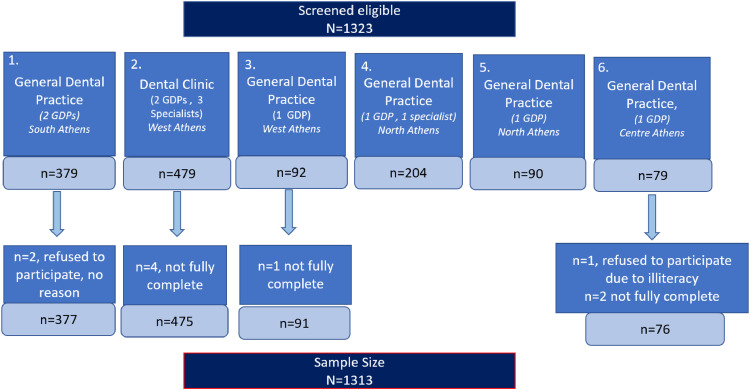
A cross-sectional study was applied. 1313 Adults were recruited, as they attended 1 of 6 different dental settings and were scheduled for a routine dental appointment involving any of the following routine procedures: Check-up, hygiene, restoration, extraction, and pain relief. Their anxiety levels were assessed by applying the Modified Dental Anxiety Scale (MDAS), and by using the cut-off scores of 12 and 19 for assessing moderate and extreme anxiety, respectively.
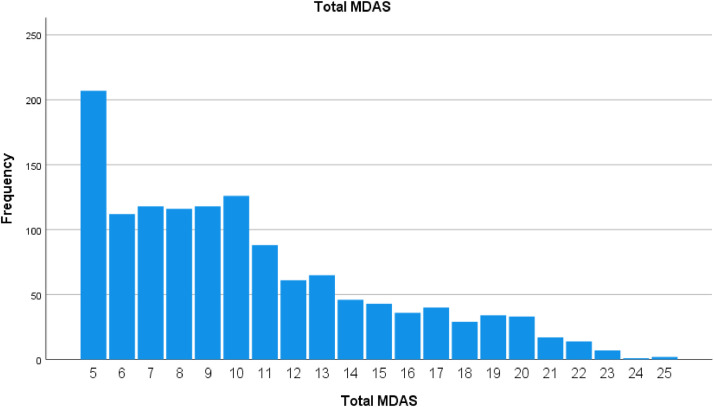
32.6% per cent of the respondents were found to be dentally anxious, out of which 8.2 % experienced high levels of dental anxiety. The mean MDAS score for the total study population was 10.36 (SD= 4.639). The findings indicated that females and first-time dental patients reported significantly higher levels of dental anxiety than males and repeat attendees. However, dental anxiety levels did not vary significantly across different dental procedures, age groups and dental settings. These results are in line with those reported by White in the U.S. population, demonstrating comparable levels of dental anxiety across both populations.
One in 3 patients visiting the dentist in Greece experience some level of dental anxiety. This finding underscores that dental anxiety is a prevalent public health concern in Greece. Dentists and healthcare providers should consider screening for dental anxiety that could lead to early identification and management.
牙科焦虑是个体在面对与牙科相关的事情时所体验到的忧虑,它会影响个体的牙科就诊经历以及牙科医疗服务提供者的职业生涯,导致紧张情绪加剧,并可能影响工作表现。不同文化背景下的牙科焦虑水平存在差异。
从前往常规牙医处进行定期牙科预约的具有代表性的人群样本中收集希腊牙科焦虑水平的规范数据。
采用横断面研究。招募了1313名成年人,他们前往6个不同牙科机构中的1个,并安排进行以下任何一种常规程序的定期牙科预约:检查、口腔卫生、修复、拔牙和止痛。通过应用改良牙科焦虑量表(MDAS)评估他们的焦虑水平,并分别使用12分和19分的临界值来评估中度和极度焦虑。
发现32.6%的受访者存在牙科焦虑,其中8.2%经历高水平的牙科焦虑。整个研究人群的MDAS平均得分为10.36(标准差=4.639)。研究结果表明,女性和首次看牙的患者报告的牙科焦虑水平明显高于男性和复诊患者。然而,不同牙科程序、年龄组和牙科机构之间的牙科焦虑水平没有显著差异。这些结果与美国人群中White报告的结果一致,表明两个群体的牙科焦虑水平相当。
在希腊,每3名看牙医的患者中就有1人经历某种程度的牙科焦虑。这一发现强调了牙科焦虑是希腊普遍存在的公共卫生问题。牙医和医疗服务提供者应考虑对牙科焦虑进行筛查,以便早期识别和管理。