Li Kexin, Huang Fanwei, Zhang Tao, Yang Fan, Duan Weitao, Chen Shimin, Hu Ting, Huang Xiaoyuan
Department of Obstetrics and Gynecology, Tongji Hospital, Tongji Medical College, Huazhong University of Science and Technology, Wuhan, Hubei, 430030, China.
New Technology Platform, Wuhan KDWS Biological Technology Co., Ltd., Wuhan, Hubei, 430074, China.
BMC Cancer. 2025 May 19;25(1):885. doi: 10.1186/s12885-025-14138-4.
HPV integration is a crucial genetic step in cervical carcinogenesis and the level of HPV integration increases with the grade of precancerous lesion. This study aimed to conduct risk stratification based on HPV integration levels and HPV integration status conversion among HPV integration-positive women after 1 year of follow-up.
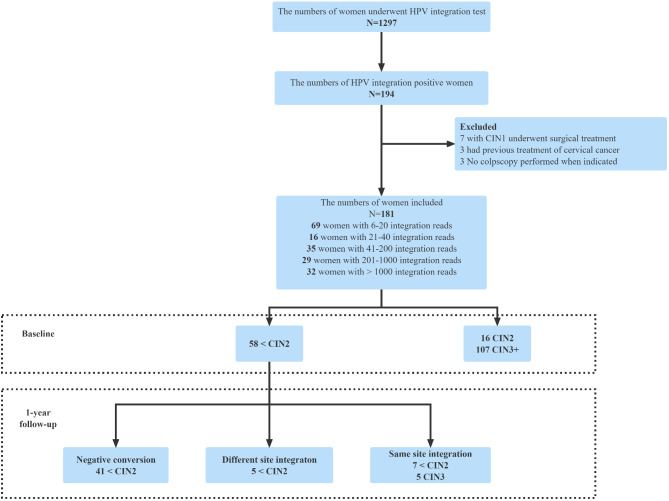
This prospective cohort study was conducted in Tongji Hospital between June 2020 and August 2022 and included 1297 consecutive HPV-positive women. The level of integration reads was stratified for risk assessment.
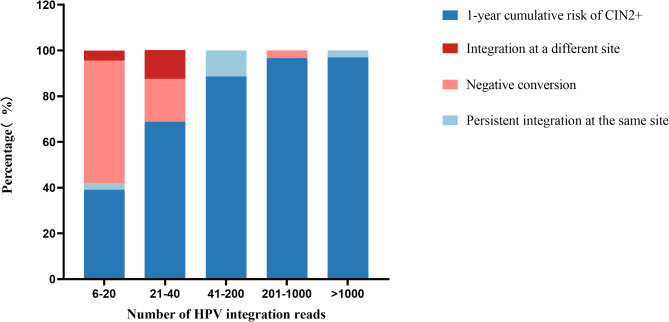
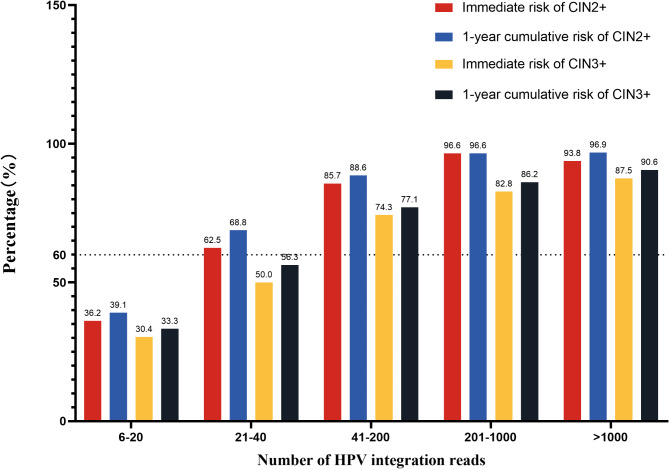
In total, 194 women were HPV integration-positive and followed for at least 1 year. The immediate risk of cervical intraepithelial neoplasia grade 2 or worse (CIN2+) increased from 36.2% (25/69) among women with 6-20 integration reads to 93.8% (30/32) among women with more than 1000 integration reads (P < 0.001). The 1-year cumulative risk of CIN2 + increased from 39.1% (27/69) among women with 6-20 integration reads to 96.9% (31/32) among women with more than 1000 integration reads (P < 0.001). The 1-year cumulative risk of CIN2 + with HPV integration reads more than 40 was 93.8% (90/96), which was significantly higher than that of HPV integration reads less than 40 (38/85, P < 0.001). Among women with HPV integration reads more than 40, 99.0% (95/96) of women progressed with positive outcomes after one year of follow-up (persistent integration at the same site, immediate CIN2+, and 1-year CIN2+). The progression rate of women with persistent integration at the same site was 41.6% (5/12), which was significantly higher than those of HPV integration-negative conversion (0/41, 0%, P < 0.001).
The number of HPV integration reads may help CIN2 + risk stratification and facilitate the clinical management of high-risk patients.
人乳头瘤病毒(HPV)整合是宫颈癌发生过程中的关键遗传步骤,且HPV整合水平随癌前病变等级升高而增加。本研究旨在基于HPV整合水平以及HPV整合阳性女性随访1年后的HPV整合状态转换进行风险分层。
本前瞻性队列研究于2020年6月至2022年8月在同济医院开展,纳入1297例连续的HPV阳性女性。对整合读数水平进行分层以进行风险评估。
共有194例女性HPV整合阳性并接受了至少1年的随访。宫颈上皮内瘤变2级或更严重病变(CIN2+)的即刻风险从整合读数为6 - 20的女性中的36.2%(25/69)增至整合读数超过1000的女性中的93.8%(30/32)(P < 0.001)。CIN2+的1年累积风险从整合读数为6 - 20的女性中的39.1%(27/69)增至整合读数超过1000的女性中的96.9%(31/32)(P < 0.001)。整合读数超过40的CIN2+的1年累积风险为93.8%(90/96),显著高于整合读数小于40的情况(38/85,P < 0.001)。在整合读数超过40的女性中,99.0%(95/96)的女性在随访1年后进展为阳性结果(同一部位持续整合、即刻CIN2+和1年CIN2+)。同一部位持续整合的女性进展率为41.6%(5/12),显著高于HPV整合阴性转换的女性(0/41,0%,P < 0.001)。
HPV整合读数的数量可能有助于CIN2+风险分层,并促进高危患者的临床管理。