Schweingruber Christoph, Nijssen Jik, Mechtersheimer Jonas, Reber Stefan, Lebœuf Mélanie, O'Brien Niamh L, Mei Irene, Hedges Erin, Keuper Michaela, Benitez Julio Aguila, Radoi Vlad, Jastroch Martin, Ruepp Marc-David, Hedlund Eva
Department of Biochemistry and Biophysics, Stockholm University, Svante Arrhenius v. 16C, 106 91, Stockholm, Sweden.
Department of Cell and Molecular Biology, Karolinska Institutet, Biomedicum, Solna v. 9, 171 77, Stockholm, Sweden.
Nat Commun. 2025 May 19;16(1):4633. doi: 10.1038/s41467-025-59679-1.
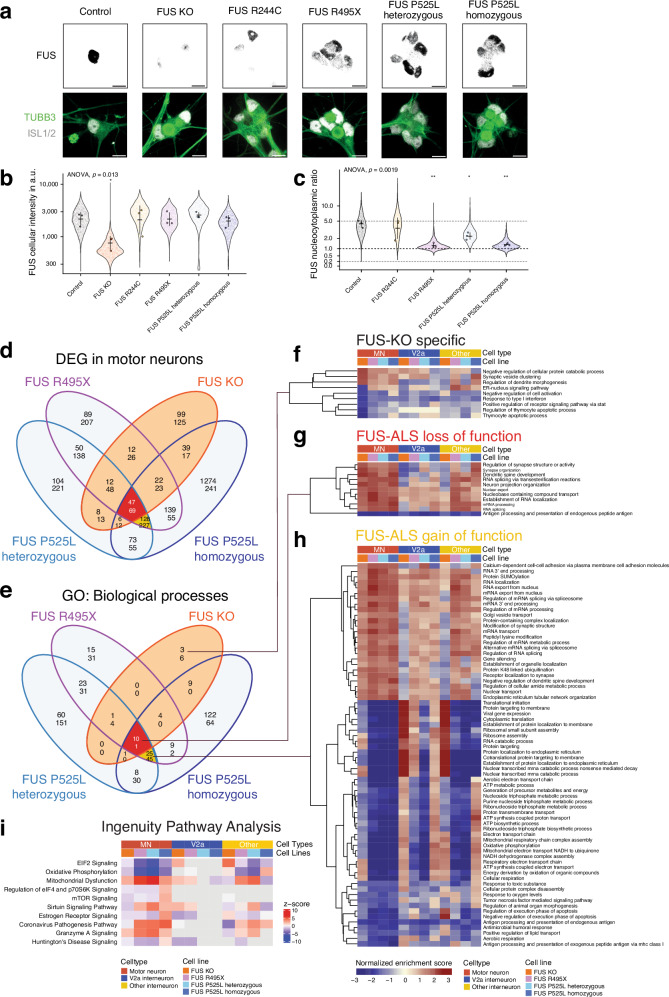
Mutations in FUS and TARDBP cause amyotrophic lateral sclerosis (ALS), but the precise mechanisms of selective motor neuron degeneration remain unresolved. To address if pathomechanisms are shared across mutations and related to either gain- or loss-of-function, we performed single-cell RNA sequencing across isogenic induced pluripotent stem cell-derived neuron types, harbouring FUS P525L, FUS R495X, TARDBP M337V mutations or FUS knockout. Transcriptional changes were far more pronounced in motor neurons than interneurons. About 20% of uniquely dysregulated motor neuron transcripts were shared across FUS mutations, half from gain-of-function. Most indicated mitochondrial impairments, with attenuated pathways shared with mutant TARDBP M337V as well as C9orf72-ALS patient motor neurons. Mitochondrial motility was impaired in ALS motor axons, even with nuclear localized FUS mutants, demonstrating shared toxic gain-of-function mechanisms across FUS- and TARDBP-ALS, uncoupled from protein mislocalization. These early mitochondrial dysfunctions unique to motor neurons may affect survival and represent therapeutic targets in ALS.
FUS和TARDBP的突变会导致肌萎缩侧索硬化症(ALS),但选择性运动神经元变性的确切机制仍未得到解决。为了探究致病机制是否在不同突变中具有共性,以及是否与功能获得或功能丧失相关,我们对携带FUS P525L、FUS R495X、TARDBP M337V突变或FUS基因敲除的同基因诱导多能干细胞衍生的神经元类型进行了单细胞RNA测序。运动神经元中的转录变化比中间神经元更为明显。约20%独特失调的运动神经元转录本在FUS突变中是共有的,其中一半来自功能获得。大多数表明存在线粒体损伤,其衰减途径与突变型TARDBP M337V以及C9orf72-ALS患者的运动神经元共有。即使是核定位的FUS突变体,ALS运动轴突中的线粒体运动也受到损害,这表明FUS-和TARDBP-ALS存在共同的毒性功能获得机制,与蛋白质错误定位无关。这些运动神经元特有的早期线粒体功能障碍可能会影响其存活,并代表ALS的治疗靶点。