Wang Liwen, Zhao Hongjun, Li Runfang, Tian Rumei, Jia Kaihua, Gong Yongchao, Hou Song, Li Nana, Pu Yanyan
School of Life Sciences, Qilu Normal University, Jinan, 250200, China.
Institute of industrial Crops, Shandong Academy of Agricultural Sciences, Jinan, 250100, China.
BMC Genomics. 2025 May 19;26(1):503. doi: 10.1186/s12864-025-11671-1.
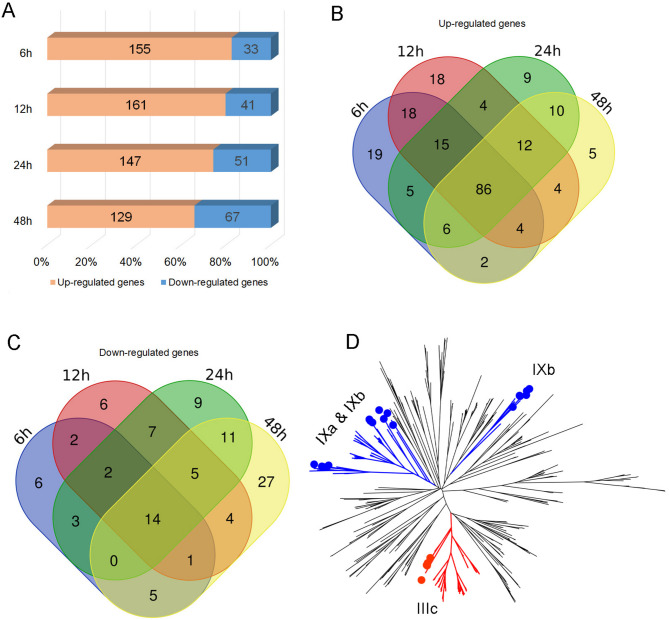
Ethylene response factors (ERFs), belonging to the AP2/ERF superfamily, play vital roles in plant growth, development, and stress responses. The evolutionary and expression features of the members of the ERF gene family have not yet been extensively analyzed through comprehensive comparative genomics across various diploid, tetraploid, and hexaploid wheat genomes. In this study, we identified a total of 2,967 ERF genes across one diploid, two tetraploid, and five hexaploid wheat genomes using the characteristics of conserved domains of ERF proteins. Phylogenetic analysis revealed that ERF genes clustered into two main groups. Analyses of expansion of the ERF gene family indicated that the members of IIIc and IX (sub)groups were observed to show the expansion in tetraploid and hexaploid wheat compared to diploid wheat. Tandem duplication was identified as a key mechanism for ERF gene family expansion, with varying proportions across different wheat genomes. Ancient evolutionary evidence was traced using Amborella trichopoda as a reference, revealing the retention of gene copies in both tetraploid and hexaploid wheat. Then, we analyzed the expression of ERF genes under salt stress in Triticum aestivum, identifying 86 consistently up-regulated and 14 down-regulated ERF genes, and reported the stress tolerant and disease resistant ERF genes in hexaploid wheat. These findings provide valuable insights into the evolutionary dynamics and functional features of ERF genes in wheat, paving the way for genetic breeding and molecular improvement of wheat species.
乙烯响应因子(ERFs)属于AP2/ERF超家族,在植物生长、发育和胁迫响应中发挥着至关重要的作用。尚未通过对各种二倍体、四倍体和六倍体小麦基因组进行全面比较基因组学分析,广泛研究ERF基因家族成员的进化和表达特征。在本研究中,我们利用ERF蛋白保守结构域的特征,在一个二倍体、两个四倍体和五个六倍体小麦基因组中总共鉴定出2967个ERF基因。系统发育分析表明,ERF基因聚为两个主要类群。对ERF基因家族扩张的分析表明,与二倍体小麦相比,在四倍体和六倍体小麦中观察到IIIc和IX(亚)类群的成员出现扩张。串联重复被确定为ERF基因家族扩张的关键机制,在不同小麦基因组中的比例各不相同。以无油樟为参考追溯古老的进化证据,揭示了四倍体和六倍体小麦中基因拷贝的保留情况。然后,我们分析了普通小麦在盐胁迫下ERF基因的表达,鉴定出86个持续上调和14个下调的ERF基因,并报道了六倍体小麦中的耐逆和抗病ERF基因。这些发现为小麦中ERF基因的进化动态和功能特征提供了有价值的见解,为小麦品种的遗传育种和分子改良铺平了道路。