Song Aisheng, Zhao Jian-Xun, Tang Xin, Wu Hai-Jun, Xu Zhiyue, Cao Jiawei, Liu Xiao, Wang Hui, Li Qunyang, Hu Yuan-Zhong, Li Xin, Luo Jianbin, Ma Tian-Bao
State Key Laboratory of Tribology in Advanced Equipment, Tsinghua University, Beijing, 100084, China.
State Key Laboratory of Precious Metal Functional Materials, Kunming, 650106, China.
Nat Commun. 2025 May 20;16(1):4704. doi: 10.1038/s41467-025-59989-4.
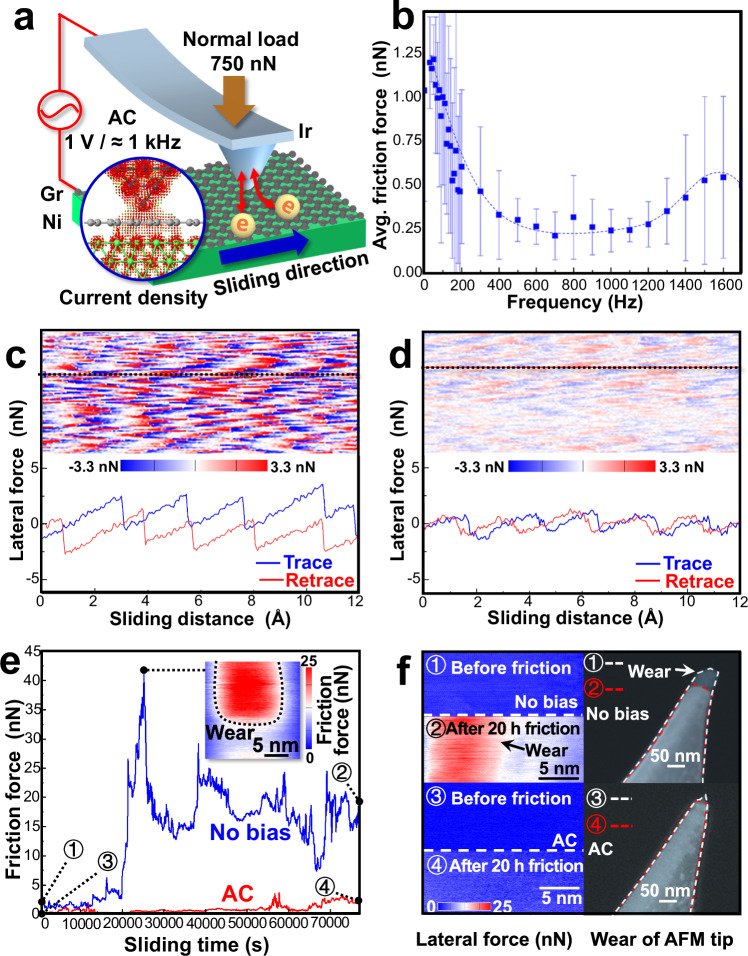
Reducing friction has been a human pursuit for centuries, and is especially important for the development of nanotechnology. Nowadays, with the atomic-level understanding of friction, it is possible to reduce friction by modulating the configuration and motion of interfacial atoms. However, how to further reduce friction by modulating the interfacial electronic properties is still unclear. Here we show a strategy to achieve friction and wear reduction through inducing dynamic electronic density redistribution via alternating electric current. The friction force between conductive Ir AFM tip and graphene on Ni substrate can be reduced to 1/4 under 1 kHz alternating current, and maintain for more than 70,000 s under 9.1 GPa contact pressure without any obvious wear. An electronic-level friction model (PTT-E model) is presented to unravel and quantify the tuning effect, showing that the alternating current induced dynamic electron density redistribution is the key to friction reduction. This work proposes a feasible and robust method to reduce friction and wear in nanomechanical devices, and advances the understanding and predicting of electronic contribution in friction tuning.
几个世纪以来,减少摩擦一直是人类的追求,对于纳米技术的发展尤为重要。如今,随着对摩擦的原子级理解,通过调节界面原子的构型和运动来减少摩擦成为可能。然而,如何通过调节界面电子性质进一步降低摩擦仍不清楚。在此,我们展示了一种通过交变电流诱导动态电子密度重新分布来实现减少摩擦和磨损的策略。在1kHz交变电流下,导电铱原子力显微镜(AFM)探针与镍基底上的石墨烯之间的摩擦力可降至1/4,并且在9.1GPa接触压力下可保持超过70000秒而无明显磨损。提出了一个电子级摩擦模型(PTT-E模型)来揭示和量化这种调节效应,表明交变电流诱导的动态电子密度重新分布是减少摩擦的关键。这项工作提出了一种可行且可靠的方法来减少纳米机械设备中的摩擦和磨损,并推进了对摩擦调节中电子贡献的理解和预测。