Lee Grace Yoojin, Kwon Hee Yeon, Park Kanggil, Jo Sungyang, Lee Jihyun, Lee Sangjin, Lee June-Goo, Kim Namkug, Chung Sun Ju
Department of Medical Science, Asan Medical Institute of Convergence Science and Technology, Asan Medical Center, University of Ulsan College of Medicine, Seoul, 05505, Republic of Korea.
Department of Convergence Medicine, Department of Radiology, Asan Medical Institute of Convergence Science and Technology, Asan Medical Center, University of Ulsan College of Medicine, 88 Olympic-ro 43-gil, Seoul, 05505, Republic of Korea.
Sci Rep. 2025 May 21;15(1):17557. doi: 10.1038/s41598-025-02098-5.
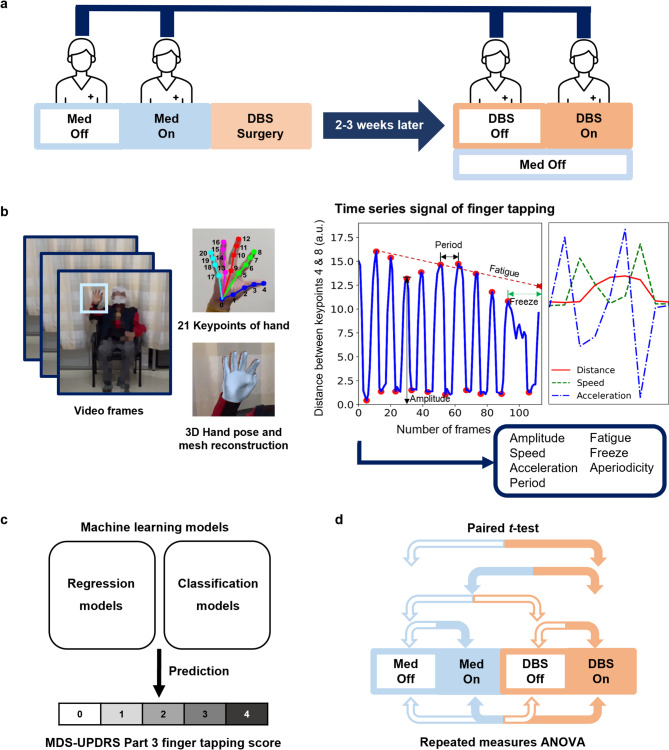
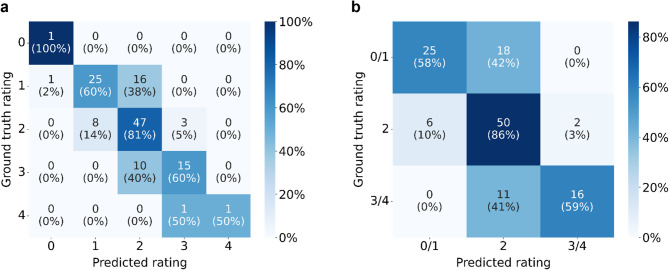
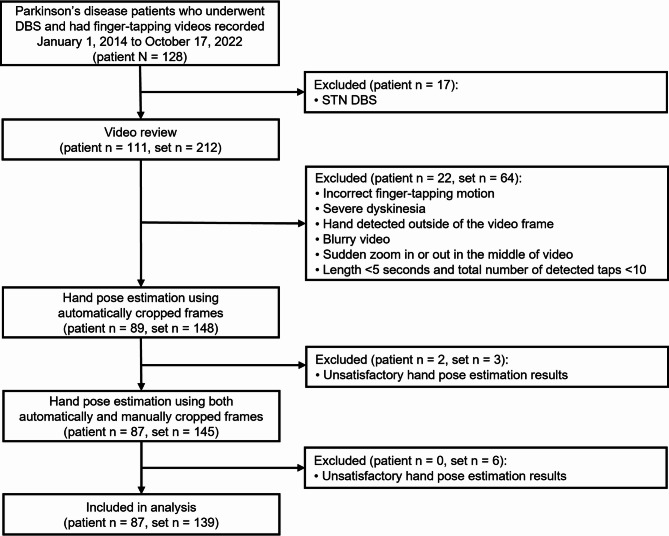
In advanced Parkinson's disease (PD), considerable number of patients receive deep brain stimulation (DBS) surgery, to alleviate symptoms not readily controlled by medication. However, the differential effects of medication and DBS on improving motor symptoms, especially for DBS targeting the globus pallidus internus (GPi), have not been explored in sufficient detail. We studied the finger tapping (FT) task of the Movement Disorder Society Unified Parkinson's Disease Rating Scale Part 3, to evaluate the improvements in bradykinesia achieved through GPi DBS in patients with PD. In this observational study, videos were recorded during the FT task in four different states for each patient, without and with medication in the preoperative setting, and before and after DBS programming in the postoperative setting. Using a deep learning model, we reconstructed the 2D hand motions into 3D meshes to extract 21 motion parameters that characterize hand bradykinesia. We employed these parameters to predict the FT score using machine learning models. Finally, statistical tests were used to compare motion parameters across four distinct states. A total of 556 videos from 87 patients were collected. The best model predicted the FT score with an accuracy of 0.70, which was on par with human experts. Notably, GPi DBS significantly improved speed and acceleration parameters compared to medication. Our study results indicate that GPi DBS and medication might act through different mechanisms, with GPi DBS more directly influencing neural pathways related to speed control in fine rhythmic hand movements.
在晚期帕金森病(PD)中,相当数量的患者接受脑深部电刺激(DBS)手术,以缓解药物难以控制的症状。然而,药物治疗和DBS对改善运动症状的不同影响,尤其是针对内侧苍白球(GPi)的DBS,尚未得到充分详细的研究。我们研究了运动障碍协会统一帕金森病评定量表第3部分的手指敲击(FT)任务,以评估PD患者通过GPi DBS实现的运动迟缓改善情况。在这项观察性研究中,为每位患者在FT任务期间记录了四种不同状态下的视频,术前未用药和用药时,以及术后DBS程控前后。使用深度学习模型,我们将二维手部动作重建为三维网格,以提取21个表征手部运动迟缓的运动参数。我们使用这些参数通过机器学习模型预测FT评分。最后,使用统计测试比较四种不同状态下的运动参数。共收集了来自87名患者的556个视频。最佳模型预测FT评分的准确率为0.70,与人类专家相当。值得注意的是,与药物治疗相比,GPi DBS显著改善了速度和加速度参数。我们的研究结果表明,GPi DBS和药物治疗可能通过不同机制起作用,GPi DBS更直接地影响与精细节律性手部运动速度控制相关的神经通路。