Ding Haoyuan, Han Dapeng, Ma Nanshan, Gao Chenxin, Yao Jie, Ouyang Guilin
Shanghai University of Traditional Chinese Medicine, Shanghai, China.
Department of Orthopedic Surgery, Guanghua Hospital Affiliated to Shanghai University of Traditional Chinese Medicine, Shanghai, China.
Front Surg. 2025 May 6;12:1522588. doi: 10.3389/fsurg.2025.1522588. eCollection 2025.
To compare the early clinical outcomes of posterior cruciate ligament-retaining (CR) and posterior stabilized (PS) knee prostheses in total knee arthroplasty for patients with rheumatoid arthritis.
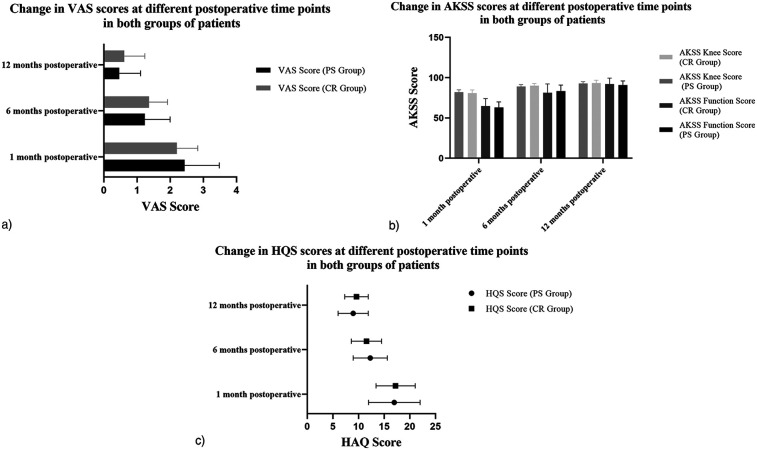
A retrospective analysis was conducted on 74 patients with rheumatoid arthritis (RA) who underwent unilateral total knee arthroplasty (TKA) from January 2021 to December 2022. Among these, 39 patients received CR prostheses (CR group), while 35 received PS prostheses (PS group). Data on operation time, intraoperative blood loss, hospital stay, preoperative and postoperative Visual Analogue Scale (VAS) scores, American Knee Society Score (AKSS), Functional Joint Score-12 (FJS-12) scores, Health Assessment Questionnaire scores (HAQ) and postoperative complications were recorded and compared between the two groups.
All 74 patients successfully completed the surgery without complications. The average operation time for the CR group was shorter than that of the PS group, with no statistically significant differences in intraoperative blood loss or hospital stay. Both groups showed improved postoperative AKSS scores, VAS scores, and HAQ Scores compared to preoperative levels. Between-group comparisons showed no statistical differences in postoperative AKSS, VAS, HAQ scores. However, the CR group had significantly higher FJS-12 scores at 6 and 12 months postoperatively compared to the PS group.
Both CR and PS prostheses can achieve good clinical outcomes in TKA for RA patients. Compared to PS prostheses, CR prostheses may provide better knee proprioception postoperatively, as indicated by higher FJS-12 scores at 6 and 12 months postoperatively.
比较保留后交叉韧带(CR)型和后稳定(PS)型膝关节假体在类风湿关节炎患者全膝关节置换术中的早期临床疗效。
对2021年1月至2022年12月期间接受单侧全膝关节置换术(TKA)的74例类风湿关节炎(RA)患者进行回顾性分析。其中,39例患者接受CR假体(CR组),35例接受PS假体(PS组)。记录并比较两组患者的手术时间、术中出血量、住院时间、术前和术后视觉模拟评分(VAS)、美国膝关节协会评分(AKSS)、功能关节评分-12(FJS-12)、健康评估问卷评分(HAQ)及术后并发症。
74例患者均成功完成手术,无并发症发生。CR组的平均手术时间短于PS组,术中出血量和住院时间差异无统计学意义。与术前相比,两组患者术后的AKSS评分、VAS评分和HAQ评分均有所改善。组间比较显示,术后AKSS、VAS、HAQ评分差异无统计学意义。然而,与PS组相比,CR组术后6个月和12个月的FJS-12评分显著更高。
CR和PS假体在RA患者的TKA中均可取得良好的临床疗效。与PS假体相比,CR假体术后可能具有更好的膝关节本体感觉,术后6个月和12个月的FJS-12评分更高表明了这一点。