Caballero Cassia B, Biggs Trent W, Vergopolan Noemi, Camelo Luana G G, de Andrade Bruno Comini, Laipelt Leonardo, L Ruhoff Anderson
Institute of Hydraulic Research, Federal University of Rio Grande do Sul, Porto Alegre, RS, 91509900, Brazil.
Department of Agricultural and Biological Engineering, Mississippi State University, Mississippi, MS, 39759, USA.
Sci Rep. 2025 May 21;15(1):17675. doi: 10.1038/s41598-025-01980-6.
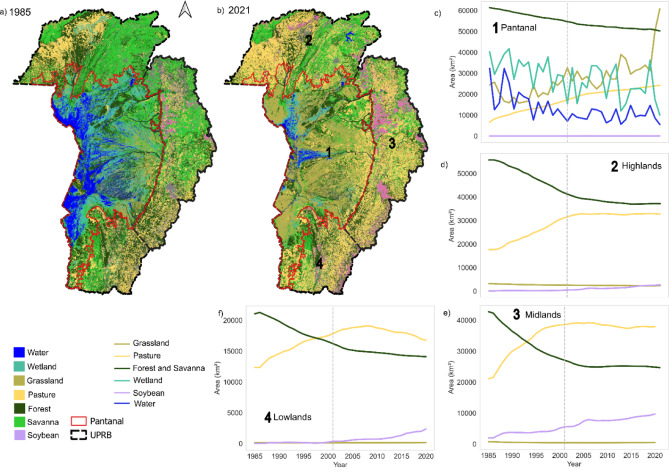
The Pantanal, the world's largest tropical wetland, experienced unusual drying in 2000-2021, but the causes are poorly understood. Combining remotely sensed data of wetland extent and land cover with observed water level discharge and meteorological data, we quantify the relative contributions of climate and land use to changes in Pantanal wetland extent. Climate variability drove 96% of the runoff changes over four major hydroclimate regimes, including two wet (1951-1964; 1976-2000) and two dry (1965-1975; 2001-2021) periods. Reduced precipitation, runoff, and wetland shrinkage observed in 2001-2021 resembled the previous dry period (1965-1975), indicating decadal climatic variability. However, the higher aridity index in the recent period exacerbated the duration of the drought, and the rainfall-runoff relationship shifted over time, with more runoff for a given rainfall amount in recent periods. Wetland area is highly sensitive to climate variability, contracting to 25% of the maximum during dry years. Future warming and reduced rainfall will likely continue the recent drying trend, further reducing runoff, wetland area, and the Pantanal biodiversity.
潘塔纳尔湿地是世界上最大的热带湿地,在2000 - 2021年期间经历了异常干旱,但干旱原因尚不清楚。我们将湿地范围和土地覆盖的遥感数据与观测到的水位流量和气象数据相结合,量化了气候和土地利用对潘塔纳尔湿地范围变化的相对贡献。在四个主要水文气候时期,包括两个湿润期(1951 - 1964年;1976 - 2000年)和两个干旱期(1965 - 1975年;2001 - 2021年),气候变率驱动了96%的径流变化。2001 - 2021年观测到的降水减少、径流减少和湿地萎缩与前一个干旱期(1965 - 1975年)相似,表明存在年代际气候变率。然而,近期较高的干旱指数加剧了干旱持续时间,且降雨 - 径流关系随时间发生了变化,近期在给定降雨量下产生的径流更多。湿地面积对气候变率高度敏感,在干旱年份收缩至最大面积的25%。未来的变暖和降雨减少可能会延续近期的干旱趋势,进一步减少径流、湿地面积以及潘塔纳尔湿地的生物多样性。