
鉴定与RUNX1-ETO的NHR2结构域相互作用的不带电荷的7.44类似物,其在RUNX-ETO阳性细胞中具有增强的抗增殖作用。
Identification of non-charged 7.44 analogs interacting with the NHR2 domain of RUNX1-ETO with improved antiproliferative effect in RUNX-ETO positive cells.
作者信息
Gopalswamy Mohanraj, Bickel David, Dienstbier Niklas, Tu Jia-Wey, Vogt Melina, Schott-Verdugo Stephan, Bhatia Sanil, Etzkorn Manuel, Gohlke Holger
机构信息
Institute for Pharmaceutical and Medicinal Chemistry, Heinrich Heine University Düsseldorf, Düsseldorf, Germany.
Interuniversity Institute of Bioinformatics in Brussels, Brussels, Belgium.
出版信息
Sci Rep. 2025 May 22;15(1):17720. doi: 10.1038/s41598-025-02422-z.
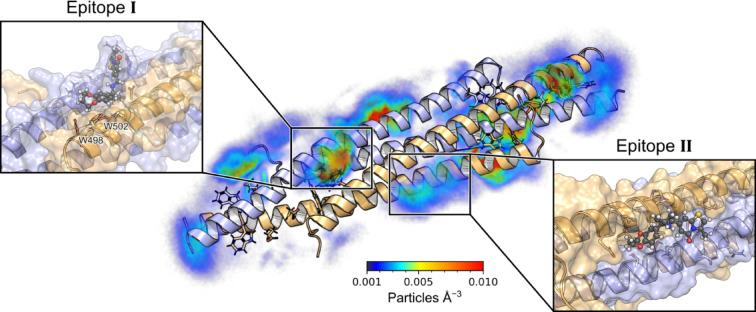
The RUNX1/ETO fusion protein is a chimeric transcription factor in acute myeloid leukemia (AML) created by chromosomal translocation t(8;21)(q22;q22). t(8;21) abnormality is associated with 12% of de novo AML cases and up to 40% in the AML subtype M2. Previously, we identified the small-molecule inhibitor 7.44, which interferes with NHR2 domain tetramerization of RUNX1/ETO, restores gene expression down-regulated by RUNX1/ETO, inhibits proliferation, and reduces RUNX1/ETO-related tumor growth in a mouse model. However, despite favorable properties, 7.44 is negatively charged at physiological pH and was predicted to have low to medium membrane permeability. Here, we identified M23, M27, and M10 as non-charged analogs of 7.44 using ligand-based virtual screening, in vivo hit identification, biophysical and in vivo hit validation, and integrative modeling and ADMET predictions. All three compounds interact with the NHR2 domain, have K values of 39-114 µM in Microscale Thermophoresis experiments, and IC values of 33-77 µM as to cell viability in RUNX1/ETO-positive KASUMI cells, i.e., are ~ 5 to 10-fold more potent than 7.44. M23 is ~ 10-fold more potent than 7.44 in inhibiting cell proliferation of RUNX1/ETO-positive cells. Biological characterization of M23 in relevant RUNX1/ETO-positive -and negative cell lines indicates that M23 induces apoptosis and promotes differentiation in RUNX1/ETO-positive AML cells. M23 and M27 are negligibly protonated or in a ~ 1:1 ratio at physiological pH, while M10 has no (de-)protonatable group. The non-protonated species are predicted to be highly membrane-permeable, along with other favorable pharmacokinetic and toxicological properties. These compounds might serve as lead structures for compounds inhibiting RUNX1/ETO oncogenic function in t(8;21) AML.
RUNX1/ETO融合蛋白是急性髓系白血病(AML)中的一种嵌合转录因子,由染色体易位t(8;21)(q22;q22)产生。t(8;21)异常与12%的初发AML病例相关,在AML M2亚型中高达40%。此前,我们鉴定出小分子抑制剂7.44,它干扰RUNX1/ETO的NHR2结构域四聚化,恢复被RUNX1/ETO下调的基因表达,抑制增殖,并在小鼠模型中减少RUNX1/ETO相关的肿瘤生长。然而,尽管具有良好的特性,但7.44在生理pH下带负电荷,预计具有低至中等的膜通透性。在此,我们通过基于配体的虚拟筛选、体内活性化合物鉴定、生物物理和体内活性化合物验证以及综合建模和ADMET预测,鉴定出M23、M27和M10为7.44的不带电荷类似物。这三种化合物均与NHR2结构域相互作用,在微量热泳实验中的K值为39 - 114 µM,对RUNX1/ETO阳性KASUMI细胞的细胞活力的IC值为33 - 77 µM,即效力比7.44高约5至10倍。M23在抑制RUNX1/ETO阳性细胞的细胞增殖方面比7.44强约10倍。M23在相关的RUNX1/ETO阳性和阴性细胞系中的生物学特性表明,M23在RUNX1/ETO阳性AML细胞中诱导凋亡并促进分化。M23和M27在生理pH下质子化程度可忽略不计或呈约1:1的比例,而M10没有可(去)质子化的基团。预计非质子化形式具有高膜通透性,以及其他良好的药代动力学和毒理学特性。这些化合物可能作为抑制t(8;21) AML中RUNX1/ETO致癌功能的化合物的先导结构。




 Zotero 插件