Morris Emily C, Tucker Katherine L, McManus Richard J, Stevens Richard J
Nuffield Department of Primary Care Health Sciences, University of Oxford, Oxford.
Brighton and Sussex Medical School, University of Brighton and University of Sussex, Brighton, UK.
J Hypertens. 2025 Aug 1;43(8):1400-1406. doi: 10.1097/HJH.0000000000004062. Epub 2025 May 23.
This study investigates how prior home blood pressure monitoring (HBPM) experience affects blood pressure variability and evaluates if reduced HBPM regimens could be recommended for experienced patients.
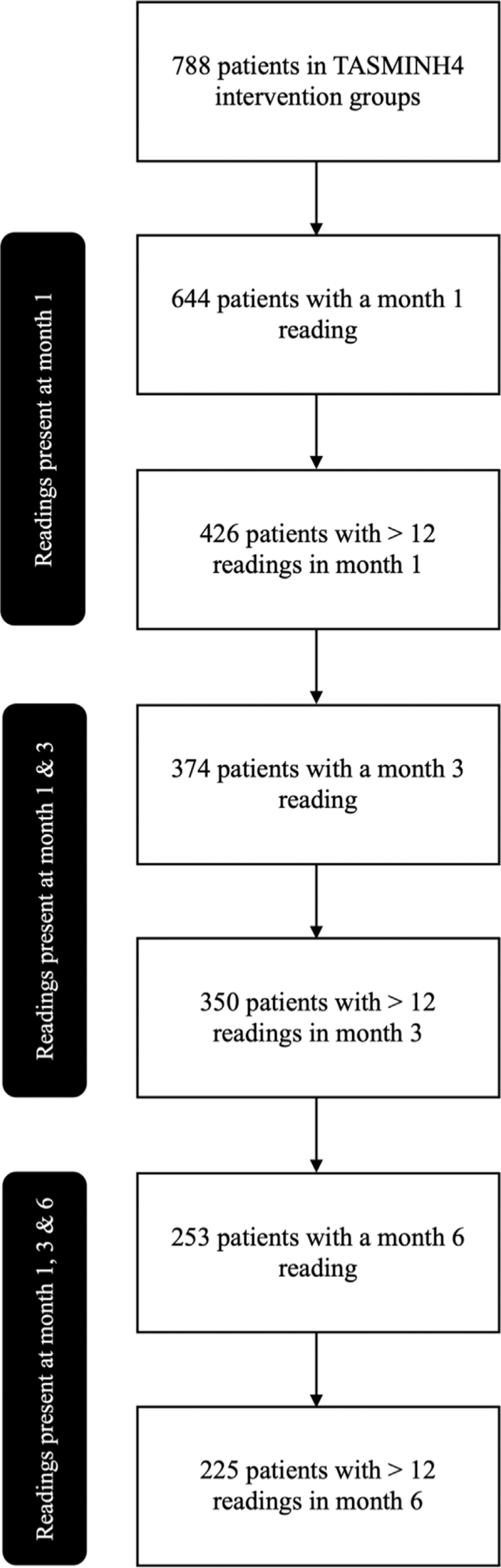
This posthoc analysis of the TASMINH4 trial included self-monitored blood pressure (BP) data from 225 patients. The standard deviation of systolic BP recordings was calculated for each patient-week to assess how BP variability changes with HBPM duration. A subgroup of 84 patients, who submitted at least 1 reading a day for 7 days at months 1, 3, and 6, was analysed to assess the impact of reduced HBPM regimens on BP estimates.
Day 1 readings were significantly higher than day 2-7 in the first 3 months of HBPM: 1.1 (95% CI 0.4, 1.8) day 1 vs. day 2. This effect diminished after 6 months: 1.0 (95% CI -0.8, 2.8) day 1 vs. 2. Long term monitoring significantly reduced intra-week BP variability, with the standard deviation of systolic BP recordings within each patient-week significantly reduced after 6 months. After 6 months of HBPM, the inclusion of day 1 readings or use of an abbreviated monitoring regimen had a reduced impact on estimates of mean systolic and diastolic blood pressure.
Long-term HBPM reduces intra-week BP variability, making day 1 readings insignificantly raised after 6 months of HBPM. This provides rationale for different HBPM recommendations: longer regimes, excluding day one readings, for diagnosis and short-term monitoring; and abbreviated regimes including day 1 for longer term monitoring in those with HBPM experience.
本研究调查既往家庭血压监测(HBPM)经历如何影响血压变异性,并评估是否可为有经验的患者推荐减少HBPM方案。
对TASMINH4试验的这项事后分析纳入了225例患者的自我监测血压(BP)数据。计算每位患者每周收缩压记录的标准差,以评估血压变异性如何随HBPM持续时间变化。分析了一个由84例患者组成的亚组,这些患者在第1、3和6个月每天至少提交1次读数,共7天,以评估减少HBPM方案对血压估计值的影响。
在HBPM的前3个月中,第1天的读数显著高于第2 - 7天:第1天为1.1(95%CI 0.4, 1.8),第2天为1.0(95%CI -0.8, 2.8)。6个月后这种效应减弱。长期监测显著降低了周内血压变异性,每位患者每周收缩压记录的标准差在6个月后显著降低。HBPM 6个月后,纳入第1天的读数或使用简化监测方案对平均收缩压和舒张压估计值的影响较小。
长期HBPM可降低周内血压变异性,使HBPM 6个月后第1天的读数升高不显著。这为不同的HBPM建议提供了依据:对于诊断和短期监测,采用较长方案,不包括第1天的读数;对于有HBPM经验的患者进行长期监测,采用包括第1天的简化方案。