Reddy Kriyana P, Mirpuri Saania, Berkowitz Cara L, de Jesus Elizabeth M, Hulse Sarah B, Lewandowski Julia T, Coughlin Kerry Q, Burwell Merium L, Evans Robin, Galetta Jennifer, Rivera Sanchez Sharon, Buckingham Trudy L, Livingstone Victoria, McCarthy Anne Marie, Gabriel Peter E, Edmonds Christine E, Cadet Tamara J, Fayanju Oluwadamilola M
Division of Breast Surgery, Department of Surgery, Perelman School of Medicine, University of Pennsylvania, Philadelphia, PA, United States.
Penn Center for Cancer Care Innovation, Abramson Cancer Center, Philadelphia, PA, United States.
JNCI Cancer Spectr. 2025 Apr 30;9(3). doi: 10.1093/jncics/pkaf040.
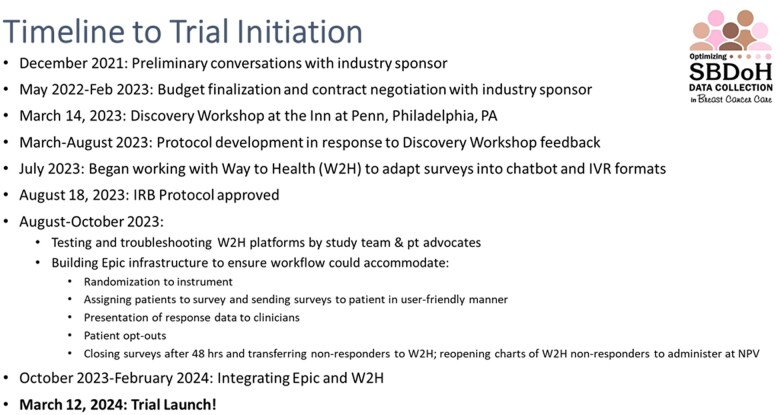
In response to growing evidence and recognition that social and behavioral determinants of health (SBDOH) differentially affect the health-care experiences and outcomes of patients with cancer, there has been an increased focus on optimizing the routine collection of such data. In spring 2024, we launched a pragmatic clinical trial titled "Effect of Early Point-of-Service Social and Behavioral Determinants of Health (SBDOH) Screening and Enhanced Navigation on Care Delivery for Patients With Breast Cancer" (ClinicalTrials.gov identifier NCT06019988) at our academic health system. Instruments and modalities were selected following a process of collaborative and iterative consensus building that included an in-person discovery workshop with patients, national experts in psychometrics and SBDOH collection, health system leadership, faculty and staff stakeholders, and study sponsors. The final protocol, which used the Consolidated Framework for Implementation Research, follows a stepped-wedge cluster-randomized format and compares 3 SBDOH screening instruments-Accountable Health Communities Health-Related Social Needs Screening Tool, Health Leads Social Screening Tool, and the National Comprehensive Care Network Distress Thermometer and Problem List-and 3 delivery modalities-the Epic electronic health record patient portal; bidirectional text-based conversational agent ("chatbot"), and interactive voice response administered by phone. Despite substantial resources, multidisciplinary collaboration, and advanced planning, we encountered challenges related to patient navigation, stakeholder engagement, and technological integration. We describe our experience as a guide for others aspiring to realize real-world implementation of routine SBDOH data collection.
鉴于越来越多的证据表明,健康的社会和行为决定因素(SBDOH)对癌症患者的医疗保健体验和结果产生不同影响,人们越来越关注优化此类数据的常规收集。2024年春季,我们在学术健康系统中开展了一项名为“早期服务点健康的社会和行为决定因素(SBDOH)筛查及强化导航对乳腺癌患者护理的影响”的务实临床试验(ClinicalTrials.gov标识符NCT06019988)。通过协作和反复达成共识的过程选择工具和方式,该过程包括与患者、心理测量学和SBDOH收集方面的国家专家、健康系统领导、教职员工利益相关者以及研究赞助商举行的面对面发现研讨会。最终方案采用实施研究综合框架,采用阶梯式楔形整群随机形式,比较3种SBDOH筛查工具——责任健康社区健康相关社会需求筛查工具、健康引导社会筛查工具以及国家综合癌症网络苦恼温度计和问题清单,以及3种提供方式——Epic电子健康记录患者门户;双向基于文本的对话代理(“聊天机器人”),以及通过电话进行的交互式语音应答。尽管投入了大量资源、开展了多学科协作并进行了前期规划,但我们在患者导航、利益相关者参与和技术整合方面仍遇到了挑战。我们将自己的经验作为指南,供其他有志于在现实世界中实现常规SBDOH数据收集的人参考。