Burton Jackson, Brothers Holly M, Hutchison R Matthew, Murphy Jennifer, Sun Tao, Dent Gersham, Curiale Gioacchino, Kowalski Ken
Biogen Inc., Cambridge, MA, USA.
Biogen Inc., Cambridge, MA, USA.
J Prev Alzheimers Dis. 2025 Aug;12(7):100202. doi: 10.1016/j.tjpad.2025.100202. Epub 2025 May 24.
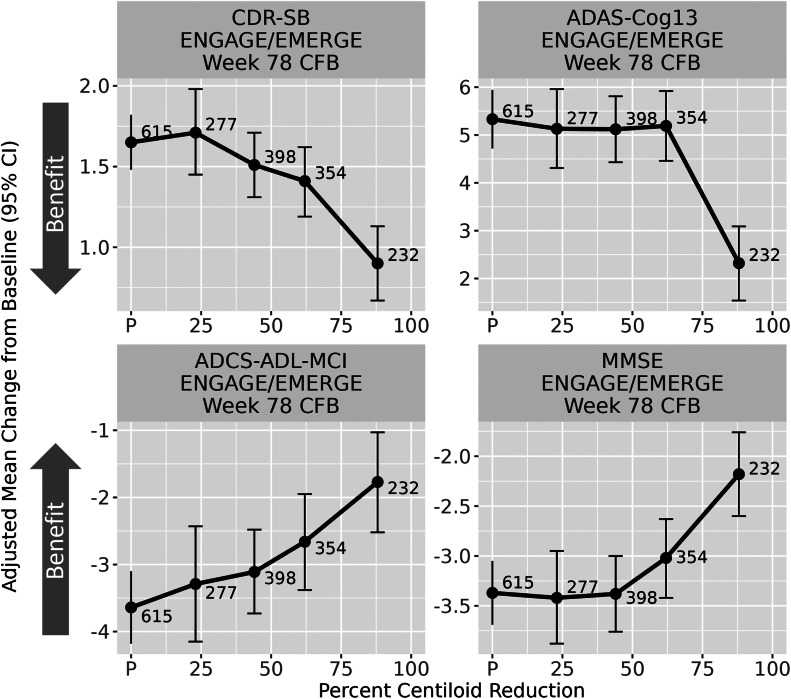
Aducanumab is a human immunoglobulin G1 anti-amyloid beta antibody for early-stage Alzheimer's disease. After the discontinuation of the aducanumab clinical program and market withdrawal, the Phase 3 data were further assessed to characterize the relationship between baseline amyloid beta load, degree of amyloid beta removal, and subsequent clinical outcomes to provide context for future research.
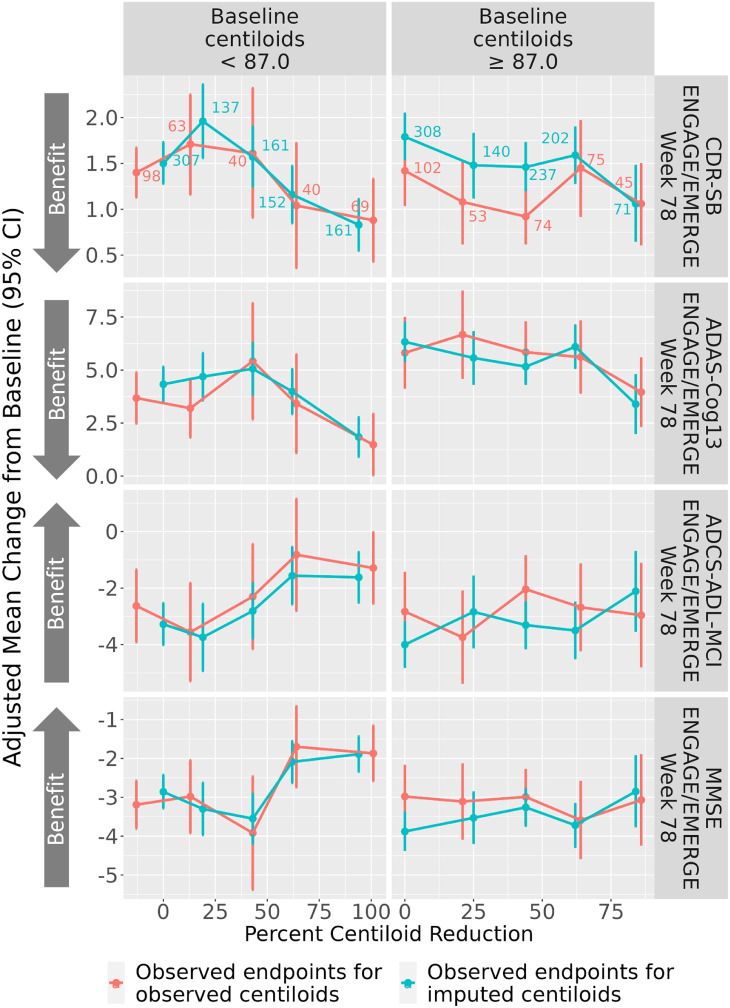
This analysis leveraged modelling techniques to impute missing amyloid beta positron emission tomography values and better understand the relationship between baseline amyloid beta positron emission tomography status, amyloid beta positron emission tomography reduction, and clinical outcomes in the aducanumab Phase 3 ENGAGE and EMERGE (NCT02477800/NCT02484547) studies.
Exploratory data analysis.
A previously developed model which characterized the relationship between aducanumab exposure and amyloid beta positron emission tomography standard uptake value ratio was updated to impute centiloid values for participants not enrolled in the amyloid beta positron emission tomography substudy. Additional clinically-relevant variables were also summarized.
1876 participants with baseline amyloid beta positron emission tomography and clinical endpoints in a pooled ENGAGE/EMERGE dataset at week 78.
Aducanumab MEASUREMENTS: Amyloid burden measured by centiloids and clinical endpoints.
In older participants whose baseline amyloid beta burden is lower than the average trial population, exposure to aducanumab provides greater clinical benefit across cognitive and functional endpoints.
The relationship between baseline amyloid beta load and treatment benefit in a large population after exposure to an amyloid beta-directed antibody provides insight into which subpopulations are likely to benefit from this class of treatment.
阿杜卡努单抗是一种用于早期阿尔茨海默病的人免疫球蛋白G1抗β淀粉样蛋白抗体。在阿杜卡努单抗临床项目终止和撤市后,对3期数据进行了进一步评估,以确定基线β淀粉样蛋白负荷、β淀粉样蛋白清除程度与后续临床结果之间的关系,为未来研究提供背景信息。
本分析利用建模技术推算缺失的β淀粉样蛋白正电子发射断层扫描值,以更好地理解在阿杜卡努单抗3期ENGAGE和EMERGE(NCT02477800/NCT02484547)研究中,基线β淀粉样蛋白正电子发射断层扫描状态、β淀粉样蛋白正电子发射断层扫描降低情况与临床结果之间的关系。
探索性数据分析。
更新了一个先前开发的模型,该模型描述了阿杜卡努单抗暴露与β淀粉样蛋白正电子发射断层扫描标准摄取值比率之间的关系,以推算未参加β淀粉样蛋白正电子发射断层扫描子研究的参与者的百分位数。还总结了其他临床相关变量。
在第78周的ENGAGE/EMERGE合并数据集中,有1876名具有基线β淀粉样蛋白正电子发射断层扫描和临床终点的参与者。
阿杜卡努单抗
通过百分位数测量的淀粉样蛋白负荷和临床终点。
在基线β淀粉样蛋白负荷低于试验总体平均水平的老年参与者中,使用阿杜卡努单抗在认知和功能终点方面提供了更大的临床益处。
在暴露于抗β淀粉样蛋白抗体后,基线β淀粉样蛋白负荷与大量人群治疗益处之间的关系,为哪些亚组可能从此类治疗中获益提供了见解。