Shen Anruo, Sun Jingnan, Chen Xiaogang, Gao Xiaorong
Department of Biomedical Engineering, Tsinghua University, Beijing, 100084, China.
Department of Biomedical Engineering, Johns Hopkins University School of Medicine, Baltimore, MD, 21218, USA.
J Neuroeng Rehabil. 2025 May 25;22(1):116. doi: 10.1186/s12984-025-01645-5.
Major Depressive Disorder is a leading cause of disability worldwide. An accurate assessment of depression severity is critical for diagnosis, treatment planning, and monitoring, yet current clinical tools are largely subjective, relying on self-report and clinician judgment via traditional assessment scales. EEG has emerged as a promising, non-invasive modality for capturing neural correlates of depression. However, most EEG-based machine learning diagnostic studies focus on boosting classification accuracy through complex algorithms and small, homogenous datasets. These black-box approaches often yield results that are difficult to interpret and poorly generalizable, making clinical translation impractical. Therefore there remains a critical need for models that are not only accurate but also transparent, robust, and grounded in the physiological properties of the data itself.
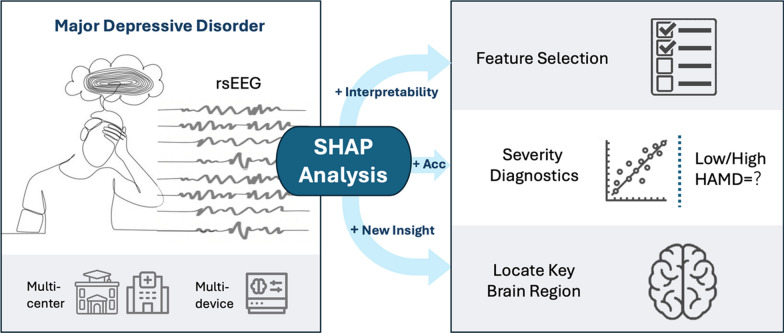
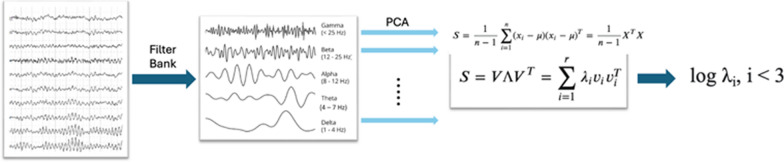
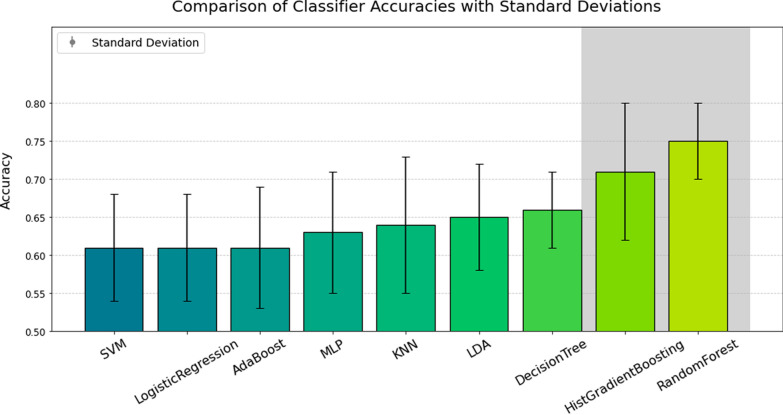
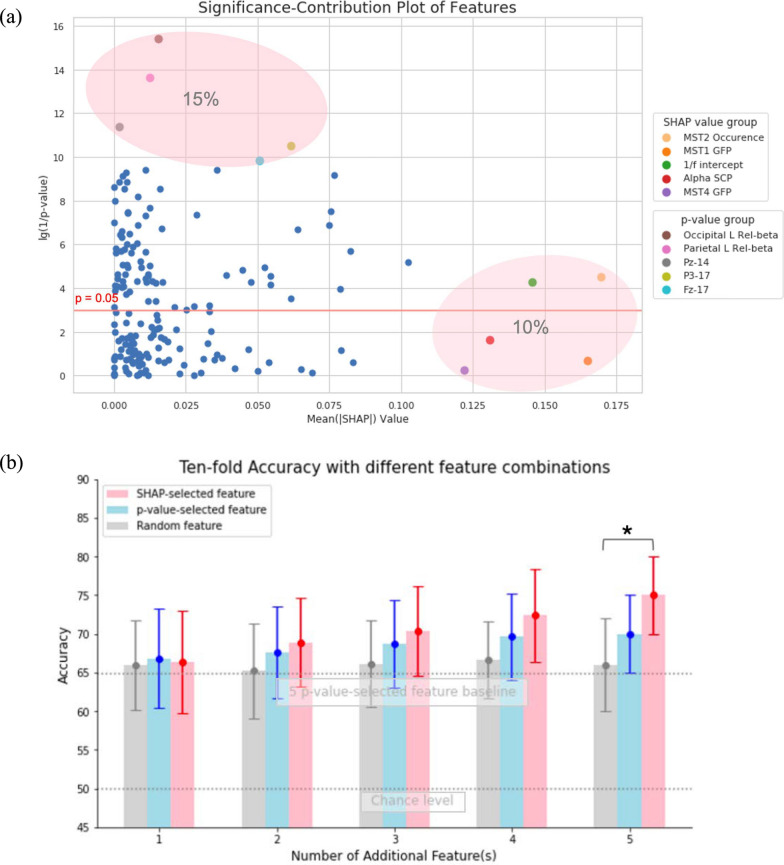
We proposed a data-centric, interpretable framework for EEG-based depression severity grading. A hybrid feature selection method was used, combining p-value and SHapley Additive exPlanations (SHAP) methods to select features that are both independently significant and jointly informative. The system was trained and evaluated on a large-scale, multi-site resting-state EEG dataset, using random forest for both classification and regression tasks. The SHAP method, an explainable artificial intelligence technique, is also used post-hoc to infer the key electrophysiological features and key brain regions associated with MDD mechanism to further increase interpretability.
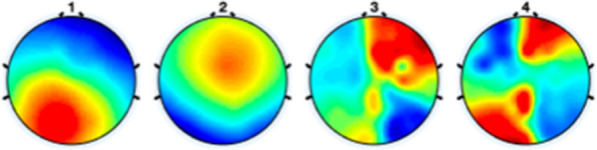
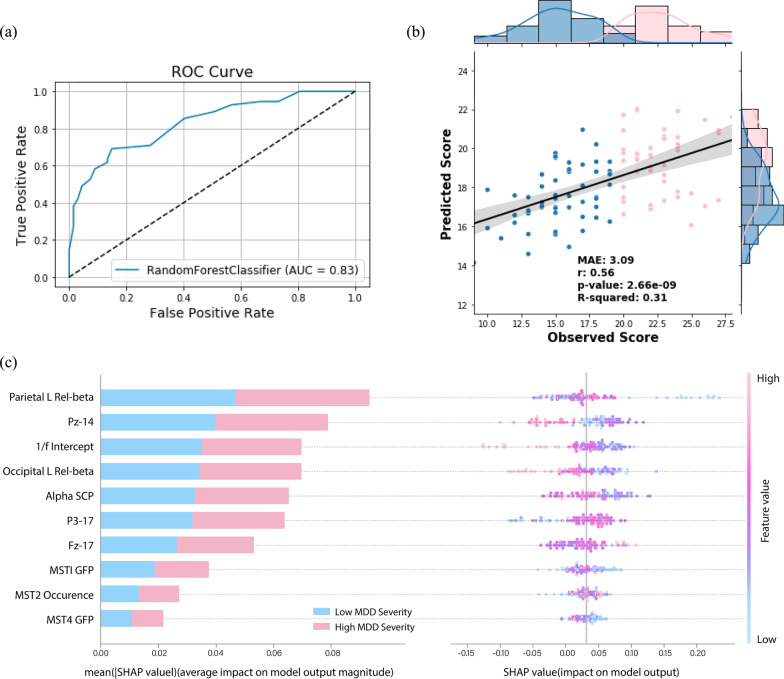
The proposed system achieved 74.5% (95% CI [70.97%, 78.80%], p < 0.001) ten-fold classification accuracy and a correlation coefficient of 0.56 (95% CI [0.407, 0.683], p < 0.001) for severity estimation. SHAP analysis identified consistent, clinically meaningful EEG features, particularly in the left parietal-occipital lobe. Through in-depth SHAP value analysis, we identified critical disease-related brain areas in the left occipital and parietal lobes, along with key features including relative beta power in the left parietal lobe, time-domain features at the parietal midline, 1/f intercept, left occipital relative beta power, and global brain alpha energy.
This study proposes a data-centric, interpretable depression grading system built on large-scale, multi-center EEG data, using simple models and hybrid feature selection to emphasize explainability, generalizability and data fidelity. By shifting the focus from algorithmic complexity to data transparency and feature-level insight, the model offers a practical and trustworthy path toward real-world mental health assessment.
重度抑郁症是全球致残的主要原因。准确评估抑郁严重程度对于诊断、治疗规划和监测至关重要,但目前的临床工具在很大程度上是主观的,依赖于自我报告和临床医生通过传统评估量表进行的判断。脑电图(EEG)已成为一种有前景的、非侵入性的捕捉抑郁症神经关联的方法。然而,大多数基于EEG的机器学习诊断研究都集中在通过复杂算法和小的、同质的数据集来提高分类准确率。这些黑箱方法往往产生难以解释且泛化性差的结果,使得临床转化不切实际。因此,迫切需要不仅准确而且透明、稳健且基于数据本身生理特性的模型。
我们提出了一个以数据为中心的、可解释的基于EEG的抑郁严重程度分级框架。使用了一种混合特征选择方法,结合p值和SHapley加性解释(SHAP)方法来选择既独立显著又具有联合信息性的特征。该系统在一个大规模、多站点静息态EEG数据集上进行训练和评估,使用随机森林进行分类和回归任务。SHAP方法,一种可解释的人工智能技术,也在事后用于推断与重度抑郁症机制相关的关键电生理特征和关键脑区,以进一步提高可解释性。
所提出的系统在十折交叉验证中实现了74.5%(95%置信区间[70.97%,78.80%],p < 0.001)的分类准确率,在严重程度估计方面的相关系数为0.56(95%置信区间[0.407,0.683],p < 0.001)。SHAP分析确定了一致的、具有临床意义的EEG特征,特别是在左顶枕叶。通过深入的SHAP值分析,我们确定了左枕叶和顶叶中与疾病相关的关键脑区,以及关键特征,包括左顶叶的相对β功率、顶叶中线的时域特征、1/f截距、左枕叶相对β功率和全脑α能量。
本研究提出了一个以数据为中心的、可解释的抑郁分级系统,该系统基于大规模、多中心EEG数据构建,使用简单模型和混合特征选择来强调可解释性、泛化性和数据保真度。通过将重点从算法复杂性转移到数据透明度和特征级洞察,该模型为现实世界的心理健康评估提供了一条实用且可靠的途径。