Niyomdecha Nattamon, Sungvaraporn Suwitchaya, Pinmuang Arisa, Mungkornkaew Narissara, Saita Thanchira, Rodraksa Waratchaya, Phanitmas Achiraya, Yamasamit Nattapong, Noisumdaeng Pirom
Department of Medical Technology, Faculty of Allied Health Sciences, Thammasat University, Khlong Luang, Pathum Thani, Thailand.
Microbiology Laboratory, Thammasat University Hospital, Thammasat University, Khlong Luang, Pathum Thani, Thailand.
PeerJ. 2025 May 20;13:e19465. doi: 10.7717/peerj.19465. eCollection 2025.
The existence and transmission of pathogenic and antibiotic-resistant bacteria through currency banknotes and coins poses a global public health risk. Banknotes and coins are handled by people in everyday life and have been identified as a universal medium for potentially microbial contamination.
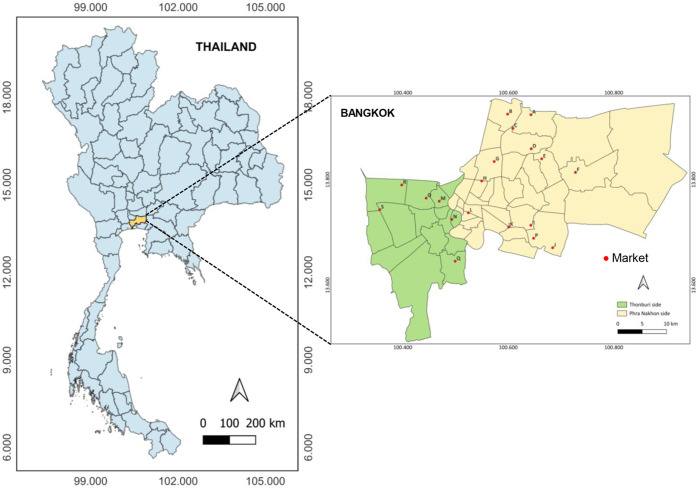
To ascertain existence of medically important bacteria, a total of 300 samples including 150 banknotes and 150 coins were randomly collected at onsite retail fresh meat stores, , pork and chicken, fish, and seafood stores, from nineteen fresh markets distributed across Bangkok, Thailand. An individual banknote or coin was entirely swabbed, and bacterial culture was carried out using tryptic soy agar (TSA), sheep blood agar (SBA) and MacConkey agar (Mac). A colony count was performed and bacterial species identification was conducted using matrix-assisted laser desorption/ionization (MALDI)-time of flight (TOF) mass spectrometry. Phenotypic antimicrobial susceptibility testing was carried out using the Kirby-Bauer disc diffusion methods.
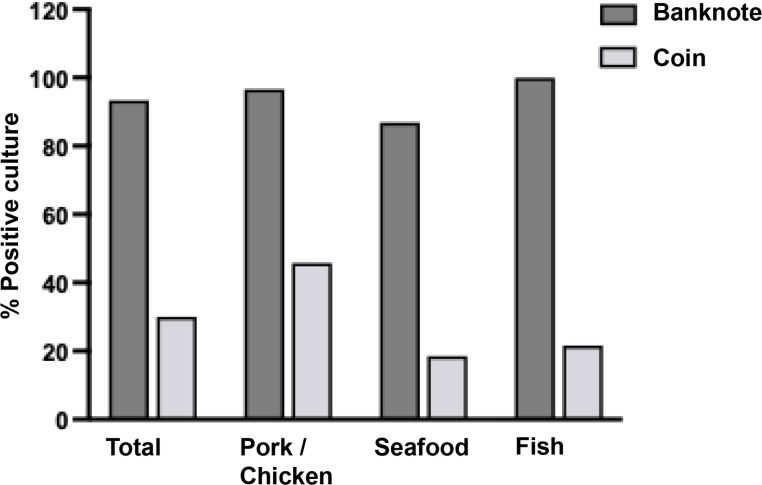
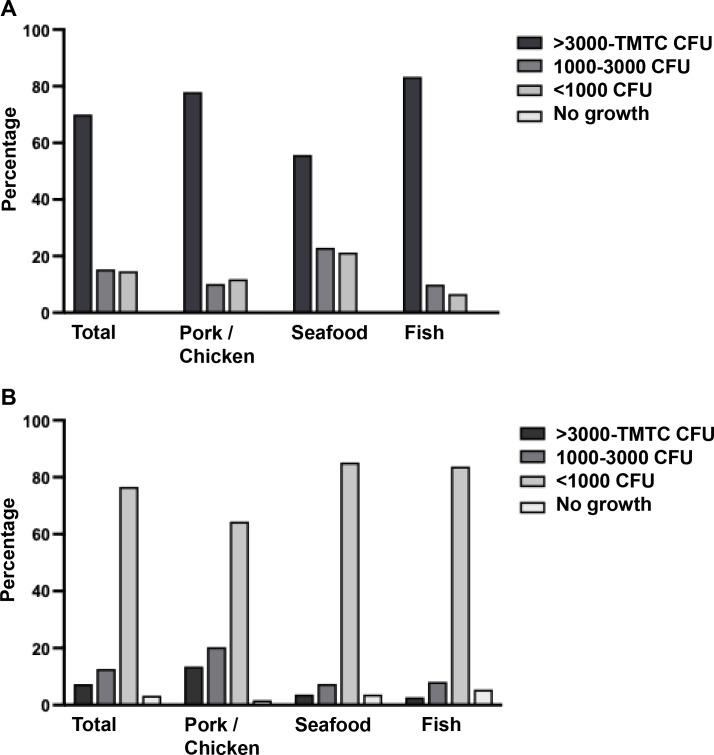
The results demonstrated that the bacterial contamination rate was higher on banknotes than on coins (93.33% 30.00%) in all three store types. A substantial number of colonies of >3,000 colony forming units (CFU) was predominantly found in banknotes (70.00%), especially from fish store (83.3%); meanwhile, <1,000 CFU was observed in coin sample (76.67%). MALDI-TOF mass spectrometry could identify 107 bacterial species, most of them were (14.02%, 15/107), (12.15%, 13/107), and (8.41%, 9/107). The prevalence based on genera were (36.45%, 39/107), (20.56%, 22/107), and (10.28%, 11/107). Almost all Staphylococcus isolates had low susceptibility to penicillin (21%). Notably, , and were multidrug-resistant (MDR). It is notable that none of the staphylococci and macrococci isolates exhibited inducible clindamycin resistance (D-test negative). and isolates were carbapenem-resistant, and isolates were MDR with showing carbapenem resistance.
Our data demonstrated a high prevalence of medically important bacteria presented on Thai currency, which may pose a potential risk to human health and food safety. Food vendors and consumers should be educated about the possible cross-contamination of bacteria between the environment, food item, and currency.
致病性和抗生素耐药性细菌通过纸币和硬币存在及传播,构成全球公共卫生风险。纸币和硬币在日常生活中由人们经手,已被确定为潜在微生物污染的普遍媒介。
为确定具有医学重要性的细菌的存在情况,在泰国曼谷分布的19个生鲜市场的现场零售鲜肉店、猪肉和鸡肉店、鱼类和海鲜店,随机收集了总共300个样本,包括150张纸币和150枚硬币。对每张纸币或每枚硬币进行全面擦拭,使用胰蛋白胨大豆琼脂(TSA)、羊血琼脂(SBA)和麦康凯琼脂(Mac)进行细菌培养。进行菌落计数,并使用基质辅助激光解吸/电离(MALDI)-飞行时间(TOF)质谱法进行细菌种类鉴定。使用 Kirby-Bauer 纸片扩散法进行表型抗菌药物敏感性测试。
结果表明,在所有三种店铺类型中,纸币上的细菌污染率高于硬币(93.33%对30.00%)。大量菌落形成单位(CFU)>3000的菌落主要在纸币中发现(70.00%),尤其是在鱼类店铺(83.3%);同时,在硬币样本中观察到<1000 CFU(76.67%)。MALDI-TOF质谱法可鉴定出107种细菌,其中大多数是[具体细菌名称1](14.02%,15/107)、[具体细菌名称2](12.15%,13/107)和[具体细菌名称3](8.41%,9/107)。基于属的患病率分别为[属名1](36.45%,39/107)、[属名2](20.56%,22/107)和[属名3](10.28%,11/107)。几乎所有葡萄球菌分离株对青霉素敏感性较低(21%)。值得注意的是,[具体细菌名称4]、[具体细菌名称5]和[具体细菌名称6]具有多重耐药性(MDR)。值得注意的是,没有葡萄球菌和巨球菌分离株表现出诱导性克林霉素耐药性(D试验阴性)。[具体细菌名称7]和[具体细菌名称8]分离株对碳青霉烯耐药,[具体细菌名称9]分离株为MDR且表现出碳青霉烯耐药。
我们的数据表明泰国货币上存在大量具有医学重要性的细菌,这可能对人类健康和食品安全构成潜在风险。应教育食品摊贩和消费者注意环境、食品和货币之间细菌可能的交叉污染。