Schwartz Bennett L, Cleary Anne M
Florida International University, US.
Colorado State University, US.
J Cogn. 2025 May 23;8(1):36. doi: 10.5334/joc.447. eCollection 2025.
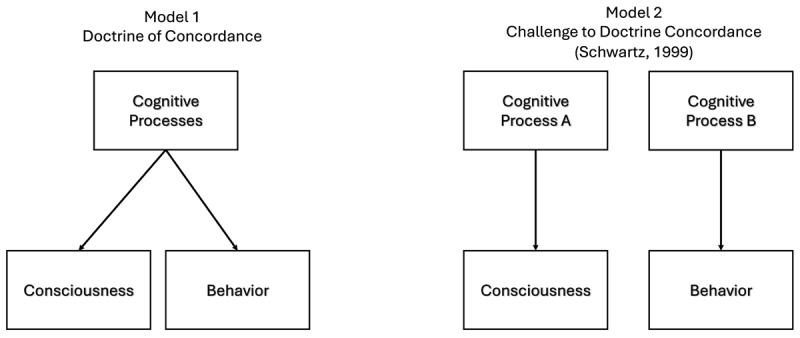
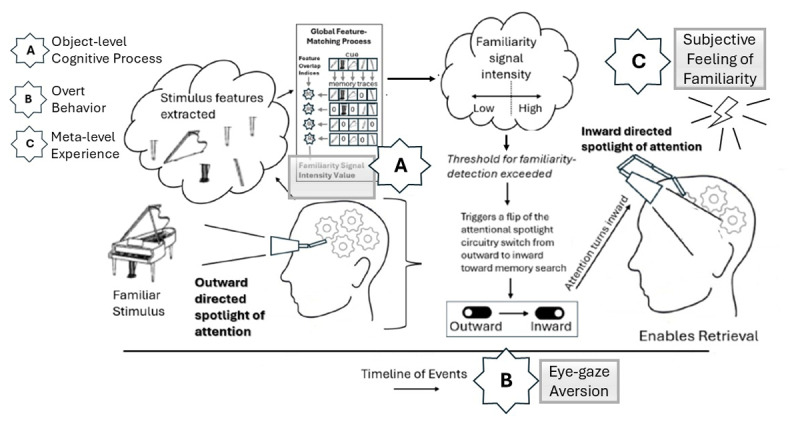
The Doctrine of Concordance is the implicit assumption that cognitive processes, behavior, and phenomenological experience are highly correlated (Tulving, 1989). Tulving challenged this assumption, pointing to domains in which conscious experience did not accompany a particular measured cognitive process and to situations in which consciousness did not correlate with the observable behavior. Schwartz (1999) extended this view, asserting that the underlying cognitive processes that produce conscious experience may differ from those that produce observable behavior. Though research on conscious experience blossomed during the last quarter century and progress has been made in moving past the Doctrine of Concordance, we argue that some subdomains within memory research remain hampered by an implicit endorsement of it. We outline two areas of memory research in which current research and interpretations appear to fall prey to the Doctrine today: research on the dual- vs. single-process theory in recognition memory, including work on remember/know judgments, and research on retrospective memory confidence. We then describe four areas of research that show progress in understanding conscious experience by rejecting the Doctrine of Concordance: These are 1) metacognitive disconnects in the science of learning, 2) recognition illusions, 3) déjà vu experiences, and 4) aha experiences. We claim that there is often a dissociation between the mechanisms that create conscious experience and the underlying cognitive processes that contribute to behaviors, which may seem causally correlated with conscious experience. Disentangling the relations between process, behavior, and conscious experience in the human mind's operation are important to understanding it.
一致性学说隐含的假设是认知过程、行为和现象学体验高度相关(图尔文,1989年)。图尔文对这一假设提出了质疑,指出在某些领域中,有意识体验并未伴随特定测量的认知过程,以及在某些情况下,意识与可观察行为并不相关。施瓦茨(1999年)扩展了这一观点,断言产生有意识体验的潜在认知过程可能与产生可观察行为的认知过程不同。尽管在过去四分之一个世纪里,关于有意识体验的研究蓬勃发展,并且在超越一致性学说方面取得了进展,但我们认为记忆研究中的一些子领域仍然受到对该学说的隐性认可的阻碍。我们概述了记忆研究的两个领域,在这两个领域中,当前的研究和解释如今似乎仍受一致性学说的影响:识别记忆中关于双过程理论与单过程理论的研究,包括关于记住/知道判断的研究,以及回顾性记忆信心的研究。然后,我们描述了四个通过拒绝一致性学说在理解有意识体验方面取得进展的研究领域:这些领域是1)学习科学中的元认知脱节,2)识别错觉,3)似曾相识体验,以及4)顿悟体验。我们认为,产生有意识体验的机制与促成行为的潜在认知过程之间往往存在分离,而这些行为可能看似与有意识体验存在因果关联。理清人类思维运作过程、行为和有意识体验之间的关系对于理解它很重要。