Diao Wenjiao, Zhang Wei, Zhang Xiaoxi, Du Siyu, Zheng Caijuan, Huang Xuenian, Lu Xuefeng
Shandong Provincial Key Laboratory of Synthetic Biology, Qingdao Institute of Bioenergy and Bioprocess Technology, Chinese Academy of Sciences, Qingdao 266101, China.
Key Laboratory of Tropical Medicinal Resource Chemistry of Ministry of Education, College of Chemistry and Chemical Engineering, Hainan Normal University, Haikou 571158, China.
Mar Drugs. 2025 May 21;23(5):219. doi: 10.3390/md23050219.
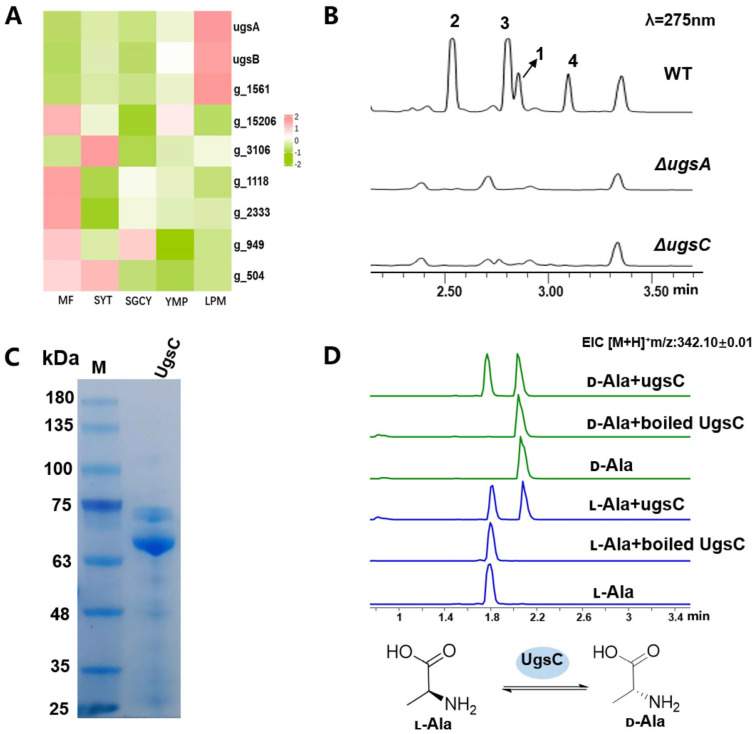
Unguisins, a class of structurally complex cyclic peptides featuring a -aminobutyric acid residue embedded in the skeleton, exhibit diverse biological activities. Here, a new unguisin K, along with three known congeners, was isolated from the marine-derived fungus MEFC1001. The biosynthetic pathway was elucidated through gene disruption coupled with in vitro enzymatic characterization. The biosynthetic gene cluster (BGC) containing and , in conjunction with an extra-clustered gene , collaborates to synthesize these unguisins. The alanine racemase (AR) UgsC catalyzes the isomerization of Ala and provides d-Ala as the starter unit for the non-ribosomal peptide synthetase (NRPS). The unique localization of outside the BGC is different from previously reported unguisin-producing systems where AR genes reside within BGCs. The methyltransferase UgsB mediates a key pre-modification step by methylating phenylpyruvic acid to yield -methylphenylpyruvate, which is subsequently incorporated as -methylphenylalanine during NRPS assembly. This represents the first experimental evidence of the -carbon methylation of Phe residue occurring at the precursor level rather than through post-assembly modification. The NRPS UgsA recruits a variety of amino acids for assembly and cyclization to form mature unguisins. Additionally, genome mining utilizing UgsA as a query identified homologous NRPSs in diverse fungal species, highlighting the potential for unguisin production in fungi. This study enriches the biosynthetic diversity of cyclic peptides and provides guidance for exploring unguisin-like natural products derived from fungi.
乌吉辛类是一类结构复杂的环肽,其骨架中含有嵌入的γ-氨基丁酸残基,具有多种生物活性。在此,从海洋来源的真菌MEFC1001中分离出一种新的乌吉辛K以及三种已知的同系物。通过基因破坏结合体外酶学表征阐明了生物合成途径。包含基因 和 的生物合成基因簇(BGC),与一个基因簇外的基因 协同作用,共同合成这些乌吉辛。丙氨酸消旋酶(AR)UgsC催化丙氨酸的异构化,提供d-丙氨酸作为非核糖体肽合成酶(NRPS)的起始单元。 基因在BGC之外的独特定位不同于先前报道的乌吉辛产生系统,在那些系统中AR基因位于BGC内。甲基转移酶UgsB通过将苯丙酮酸甲基化产生α-甲基苯丙酮酸,介导关键的预修饰步骤,随后在NRPS组装过程中α-甲基苯丙酮酸作为α-甲基苯丙氨酸被掺入。这代表了苯丙氨酸残基的α-碳甲基化发生在前体水平而非组装后修饰的首个实验证据。NRPS UgsA募集多种氨基酸进行组装和环化以形成成熟的乌吉辛。此外,以UgsA为查询进行基因组挖掘,在多种真菌物种中鉴定出同源NRPS,突出了真菌中产生乌吉辛的潜力。本研究丰富了环肽的生物合成多样性,并为探索源自真菌的乌吉辛样天然产物提供了指导。