Pucėtaitė Milda, Mitraitė Dalia, Tarasevičius Rytis, Farina Davide, Ryškienė Silvija, Lukoševičius Saulius, Padervinskis Evaldas, Šarauskas Valdas, Vaitkus Saulius
Department of Radiology, Faculty of Medicine, Medical Academy, Lithuanian University of Health Sciences, A. Mickevičiaus Str. 9, 44307 Kaunas, Lithuania.
Department of Radiology, Lithuanian University of Health Sciences Kaunas Clinics, Eivenių 2, 50009 Kaunas, Lithuania.
Tomography. 2025 May 16;11(5):57. doi: 10.3390/tomography11050057.
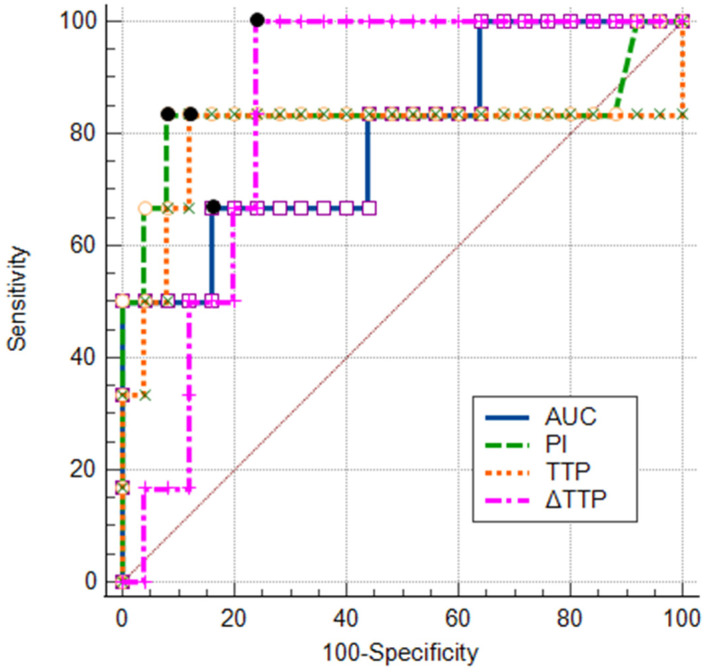
This study aimed to assess the diagnostic value of contrast-enhanced ultrasound (CEUS) time-intensity curve (TIC) parameters in detecting non-ossified thyroid cartilage invasion in patients with laryngeal squamous cell carcinoma (SCC). : A CEUS TIC analysis was performed on 32 cases from 27 patients with histologically confirmed laryngeal SCC. The diagnostic performance of time to peak (TTP), peak intensity (PI), wash-in slope (WIS), area under the curve (AUC), and their quantitative differences (∆TTP, ∆PI, ∆WIS, and ∆AUC) to discriminate between the invaded and the non-invaded non-ossified thyroid cartilage was determined using ROC analysis. A logistic regression analysis was employed to identify significant predictors. : In an ROC analysis, of all TIC parameters analyzed separately, ∆TTP showed the greatest diagnostic performance (AUC: 0.85). A ∆TTP cut-off of ≤ 8.9 s differentiated between the invaded and the non-invaded non-ossified thyroid cartilage with a sensitivity of 100%, specificity of 76.9%, and accuracy of 81.3%. A combination of ∆TTP and PI increased the AUC to 0.93, specificity to 100%, and accuracy to 96.8%, but reduced the sensitivity to 83.3%. Meanwhile, the visual assessment of enhancement on CEUS to detect cartilage invasion had 83.3% sensitivity and 84.6% specificity. In a univariate logistic regression, only ∆TTP was a significant predictor of non-ossified thyroid cartilage invasion (OR: 0.80; 95% CI: 0.64-1.00). For every second increase in ∆TTP, the probability of thyroid cartilage invasion decreased by 20%. : CEUS TIC parameters, particularly a combination of ∆TTP and PI, showed high diagnostic performance in the detection of non-ossified thyroid cartilage invasion in laryngeal SCC.
本研究旨在评估超声造影(CEUS)时间-强度曲线(TIC)参数在检测喉鳞状细胞癌(SCC)患者非骨化甲状腺软骨侵犯中的诊断价值。对27例经组织学证实为喉SCC的患者的32个病例进行了CEUS TIC分析。采用ROC分析确定达峰时间(TTP)、峰值强度(PI)、流入斜率(WIS)、曲线下面积(AUC)及其定量差异(∆TTP、∆PI、∆WIS和∆AUC)在鉴别侵袭性和非侵袭性非骨化甲状腺软骨方面的诊断性能。采用逻辑回归分析确定显著预测因素。在ROC分析中,单独分析的所有TIC参数中,∆TTP显示出最大的诊断性能(AUC:0.85)。∆TTP截断值≤8.9 s可区分侵袭性和非侵袭性非骨化甲状腺软骨,敏感性为100%,特异性为76.9%,准确性为81.3%。∆TTP和PI联合可将AUC提高到0.93,特异性提高到100%,准确性提高到96.8%,但敏感性降低到83.3%。同时,CEUS增强的视觉评估检测软骨侵犯的敏感性为83.3%,特异性为84.6%。在单因素逻辑回归中,只有∆TTP是非骨化甲状腺软骨侵犯的显著预测因素(OR:0.80;95%CI:0.64-1.00)。∆TTP每增加1秒,甲状腺软骨侵犯的概率降低20%。CEUS TIC参数,特别是∆TTP和PI联合,在检测喉SCC非骨化甲状腺软骨侵犯方面显示出较高的诊断性能。