Hindso Tine Gadegaard, Bjerrum Camilla Wium, Nissen Kristoffer, Sjøl Mette Bagger, Faber Carsten, Heegaard Steffen, Madsen Karine, Rosthøj Susanne, Kiilgaard Jens Folke
Department of Ophthalmology, Copenhagen University Hospital Rigshospitalet, Copenhagen Ø, Denmark.
Department of Radiology, Copenhagen University Hospital Rigshospitalet, Copenhagen Ø, Denmark.
Invest Ophthalmol Vis Sci. 2025 May 1;66(5):38. doi: 10.1167/iovs.66.5.38.
The purpose of this study was to validate the four prognostic models in patients with metastatic posterior uveal melanoma: (I) the American Joint Committee on Cancer (AJCC) staging system, (II) the Helsinki University Hospital Working Formulation (HUHWF), and two nomograms (III) the Valpione-nomogram, and (IV) the Mariani-nomogram.
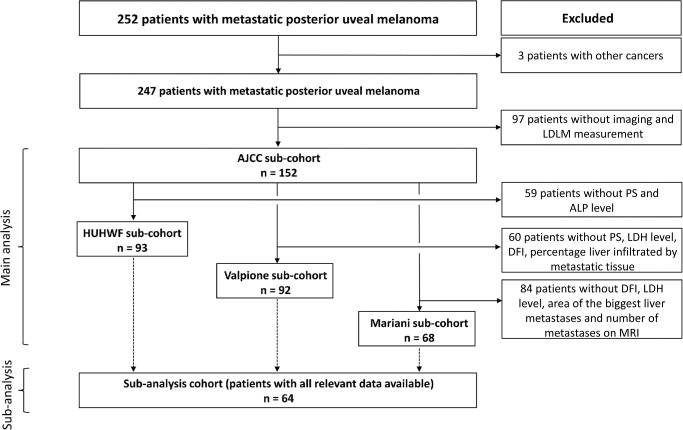
One hundred fifty-two patients with metastatic posterior uveal melanoma were retrospectively included. Dictated by data availability, five subcohorts were established: AJCC (n = 152), HUHWF (n = 93), Valpione-nomogram (n = 92), Mariani-nomogram (n = 68), and a complete dataset subcohort (n = 64). The predictive performance was evaluated with time-dependent Brier-score, calibration plots, receiver operating characteristic (ROC) curves, and the global Harrell's C-index.
The 6-month area under the ROC curve (AUC) was between 0.83 and 0.87 for, respectively, the Mariani-nomogram, the HUHWF, and the Valpione-nomogram, and was 0.77 for the AJCC staging system. The 24-month AUC was 0.81 for the Mariani-nomogram, compared with 0.79 (Valpione-nomogram), 0.74 (HUHWF), and 0.64 (AJCC). The C-index was 0.69 for the Mariani-nomogram, 0.71 for the Valpione-nomogram, and 0.73 for HUHWF (not calculated for AJCC). The accuracy of the prediction models, represented by the Brier score, was after 6 months and 24 months: 0.08 and 0.13 for the Mariani-nomogram, 0.10 and 0.17 for the Valpione-nomogram, 0.10 and 0.14 for the HUHWF, and 0.15 and 0.14 for the AJCC staging system.
All four models demonstrated an acceptable predictive performance at 6 and 24 months. The Mariani-nomogram appears to perform well across most metrics, often showing the highest values for AUC and the lowest Brier scores.
本研究旨在验证转移性后葡萄膜黑色素瘤患者的四种预后模型:(I)美国癌症联合委员会(AJCC)分期系统,(II)赫尔辛基大学医院工作分类法(HUHWF),以及两种列线图(III)瓦尔皮奥内列线图和(IV)马里亚尼列线图。
回顾性纳入152例转移性后葡萄膜黑色素瘤患者。根据数据可用性,建立了五个亚队列:AJCC(n = 152)、HUHWF(n = 93)、瓦尔皮奥内列线图(n = 92)、马里亚尼列线图(n = 68)和一个完整数据集亚队列(n = 64)。采用时间依赖性Brier评分、校准图、受试者工作特征(ROC)曲线和全局Harrell C指数评估预测性能。
马里亚尼列线图、HUHWF和瓦尔皮奥内列线图的ROC曲线下6个月面积(AUC)分别在0.83至0.87之间,AJCC分期系统为0.77。马里亚尼列线图的24个月AUC为0.81,而瓦尔皮奥内列线图为0.79、HUHWF为0.74、AJCC为0.64。马里亚尼列线图的C指数为0.69,瓦尔皮奥内列线图为0.71,HUHWF为0.73(AJCC未计算)。以Brier评分为代表的预测模型的准确性在6个月和24个月时分别为:马里亚尼列线图为0.08和0.13,瓦尔皮奥内列线图为0.10和0.17,HUHWF为0.10和0.14,AJCC分期系统为0.15和0.14。
所有四种模型在6个月和24个月时均表现出可接受的预测性能。马里亚尼列线图在大多数指标上表现良好,通常显示出最高的AUC值和最低的Brier评分。