Latorre Paula, Ferreira Cleiton Pons, Nieto-Escamez Francisco
CIBIS Research Center (Centro de Investigación para el Bienestar y la Inclusión Social), University of Almeria, 04120 Almería, Spain.
Department of Psychology, Campus La Cañada, University of Almeria, Ctra. Sacramento S/N, 04120 Almería, Spain.
Brain Sci. 2025 Apr 28;15(5):470. doi: 10.3390/brainsci15050470.
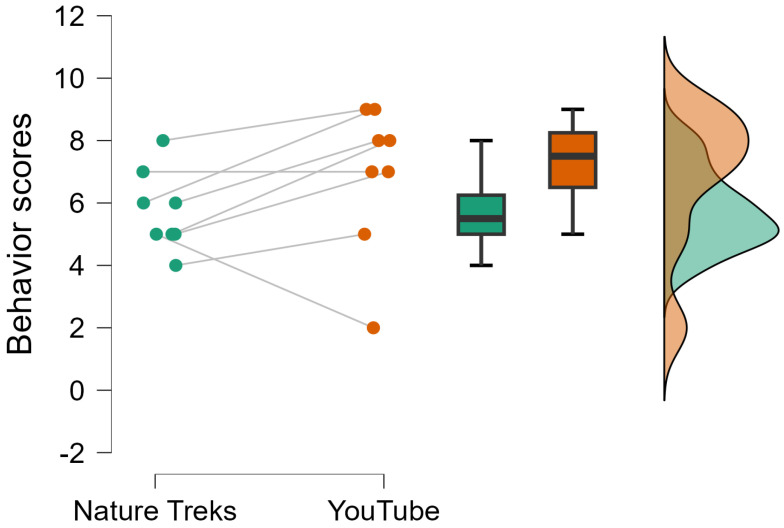
(1) Background: Immersive virtual reality (IVR) has emerged as a promising non-pharmacological intervention to promote relaxation and improve emotional well-being in this population. (2) Methods: This crossover study evaluated the effects of IVR on anxiety and psychological well-being in a sample of eight participants with mild dementia attending a day-care center. Participants underwent two conditions: an experimental condition involving relaxing nature-based VR scenarios (Nature Treks VR) and a control condition using personalized YouTube videos on a tablet. Each condition lasted 12 sessions. Assessments included heart rate (HR), the I-PANAS-SF, the reduced State-Trait Anxiety Inventory (STAI-r), behavioral observations, and a subjective response questionnaire. (3) Results: A significant reduction in HR over time was found during IVR exposure, suggesting a calming physiological effect not observed in the control condition. While changes in PANAS and STAI-r scores were not statistically significant, the PANAS score improvement in the experimental condition approached statistical significance ( = 0.054) and was just below the minimal clinically important difference (MCID), suggesting a potentially meaningful trend. Behavioral responses were higher during YouTube sessions, likely due to personalized content. All participants rated the IVR experience positively on the subjective questionnaire, indicating high acceptability, though social desirability bias cannot be excluded. (4) Conclusions: IVR appears to be a feasible and acceptable intervention for individuals with dementia, warranting further investigation.
(1) 背景:沉浸式虚拟现实(IVR)已成为一种有前景的非药物干预手段,可促进这一人群的放松并改善情绪健康。(2) 方法:这项交叉研究评估了IVR对8名在日间护理中心的轻度痴呆参与者样本的焦虑和心理健康的影响。参与者经历了两种情况:一种实验情况是涉及基于自然的放松虚拟现实场景(自然漫步VR),另一种对照情况是在平板电脑上使用个性化的YouTube视频。每种情况持续12次疗程。评估包括心率(HR)、I-PANAS-SF、简化的状态-特质焦虑量表(STAI-r)、行为观察和一份主观反应问卷。(3) 结果:在IVR暴露期间发现心率随时间显著降低,这表明在对照情况下未观察到的平静生理效应。虽然PANAS和STAI-r分数的变化没有统计学意义,但实验情况下PANAS分数的改善接近统计学意义(P = 0.054)且略低于最小临床重要差异(MCID),表明可能存在有意义的趋势。在YouTube视频疗程期间行为反应更高,可能是由于个性化内容。所有参与者在主观问卷上对IVR体验给予了积极评价,表明可接受性高,不过不能排除社会期望偏差。(4) 结论:IVR似乎是一种对痴呆患者可行且可接受的干预手段,值得进一步研究。