Huang Yichu, Min Guangtao, Wang Hongpeng, Jiang Lei
The First School of Clinical Medicine, Lanzhou University, Lanzhou 730000, China.
Department of General Surgery, The First Hospital of Lanzhou University, Lanzhou 730000, China.
Biomedicines. 2025 Apr 30;13(5):1085. doi: 10.3390/biomedicines13051085.
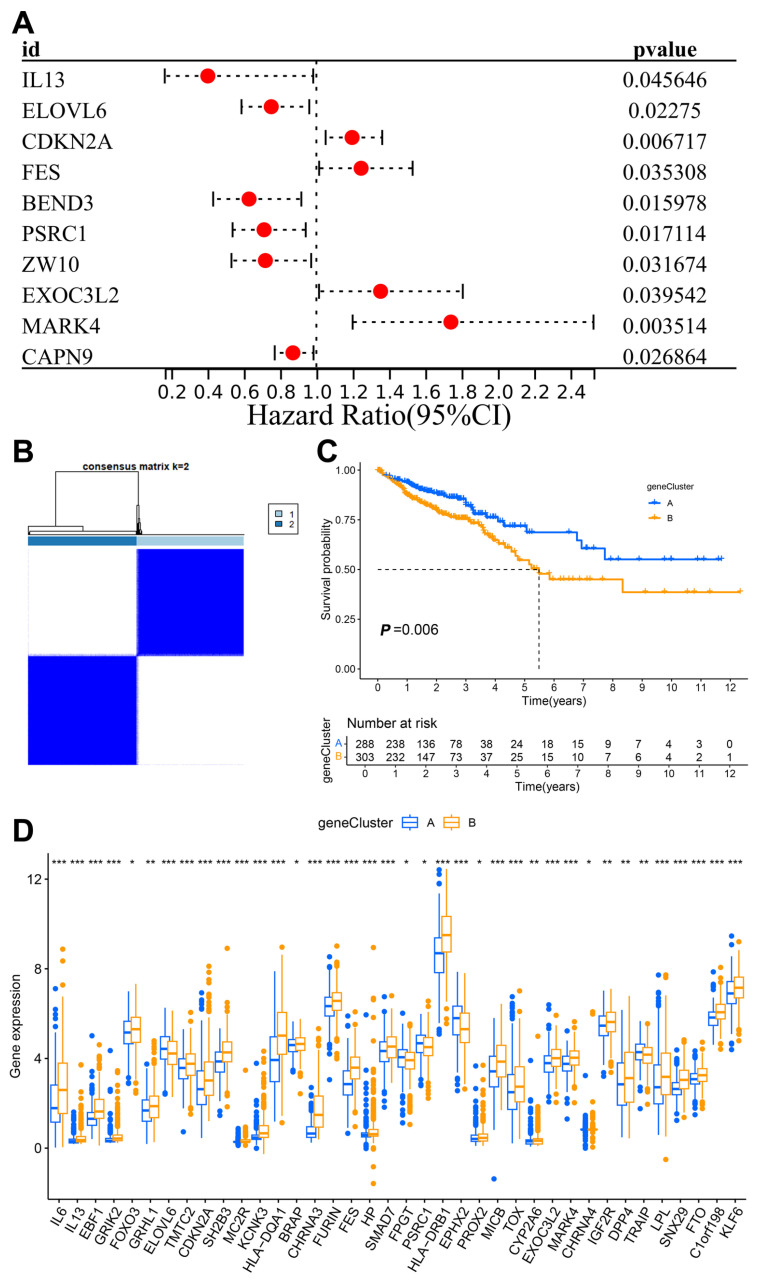
: Colorectal cancer (CRC) ranks as the third most prevalent cancer globally, with its incidence and recurrence rates steadily rising. To explore the relationship between CRC and longevity-associated genes (LAGs), and to offer new therapeutic avenues for CRC treatment, we developed a prognostic model based on these genes to predict the outcomes for CRC patients. Additionally, we conducted an immune correlation analysis. : We conducted a comprehensive analysis of the effects of 81 LAGs in CRC by integrating multiple omics datasets. This analysis led to the identification of two distinct molecular subtypes and revealed that alterations in LAGs across various layers were linked to clinicopathological features, prognosis, and cell infiltration characteristics within the tumor microenvironment (TME). The training and validation cohorts for the models were derived from the TCGA-COAD, TCGA-READ, and GSE35279 datasets. Subsequently, we developed a risk score model, and the Kaplan-Meier method was employed to estimate overall survival (OS). Ultimately, we established a prognostic model based on five LAGs: , , , , and . Furthermore, we assessed the correlations between the risk score and factors such as immune cell infiltration, microsatellite instability, and the stem cell index. : Our comprehensive bioinformatics analysis revealed a strong association between longevity genes and CRC. The risk score derived from the five newly identified LAGs was determined to be an independent prognostic factor for CRC. Patients categorized by this risk score demonstrated significant differences in immune status and microsatellite instability. : Our comprehensive multi-omic analysis of LAGs highlighted their potential roles in the tumor immune microenvironment, clinicopathological features, and prognosis, offering new insights for the treatment of CRC.
结直肠癌(CRC)是全球第三大常见癌症,其发病率和复发率呈稳步上升趋势。为了探究CRC与长寿相关基因(LAGs)之间的关系,并为CRC治疗提供新的治疗途径,我们基于这些基因开发了一种预后模型,以预测CRC患者的预后。此外,我们还进行了免疫相关性分析。:我们通过整合多个组学数据集,对81个LAGs在CRC中的作用进行了全面分析。该分析确定了两种不同的分子亚型,并揭示了不同层面LAGs的改变与肿瘤微环境(TME)中的临床病理特征、预后及细胞浸润特征相关。模型的训练和验证队列来自TCGA-COAD、TCGA-READ和GSE35279数据集。随后,我们开发了一个风险评分模型,并采用Kaplan-Meier方法估计总生存期(OS)。最终,我们基于五个LAGs( 、 、 、 、和 )建立了一个预后模型。此外,我们评估了风险评分与免疫细胞浸润、微卫星不稳定性和干细胞指数等因素之间的相关性。:我们的全面生物信息学分析揭示了长寿基因与CRC之间存在密切关联。由五个新鉴定的LAGs得出的风险评分被确定为CRC的独立预后因素。根据该风险评分分类的患者在免疫状态和微卫星不稳定性方面表现出显著差异。:我们对LAGs的全面多组学分析突出了它们在肿瘤免疫微环境、临床病理特征和预后中的潜在作用,为CRC治疗提供了新的见解。